Company Overview
Futu Holdings is a Hong Kong-based online brokerage and wealth management platform primarily serving Chinese investors globally through its flagship platforms Futubull and Moomoo. The company enables trading across equities, options, ETFs, and other financial instruments in markets like Hong Kong, the U.S., and China. It differentiates itself with a strong social trading ecosystem and advanced analytics tools tailored to retail investors. Futu has expanded aggressively into international markets such as Singapore, the U.S., and Australia via Moomoo. Despite regulatory scrutiny in China, the company continues to deliver strong growth driven by rising retail participation in equities.

Most Recent Earnings (Latest Quarter)
Futu reported its most recent earnings in March 2026 (Q4 2025 results) with revenue of ~$410M, up ~25% YoY, and EPS of ~$1.02, beating analyst expectations on both top and bottom lines. Net income growth remained strong, driven by higher trading volumes and margin financing income. Paying users and total client assets both reached record highs, signaling continued engagement strength. Guidance for the next quarter was cautiously optimistic, with management highlighting stable trading activity but flagging macro uncertainty in China. For FY2026, Futu expects continued double-digit revenue growth, albeit at a slightly moderated pace.
Founding, Founders, and History
Futu was founded in 2012 by Leaf Hua Li, a former early employee at Tencent, which remains a strategic investor in the company. The company was built with the vision of digitizing brokerage services for Chinese investors who historically faced fragmented and opaque access to global markets. Its early growth was fueled by leveraging Tencent’s ecosystem, including integrations with WeChat.
The company went public in 2019 on NASDAQ and has since scaled rapidly, particularly during the COVID-era retail trading boom. Its expansion strategy has focused on capturing affluent, tech-savvy retail investors in Asia and overseas Chinese communities. Over time, Futu evolved from a brokerage into a broader wealth management platform offering funds, IPO access, and margin financing.
Futu’s core products include Futubull (Hong Kong-focused) and Moomoo (global markets), both known for their strong UX, real-time data, and social features. Competitors include Tiger Brokers, Interactive Brokers, Charles Schwab, and Robinhood. The company is headquartered in Hong Kong but operates across multiple jurisdictions.
Market Overview
Futu operates in the global online brokerage and digital wealth management market, which has seen structural growth driven by increasing retail participation, mobile-first investing, and the democratization of financial markets. The global online brokerage market is expected to grow from ~$15B in 2023 to ~$35–40B by 2030, implying a CAGR of ~12–14%.
Asia represents one of the fastest-growing regions due to rising middle-class wealth and increasing cross-border investment activity. Chinese investors, in particular, are increasingly allocating capital to U.S. and Hong Kong equities, a trend that directly benefits Futu. Additionally, younger investors are more inclined toward self-directed investing platforms, further expanding the TAM.
However, regulatory uncertainty—especially in China—remains a key variable. While international expansion helps diversify risk, China still represents a significant user base and growth lever. The long-term growth narrative remains intact, but execution will depend heavily on navigating compliance and maintaining user trust.
Competitive Landscape
Futu competes with both global and regional brokerage platforms. Key competitors include Tiger Brokers (China-focused), Interactive Brokers (institutional-grade global platform), and Robinhood (U.S.-focused retail trading). Traditional incumbents like Charles Schwab and Fidelity also compete indirectly through their digital platforms.
Compared to peers, Futu has a stronger social trading ecosystem and higher engagement metrics. However, it faces more regulatory risk than U.S.-based competitors and lacks the same level of brand trust in Western markets. Its international growth strategy is critical to offset these disadvantages.
Unique Differentiation
Futu’s core differentiation lies in its community-driven investing model combined with high-quality analytics tools. Unlike most brokers, Futu integrates social feeds, investor discussions, and sentiment tracking directly into the trading interface. This increases engagement and retention significantly.
Additionally, its monetization is stronger than peers like Robinhood due to diversified revenue streams including margin financing, IPO distribution, and wealth management products. Its ability to cross-sell financial services to an engaged user base creates higher lifetime value per user.
Management Team Overview
Leaf Hua Li (Founder & CEO) has a strong background from Tencent and has been instrumental in shaping Futu’s product and growth strategy. His focus on product innovation and user experience has been a key driver of the company’s success.
Arthur Chen (CFO) oversees financial strategy and capital allocation, ensuring strong profitability despite aggressive expansion. His role has been critical in maintaining margins while scaling globally.
The leadership team overall is deeply product-oriented, with a strong bias toward engineering and user engagement rather than traditional finance backgrounds.
Financial Performance (Last 5 Years)
Over the past five years, Futu has delivered strong revenue growth, with revenues increasing from ~$350M in 2020 to over ~$1.5B in 2025, implying a CAGR of ~30%+. This growth was driven by a surge in retail trading activity and international expansion.
Earnings growth has been even more impressive, with net income CAGR exceeding 40%, reflecting operating leverage and efficient customer acquisition. Unlike many fintech peers, Futu is consistently profitable, with strong margins supported by high-margin services like margin lending.
The balance sheet remains robust, with significant client assets under custody and strong cash reserves. The company has minimal debt and generates healthy free cash flow, enabling reinvestment into growth initiatives.
However, growth has shown signs of normalization post-COVID trading boom. While still strong, the pace is moderating as trading volumes stabilize.
Bull Case
- Strong monetization model with higher ARPU than peers like Robinhood
- International expansion (Moomoo) unlocks large untapped markets
- High engagement platform with social + trading integration driving retention
Bear Case
- Significant regulatory risk tied to China exposure
- Growth normalization as retail trading activity stabilizes
- Increasing competition from global brokers with deeper capital and brand
Analyst Reactions to Earnings
Following the latest earnings, analysts were broadly positive with multiple firms raising price targets due to strong user growth and margin expansion. Some upgrades cited Futu’s successful international expansion as a key catalyst. However, a few analysts maintained neutral ratings, citing regulatory risks and potential slowdown in trading volumes. Overall sentiment remains cautiously optimistic.
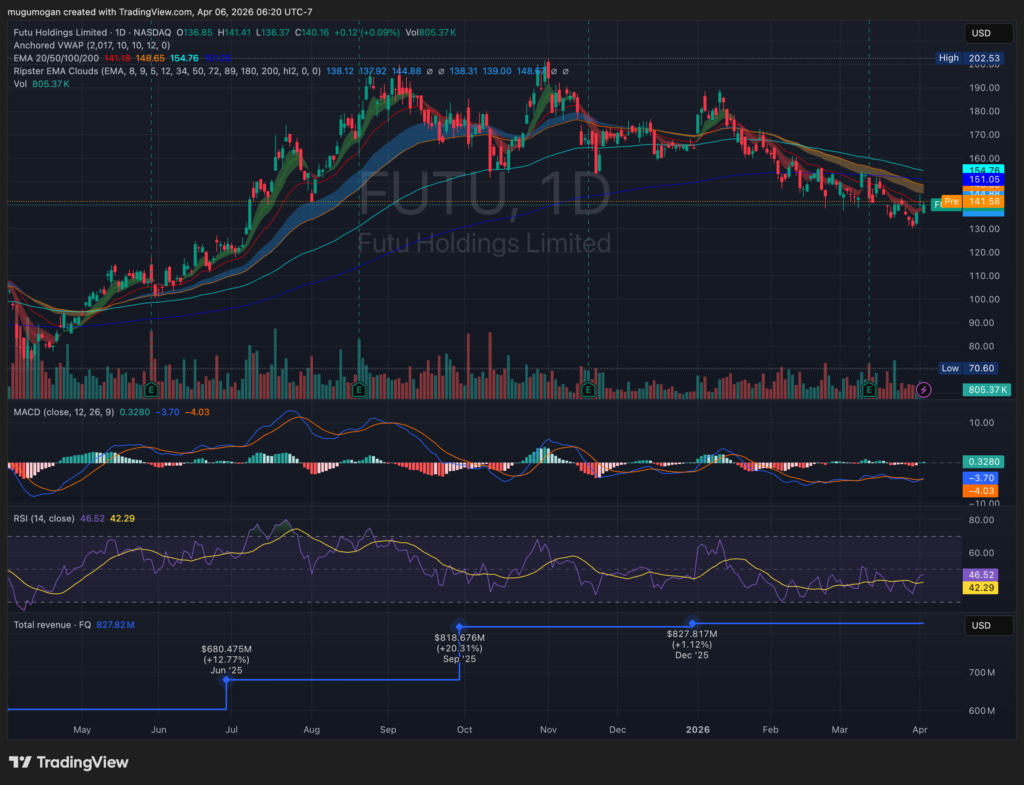
This is a classic post-parabolic pullback—weekly shows FUTU ran hard to $200 and is now correcting into the 20–50 week EMA zone ($125–$145), which is a logical institutional support area. The daily confirms short-term weakness: price is below all key EMAs, MACD is negative, and RSI (~42–46) is still not oversold—meaning downside isn’t fully exhausted yet.
If ~$135–$140 fails, next real support is around $125, which aligns with weekly structure; below that, the trend weakens materially. Upside-wise, reclaiming $150–$155 (cluster of EMAs + prior support) is key for any trend reversal.
Net: still in a higher timeframe uptrend, but short-term momentum is clearly down—this is a “wait for base or reclaim,” not a chase.