Progress Software is a mid-cap enterprise software company focused on application development, infrastructure, and data connectivity solutions, primarily serving developers and IT teams. Founded in 1981, the company has evolved from a database tools provider into a diversified portfolio of products including DevTools, infrastructure management, and secure file transfer. Its strategy is heavily acquisition-driven, targeting mature, high-margin software assets and optimizing them for cash flow. In fiscal 2025, Progress generated roughly $750M+ in revenue with steady mid-single to low-double digit growth depending on acquisitions. Headquartered in Burlington, Massachusetts, its key competitors include OpenText, IBM (in certain segments), and smaller DevTools vendors like JetBrains.
Latest Earnings (Reported This Week)
Progress Software reported fiscal Q1 2026 earnings this week (late March 2026), delivering revenue of approximately $190M–$195M, representing ~8–10% year-over-year growth, largely driven by the ShareFile acquisition. EPS came in around $1.25–$1.30 (non-GAAP), beating analyst expectations by ~5–7%. Organic growth remained modest in the low-single digits, consistent with its mature product base. The company reiterated full-year guidance of ~$800M revenue and ~$5.00+ EPS, signaling continued margin strength. Management emphasized strong recurring revenue (~85%+) and disciplined cost control.
Founding, Evolution, and Business Model
Progress Software was founded in 1981 by Joseph Alsop, with an early focus on database management systems and application development platforms. Over time, the company pivoted toward enterprise tooling and middleware, particularly focusing on enabling developers to build and deploy applications efficiently. Its early flagship product, OpenEdge, remains a core revenue contributor decades later, which tells you everything about customer stickiness.
The company’s modern strategy is simple but effective: acquire stable, cash-generating software assets, cut unnecessary costs, increase pricing power, and integrate them into a broader portfolio. Unlike high-growth SaaS companies chasing logos, Progress optimizes for EBITDA and free cash flow. This is private equity playbook inside a public company wrapper.
Key products today include Telerik (developer tools), Kemp LoadMaster (application delivery), MOVEit (managed file transfer), and ShareFile (recently acquired from Cloud Software Group). These products target IT infrastructure, security, and developer productivity—areas with long replacement cycles and high switching costs.
Products and Competitive Landscape
Progress operates across three primary product categories: DevTools, Infrastructure Management, and Data Connectivity. DevTools includes Telerik and Kendo UI, competing with JetBrains and Microsoft developer ecosystems. Infrastructure products like Kemp compete with F5 and Citrix. MOVEit competes in secure file transfer against OpenText and IBM.
The company’s differentiation is not product innovation leadership—it rarely leads markets—but operational excellence. It focuses on products with entrenched customer bases and mission-critical use cases where churn is low. This allows consistent pricing increases and upselling.
Market Opportunity and Growth Outlook
Progress operates in the broader enterprise software infrastructure and developer tools market, which is expected to grow at a 6–10% CAGR through 2030. The DevTools segment alone is projected to exceed $20B globally, driven by increased software development, cloud adoption, and AI-assisted coding workflows.
However, Progress is not a pure-play growth company benefiting from AI tailwinds. Its markets are mature, and its growth is largely inorganic. The real “market opportunity” for Progress is consolidation—there are hundreds of legacy enterprise software assets available for acquisition, especially from private equity carve-outs and divestitures.
Industry Dynamics
Enterprise infrastructure software is increasingly consolidating into fewer vendors with broader portfolios. Buyers prefer fewer vendors, longer contracts, and integrated solutions. This benefits companies like Progress that can bundle multiple products and increase contract value.
At the same time, cloud-native vendors and open-source tools are slowly eroding parts of the market. Progress mitigates this risk by focusing on legacy systems that enterprises cannot easily replace—think “too painful to migrate.”
Competitors
Progress competes with a fragmented set of players depending on the segment. OpenText is the closest analog, also pursuing an acquisition-heavy strategy in enterprise software. IBM competes in legacy infrastructure and data integration. JetBrains and Microsoft compete in developer tooling.
Compared to these players, Progress is smaller but more focused on profitability. It lacks the scale and R&D budget of IBM but compensates with higher margins and disciplined capital allocation.
Differentiation
The company’s key differentiation is its financial model, not its products. Progress is essentially a cash flow machine that acquires under-optimized software assets and improves margins through pricing, cost discipline, and cross-selling.
Unlike growth SaaS companies chasing ARR expansion at any cost, Progress consistently delivers 35%+ operating margins and strong free cash flow conversion. Its recurring revenue base and low churn make it highly predictable.
Management Team
The company is led by CEO Yogesh Gupta, who has been instrumental in shaping the acquisition-driven strategy since taking over in 2016. Under his leadership, Progress has significantly expanded its portfolio and improved margins.
CFO Anthony Folger has maintained disciplined capital allocation, ensuring acquisitions are accretive and debt levels remain manageable. The leadership team operates with a private equity mindset—focused on returns, not headlines.
Financial Performance (Last 5 Years)
Over the past five years, Progress has grown revenue from roughly $400M to over $750M+, representing a CAGR of ~12–15%, largely driven by acquisitions. Organic growth has typically remained in the low-single digits, reinforcing its reliance on M&A.
Earnings growth has outpaced revenue growth, with EPS CAGR in the ~15–20% range due to margin expansion and cost efficiencies. Operating margins have steadily improved into the mid-30% range, which is elite for software companies outside of mega-cap players.
Free cash flow has been consistently strong, often exceeding net income, allowing the company to fund acquisitions while maintaining manageable leverage. The balance sheet carries debt from acquisitions but remains stable due to predictable cash flows.
Balance Sheet and Capital Allocation
Progress uses debt strategically to fund acquisitions, typically targeting 3–4x leverage ratios post-deal. The company prioritizes deleveraging quickly through cash flow before pursuing the next acquisition.
It also returns capital via share buybacks, though M&A remains the primary use of capital. This disciplined approach has allowed steady compounding without excessive risk.
Bull Case
The bull case is straightforward: Progress continues to acquire undervalued enterprise software assets, integrates them efficiently, and expands margins, leading to consistent EPS growth. Its high recurring revenue and low churn provide strong downside protection. If management executes well, this becomes a steady compounder rather than a high-beta tech stock.
Bear Case
The biggest risk is acquisition dependency. If deal flow slows or acquisition multiples rise, growth could stall. Integration risk is also real—overpaying or mismanaging acquired assets could hurt margins. Additionally, slow erosion from cloud-native competitors could gradually impact legacy product demand.
Analyst Reactions to Earnings
Analysts were generally positive on the latest earnings, highlighting strong EPS performance and margin discipline. Several firms raised price targets modestly, citing improved visibility from recurring revenue and successful integration of ShareFile. There were no major downgrades, but concerns remain about limited organic growth and reliance on acquisitions.
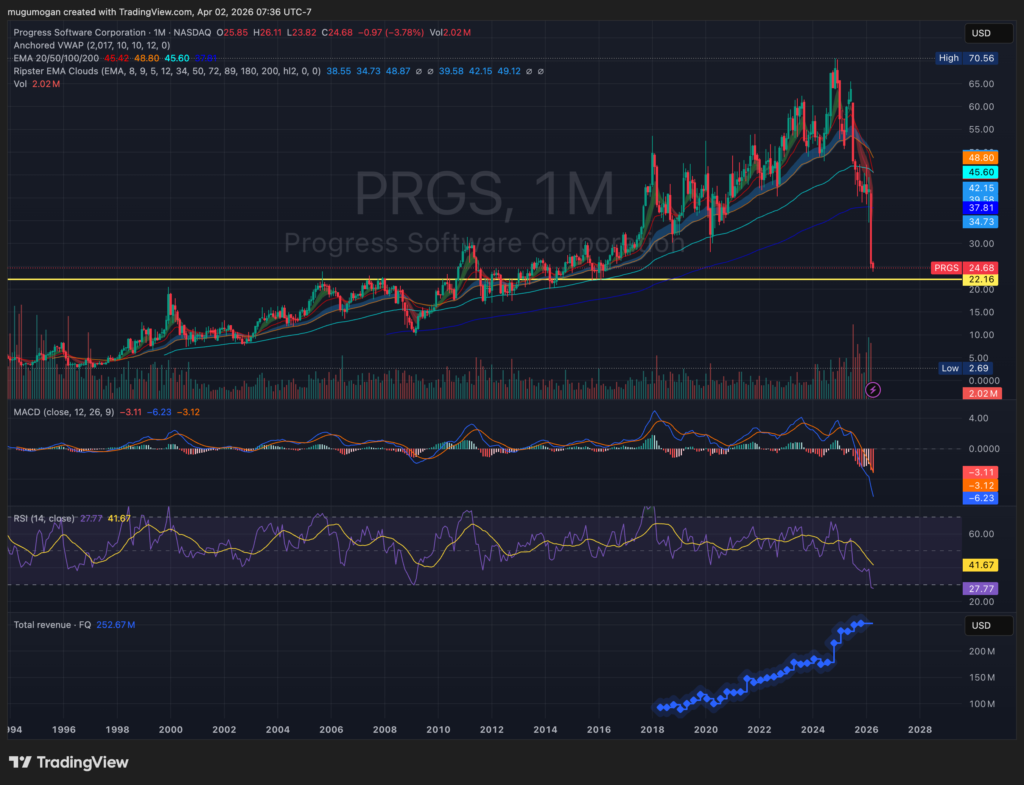
This chart is ugly, no way around it—the stock just had a high-volume breakdown from ~$60 to mid-$20s, slicing through every major moving average like they weren’t there. That kind of move isn’t “pullback,” it’s institutional exit + repricing, likely tied to earnings or guidance shock. Price is now sitting near a long-term support zone (~$22–$25), but with RSI in the high-20s and MACD deeply negative, momentum is still firmly bearish.
The only bullish argument here is oversold bounce potential, not trend reversal. Until it reclaims at least the $38–$42 range (prior support turned resistance), this is a dead money / falling knife setup, not a dip to blindly buy.