Kingsoft Cloud is a China-based public cloud service provider focused on enterprise cloud infrastructure, AI computing, and industry-specific solutions, particularly in video, gaming, and AI workloads. Founded in 2012 and spun out of Kingsoft Corporation, the company has positioned itself as a neutral alternative to hyperscalers like Alibaba Cloud and Tencent Cloud. It generates revenue primarily from public cloud services, enterprise cloud deployments, and increasingly AI-driven compute services. The company went public on NASDAQ in 2020 but has faced volatility due to macro conditions and intense competition in China’s cloud market. As of 2024, Kingsoft Cloud reported roughly $1.1–$1.3 billion in annual revenue with modest growth as it pivots toward higher-margin AI workloads.
Recent Earnings — AI Pivot Driving Stabilization
In its most recent earnings (Q4 2025, reported March 2026), Kingsoft Cloud posted revenue of approximately $260–$280 million, reflecting low single-digit year-over-year growth after several quarters of contraction. EPS remained negative, around -$0.15 to -$0.18, but showed improvement versus prior-year losses due to cost optimization and improved gross margins. The company beat analyst expectations on revenue slightly but remained in line on losses, signaling stabilization rather than breakout growth. Management guided for mid-single-digit growth in 2026, with AI cloud services expected to be the primary growth driver. Importantly, they emphasized margin expansion over aggressive top-line growth, a shift from earlier strategies.
Founding Story — A Strategic Spinout from Kingsoft
Kingsoft Cloud was established in 2012 as a subsidiary of Kingsoft Corporation, one of China’s oldest software companies known for office software and gaming. The spinout strategy allowed Kingsoft to compete in the rapidly growing cloud market without being tied to a single ecosystem. Early backing from Xiaomi provided both capital and a built-in customer ecosystem, especially for mobile and IoT workloads. This relationship helped Kingsoft Cloud scale quickly in its early years, particularly in video streaming and mobile gaming infrastructure.
Product Evolution — From Gaming Cloud to AI Infrastructure
Initially, Kingsoft Cloud focused heavily on gaming and video cloud services, leveraging its ties to Kingsoft’s gaming business and Xiaomi’s ecosystem. Over time, it expanded into enterprise cloud, offering compute, storage, networking, and database solutions. More recently, the company has pivoted toward AI infrastructure, including GPU-based computing, model training environments, and inference services. This shift aligns with broader demand in China for domestic AI infrastructure due to regulatory and geopolitical constraints.
Funding and Strategic Backers — Xiaomi as Anchor Customer
Kingsoft Cloud has raised multiple rounds of funding prior to its IPO, with Xiaomi and Kingsoft Corporation remaining key shareholders. Xiaomi continues to be a major customer, contributing a significant portion of revenue historically, though the company has been actively diversifying its customer base. This dependence has been a double-edged sword: it provided early growth but also raised concerns about customer concentration risk. Post-IPO, the company has focused on reducing this reliance while expanding into enterprise verticals like finance and public sector.
Headquarters and Competitive Landscape
The company is headquartered in Beijing, China, and operates primarily within the Chinese market. Its key competitors include Alibaba Cloud, Tencent Cloud, Huawei Cloud, and Baidu AI Cloud. Unlike these competitors, which are part of larger ecosystems, Kingsoft Cloud positions itself as a more neutral provider, appealing to enterprises that prefer not to be locked into a specific tech giant’s ecosystem.
Market Opportunity — China Cloud Market Growth
China’s cloud computing market is projected to grow significantly through 2030, with estimates suggesting it could exceed $150–$200 billion in total market size. The CAGR is expected to be in the range of 15–20%, driven by enterprise digital transformation, AI adoption, and government initiatives supporting domestic cloud providers. Public cloud penetration in China is still lower than in the U.S., indicating substantial room for growth.
AI Infrastructure — The Next Growth Engine
A major driver of future growth is AI infrastructure, particularly demand for GPU clusters, large model training, and inference workloads. Kingsoft Cloud is positioning itself as a key player in this segment by investing in AI-native infrastructure and partnerships. The company’s ability to compete will depend on access to high-performance chips and its ability to optimize costs while delivering scalable AI solutions.
Competitive Dynamics — Fighting Giants
Kingsoft Cloud competes against significantly larger players with deeper pockets and broader ecosystems. Alibaba Cloud dominates with over 30% market share, while Tencent Cloud and Huawei Cloud also have strong positions. These competitors benefit from integrated ecosystems, including e-commerce, social media, and hardware. Kingsoft Cloud’s challenge is to carve out niche segments where neutrality and specialization matter more than scale.
Differentiation — Neutral Cloud + Vertical Focus
The company’s key differentiation lies in its neutrality and vertical specialization. Unlike Alibaba or Tencent, it does not compete directly with its customers in adjacent businesses, making it attractive for enterprises wary of platform conflicts. Additionally, its deep expertise in video, gaming, and AI workloads allows it to offer optimized solutions in these areas. This niche positioning is critical in a market dominated by hyperscalers.
Management Team — Focused on Turnaround
The leadership team includes CEO Tao Zou, who has been instrumental in steering the company toward profitability and AI-focused growth. The CFO has emphasized disciplined cost management and margin improvement, which is evident in recent financial performance. The broader management team has a mix of experience from Kingsoft, Xiaomi, and China’s broader tech ecosystem, aligning well with the company’s strategic direction.
Financial Performance — Growth Then Correction
Over the past five years, Kingsoft Cloud experienced rapid revenue growth from 2019 to 2021, with CAGR exceeding 50% during peak expansion years. However, growth slowed significantly in 2022–2024 due to macroeconomic pressures and reduced spending from key customers like Xiaomi. Revenue growth turned flat to slightly negative during this period, forcing the company to pivot toward profitability.
Margins and Profitability — Improving but Still Negative
Gross margins have historically been low, often in the 5–10% range, due to intense price competition and infrastructure costs. However, recent quarters show improvement toward 10–15% as the company exits low-margin contracts and focuses on higher-value workloads like AI. Operating losses have narrowed, but the company is still not profitable on a net income basis.
Balance Sheet — Stabilizing with Discipline
Kingsoft Cloud has maintained a relatively stable balance sheet, supported by cash reserves from its IPO and ongoing backing from strategic investors. While it has not faced liquidity crises, its ability to fund future growth depends on achieving sustainable margins. Capital expenditures remain significant due to infrastructure investments, particularly in AI compute.
Bull Case — Why It Could Work
The bull case rests on Kingsoft Cloud successfully transitioning into an AI infrastructure provider, capturing high-margin workloads and benefiting from China’s push for domestic AI capabilities. If AI demand accelerates, the company could see both revenue growth and margin expansion. Additionally, reduced reliance on Xiaomi and broader enterprise adoption could improve revenue quality.
Bear Case — Why It Could Struggle
The bear case centers on intense competition from hyperscalers with superior scale and resources, which could continue to pressure pricing and margins. Limited access to advanced semiconductors due to geopolitical constraints could hinder its AI ambitions. Additionally, persistent customer concentration risk and slower-than-expected enterprise adoption could stall growth.
Analyst Reactions — Cautious Optimism
Analysts have generally maintained neutral to cautiously positive ratings following the latest earnings. Some have raised price targets slightly due to improving margins and AI positioning, while others remain skeptical about long-term competitiveness. There have been no major upgrades, but sentiment has shifted from bearish to cautiously constructive.
Valuation vs Peers — Smaller but Niche
Compared to Alibaba Cloud (part of Alibaba), Tencent Cloud, and Baidu AI Cloud, Kingsoft Cloud is significantly smaller in both revenue and market cap. Its growth rate is currently lower than peers, but its niche focus on AI workloads could justify a premium if execution improves. However, its lack of profitability remains a key valuation overhang.
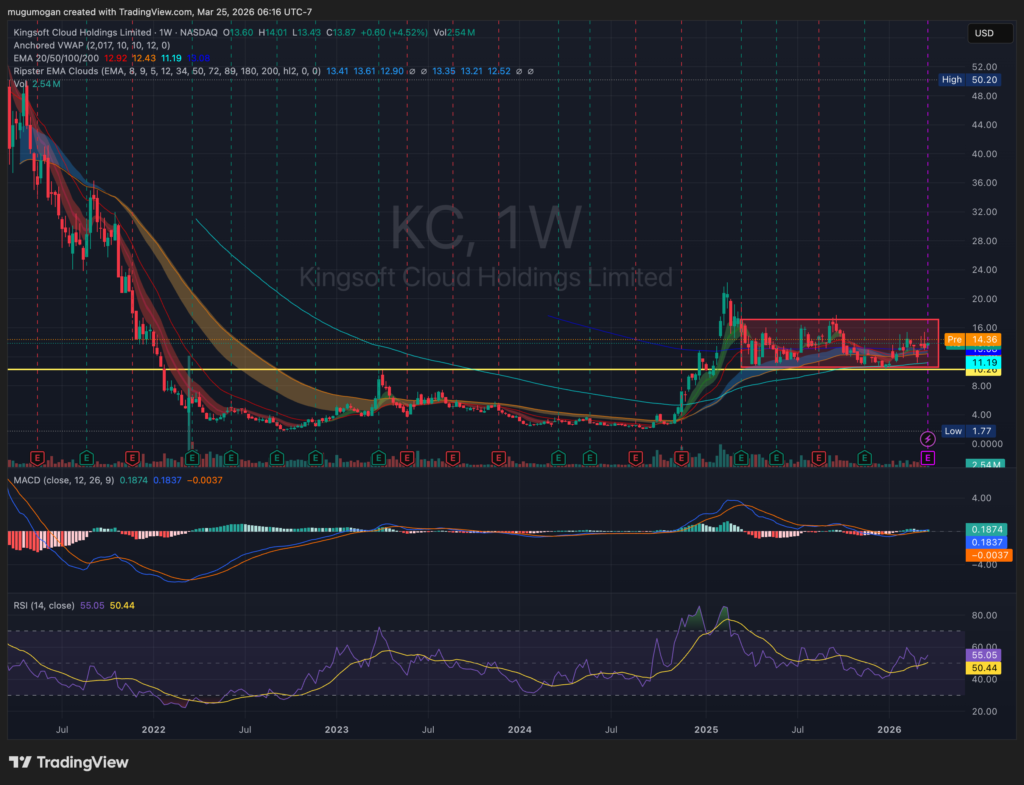
This is a classic post-collapse base with early accumulation, not a breakout—yet. After the massive drawdown from ~$70 to sub-$5, the stock has spent nearly 2+ years building a bottom, which is exactly what long-term reversals look like. The current price action is tight consolidation between ~$11–$15, with higher lows forming—this suggests institutional support but not aggressive buying yet.
The key level is clearly ~$15: multiple rejections there make it strong resistance, and until that breaks with volume, this remains a range-bound trade. The 200-week moving average is still above price, so structurally this is still in a long-term downtrend attempting a reversal, not a confirmed uptrend. RSI around ~55 and flattening MACD tell you momentum is neutral-to-slightly bullish but not explosive.