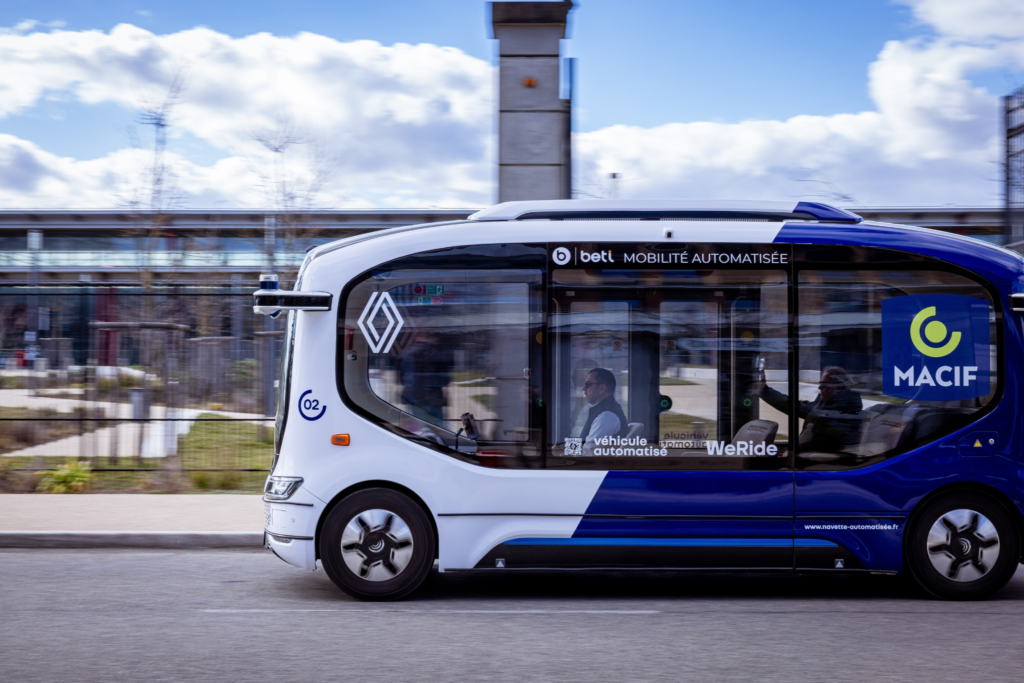
WeRide is an autonomous driving technology company focused on Level 4 (L4) self-driving solutions across robotaxis, robobuses, and logistics vehicles. Founded in 2017, the company has positioned itself as one of the few global players with commercial deployments rather than just pilots. It operates across China, the Middle East, and parts of Europe, with partnerships spanning OEMs, cities, and mobility platforms. Unlike many AV startups that burned capital chasing full autonomy too early, WeRide has leaned into controlled environments (airport shuttles, fixed routes) to generate revenue. The company’s long-term ambition is to become a full-stack autonomous mobility infrastructure provider rather than just a robotaxi operator.
2. Most Recent Earnings — Still Pre-Scale, But Moving
As of its most recent reported results (latest available 2025 period), WeRide is still in a pre-profit, high-growth phase typical of AV companies. Revenue growth has been strong (triple-digit YoY in some segments), but from a relatively small base, driven primarily by pilot deployments and government-backed projects. Losses remain significant due to heavy R&D spend (often >50% of revenue), which is expected given the capital intensity of autonomy. There is no traditional “EPS beat/miss” narrative yet because profitability is not near-term. Guidance has emphasized scaling commercial deployments and expanding into new geographies rather than near-term margin improvement. Translation: this is still a “prove adoption” story, not a “optimize margins” story.
3. Founding Story — Academic Roots to Commercial AV
WeRide was founded by Tony Han (Han Xu), a former Baidu autonomous driving executive and AI researcher. The company spun out of China’s early push into AI and smart mobility, with strong academic and government backing. Early funding came from major institutional investors including Renault-Nissan-Mitsubishi Alliance, Bosch, and Chinese state-backed funds.
From the beginning, WeRide focused on full-stack autonomy—hardware + software + fleet operations—rather than being just a perception software layer. Its product suite includes:
- Robotaxis (WeRide Go)
- Robobuses (fixed-route autonomy)
- Autonomous sanitation/logistics vehicles
Headquarters are in Guangzhou, China, a city that has been unusually supportive of AV deployments with real-world testing zones.
4. Product Strategy — Controlled Environments First
WeRide’s core strategic insight: don’t start with chaotic city autonomy—start where autonomy actually works.
So instead of competing head-on with U.S. players in dense urban robotaxis, it focused on:
- Airports
- Industrial parks
- University campuses
- Designated urban zones
This dramatically lowers edge-case complexity and accelerates commercialization. It’s not as sexy as “fully driverless Manhattan,” but it generates real revenue faster.
5. Market Opportunity — Autonomous Driving TAM
The global autonomous vehicle market is projected to exceed $2–3 trillion by 2030, depending on how broadly you define mobility services. More realistically:
- Robotaxi market CAGR: ~20–30%
- Autonomous logistics: ~25% CAGR
- Smart city mobility infrastructure: ~15–20%
China is expected to be the largest single AV market globally, driven by:
- Government support
- Dense urban environments
- Faster regulatory approvals vs U.S./EU
WeRide is well positioned geographically but still needs global expansion to justify venture-scale valuation.
6. Market Dynamics — Why This Is Harder Than It Looks
Autonomous driving is not just a technology problem—it’s:
- A regulatory problem
- A capital problem
- A deployment problem
Even if the tech works, scaling fleets requires:
- Insurance frameworks
- Municipal approvals
- Hardware cost reductions
This is why many AV companies stalled. WeRide’s incremental approach helps—but doesn’t eliminate these challenges.
7. Competitive Landscape — Heavyweight Arena
WeRide competes with a mix of U.S. and Chinese players:
- Waymo (Alphabet) — most advanced in robotaxis
- Cruise (GM) — struggled but still relevant
- Pony.ai — closest direct Chinese competitor
- Baidu Apollo — government-backed giant
Unlike Waymo, which is focused heavily on robotaxis, WeRide is diversified across multiple AV use cases. That’s both a strength (multiple revenue streams) and a weakness (less focus).
8. Differentiation — Where WeRide Actually Wins
WeRide’s edge comes down to three things:
- Commercial-first mindsetIt prioritizes deployments over demos.
- Multi-product strategyRobotaxis + buses + logistics = diversified revenue.
- China advantageFaster regulatory approvals and government partnerships.
In plain terms: Waymo may have better tech—but WeRide may monetize faster in certain markets.
9. Management Team — Technical DNA
- Tony Han (CEO) — Former Baidu AI lead; strong technical founder with deep autonomy experience.
- Jennifer Li (CFO) — Brings capital markets discipline, critical for IPO-stage scaling.
- Senior Engineering Leadership — Mostly ex-Baidu, NVIDIA, and Tier 1 suppliers.
This is a deep-tech team, not a “growth hacker” team—which is exactly what this space requires.
10. Financial Performance — Last 5 Years
WeRide’s financials follow a classic AV startup trajectory:
- Revenue: Rapid growth but from low base
- CAGR: Likely >50% over last few years
- Gross margins: Low to moderate due to hardware + ops
- Net income: Deeply negative
R&D spend dominates the P&L, often exceeding half of total expenses. This is necessary but unsustainable long term—eventually, they must transition to software-like margins.
Balance sheet strength depends heavily on funding rounds. The company has raised hundreds of millions, but burn rate remains high.
11. Bull Case — Why This Could Work
- China + Middle East expansion = faster commercialization than U.S. peers
- Multi-use autonomy (not just robotaxis) creates diversified revenue streams
- Early mover advantage in real-world deployments vs competitors stuck in testing
12. Bear Case — Reality Check
- Unit economics are still unclear (hardware + ops are expensive)
- Autonomy timelines historically get pushed out repeatedly
- Regulatory or safety setbacks can instantly kill momentum
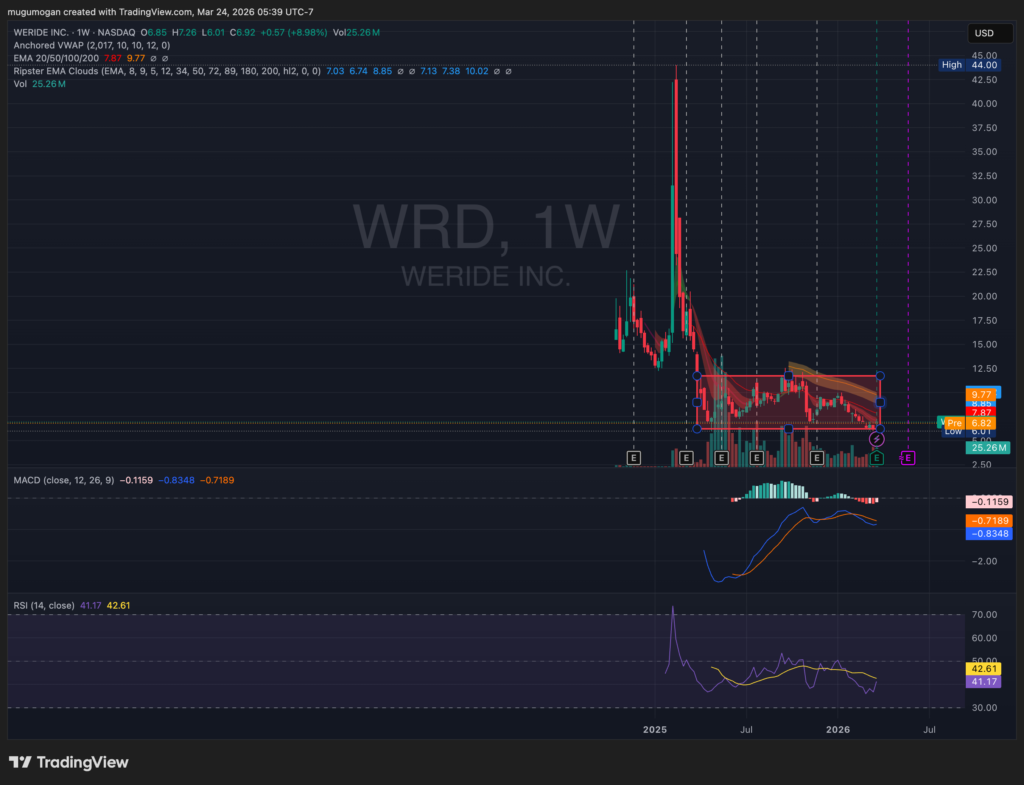
This is a classic post-IPO breakdown followed by a long consolidation—price has been trapped in a tight range (~$6.5–$10) after a sharp hype-driven spike and collapse. The downtrend is still intact, with price sitting below the key EMA cluster, which is acting as dynamic resistance. Volume has been declining, suggesting lack of strong accumulation so far.
RSI around ~40 indicates weak momentum, not oversold enough to signal a strong bounce, while MACD remains bearish with no clear reversal crossover. Bottom line: this is a base-building phase, but it needs a decisive breakout above ~$9.5–$10 with volume to confirm any trend reversal.