DraftKings is a U.S.-based digital sports entertainment and gaming company founded in 2012 that operates online sports betting, iGaming (online casino), daily fantasy sports, and media platforms. Headquartered in Boston, Massachusetts, the company has grown into one of the two dominant pure-play U.S. sportsbook operators alongside FanDuel. In 2024, DraftKings generated approximately $4.8 billion in revenue, reflecting strong double-digit growth driven by state legalization tailwinds and increased customer monetization. The company operates in over 25 U.S. states plus Ontario, leveraging a mobile-first platform and heavy brand marketing investment. Its top competitors include FanDuel (owned by Flutter Entertainment), BetMGM, and Caesars Digital.

DraftKings reported earnings last week for Q4 2025, posting revenue of approximately $1.4 billion, up roughly 25–30% year-over-year, ahead of analyst expectations. Adjusted EPS came in narrower than expected, with losses improving significantly versus last year as promotional intensity declined and structural margins expanded. The company reiterated its full-year 2026 revenue guidance in the range of $6.2–$6.4 billion and projected positive adjusted EBITDA for the full year, continuing its path toward sustained profitability. Management highlighted improved customer acquisition efficiency and stronger hold rates during the NFL season. The stock reacted positively in after-hours trading as investors focused on EBITDA inflection rather than GAAP losses.
DraftKings was founded by Jason Robins, Matt Kalish, and Paul Liberman as a daily fantasy sports company, initially competing with FanDuel in a loosely regulated gray market. Following the 2018 U.S. Supreme Court decision striking down PASPA, the company pivoted aggressively into regulated online sports betting. DraftKings went public in 2020 via a SPAC merger, one of the early high-profile de-SPAC successes during the pandemic capital markets boom. Since then, it has raised billions in capital to fund state-by-state expansion, technology stack development, and marketing campaigns.
The company’s core products include online sportsbook, in-game micro-betting, same-game parlays, and iGaming casino offerings where permitted. It operates a proprietary trading and risk platform and has steadily reduced reliance on third-party tech. Media integrations, including partnerships with ESPN and major leagues like the NFL and NBA, have helped expand brand reach. The company differentiates through product depth, parlay innovation, and increasingly data-driven personalization.
DraftKings’ headquarters in Boston positions it near a deep fintech and data science talent pool. The company employs thousands across engineering, marketing, compliance, and trading operations. While it remains U.S.-centric, management has selectively evaluated international markets but remains focused on maximizing domestic penetration. Its funding history includes public equity raises and convertible debt to fuel expansion during peak legalization years.
The U.S. online sports betting market is projected to reach $40–$45 billion in gross gaming revenue by 2030, implying high single-digit to low double-digit CAGR depending on additional state legalization. iGaming remains the larger long-term opportunity, but only a handful of states currently allow online casino. Industry growth is increasingly driven less by new states and more by increased wallet share, cross-sell, and product innovation such as live betting. Regulatory risk remains ever-present, particularly regarding taxation and advertising restrictions.
Structural margin expansion across the industry is now the central narrative. Early years were characterized by aggressive promotional spend to gain market share. Today, the market is consolidating around two leaders, with DraftKings and FanDuel controlling the majority of market share in most mature states. As promotional intensity falls and technology becomes vertically integrated, EBITDA margins are expanding toward mid-teens targets over time.
Competitively, FanDuel remains the market share leader in many states due to Flutter’s global experience. BetMGM leverages MGM’s brand and retail presence, while Caesars Digital competes aggressively in select states. Barriers to entry have increased significantly due to licensing costs, brand scale, and marketing budgets. Smaller entrants have largely exited or been acquired.
DraftKings’ unique differentiation lies in its product innovation velocity and parlay-driven monetization engine. Same-game parlays significantly increase hold percentage relative to straight bets, structurally improving margins. Its mobile-first architecture and strong CRM capabilities enable targeted promotions and improved lifetime value metrics. The company also benefits from a loyal daily fantasy sports base that can be converted into sportsbook customers at lower acquisition costs.
The management team is led by co-founder and CEO Jason Robins, who has remained at the helm since inception and has steered the company from fantasy sports to a multi-billion-dollar sportsbook platform. CFO Alan Ellingson has focused heavily on cost discipline and the path to sustained profitability. Matt Kalish, co-founder and President of DraftKings North America, oversees core U.S. operations and product expansion. The leadership team’s credibility increasingly rests on delivering consistent EBITDA rather than just revenue growth.
Over the past five years, DraftKings has grown revenue from under $1 billion in 2020 to nearly $5 billion in 2024, representing a compound annual growth rate exceeding 40%. Losses peaked during peak expansion years as marketing spend ballooned. However, operating leverage has materially improved, with EBITDA margins moving from deeply negative territory toward breakeven and positive territory in recent quarters. The company has strengthened its balance sheet by refinancing debt and managing liquidity carefully amid rising interest rates.
Customer metrics have improved meaningfully. Average revenue per monthly unique payer has increased due to cross-sell and higher-margin products. Marketing spend as a percentage of revenue has steadily declined, signaling improving unit economics. Cash flow remains volatile seasonally but trends are moving toward sustainable positive free cash flow over the next 1–2 years if guidance holds.
On the balance sheet, DraftKings maintains several billion dollars in liquidity, including cash and revolver capacity, providing flexibility for selective acquisitions or technology investment. Debt levels are manageable relative to projected EBITDA. Share dilution from equity raises and compensation has moderated compared to peak expansion years.
The bull case centers on three core drivers: continued legalization of iGaming across major states like California and Texas, sustained EBITDA margin expansion into the mid-teens, and structural dominance alongside FanDuel creating an effective duopoly. If those conditions hold, free cash flow could scale significantly by 2028.
The bear case focuses on regulatory risk, particularly rising state taxes on betting operators, intensifying competition that re-ignites promotional wars, and consumer spending weakness during economic slowdowns. Additionally, high reliance on sports calendars creates quarterly volatility that can pressure sentiment.
Analyst reactions following earnings were broadly constructive. Several firms raised price targets citing accelerating EBITDA inflection and improved hold rates. A few cautious analysts maintained neutral ratings, flagging tax risks and valuation stretch after the recent rally. Overall, sentiment shifted from “growth at any cost” skepticism to cautious profitability optimism.
From a valuation perspective, DraftKings trades at a premium revenue multiple relative to legacy casino operators but at a discount to earlier peak valuations during 2021–2022. Investors increasingly benchmark it against high-growth consumer internet platforms rather than traditional gaming companies.
A year-over-year comparison of the most recent quarter shows revenue growth of roughly 25–30% while adjusted EPS losses narrowed materially versus Q4 2024, reflecting improving operating leverage. EBITDA swung closer to breakeven compared to a significant loss in the prior-year quarter, reinforcing management’s profitability trajectory narrative.
In market capitalization comparison, DraftKings sits below Flutter Entertainment but above most standalone U.S. digital peers. Its valuation reflects leadership position, strong revenue growth, and improving margins, but still embeds regulatory and execution risk. As legalization matures, the stock’s performance will likely hinge less on revenue growth rates and more on free cash flow conversion and disciplined capital allocation.
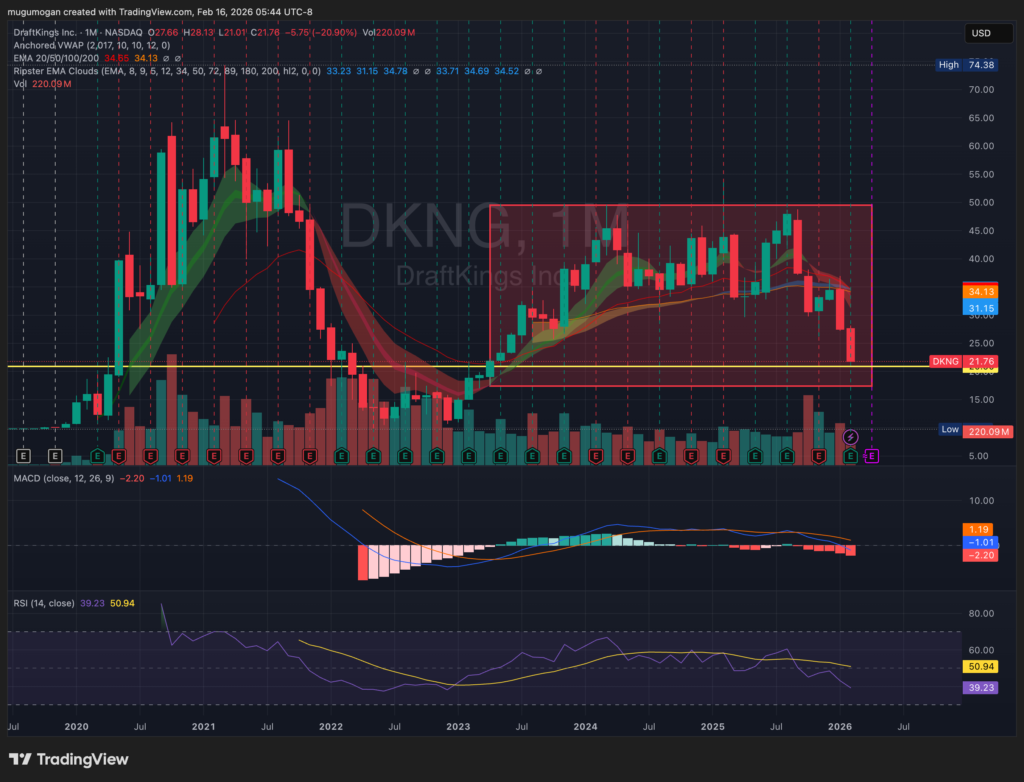
The stock is in a bearish markdown stage 4 on all 3 time frames with a move to the $20 range for a turnaround reversal likely. We are not buyers yet.