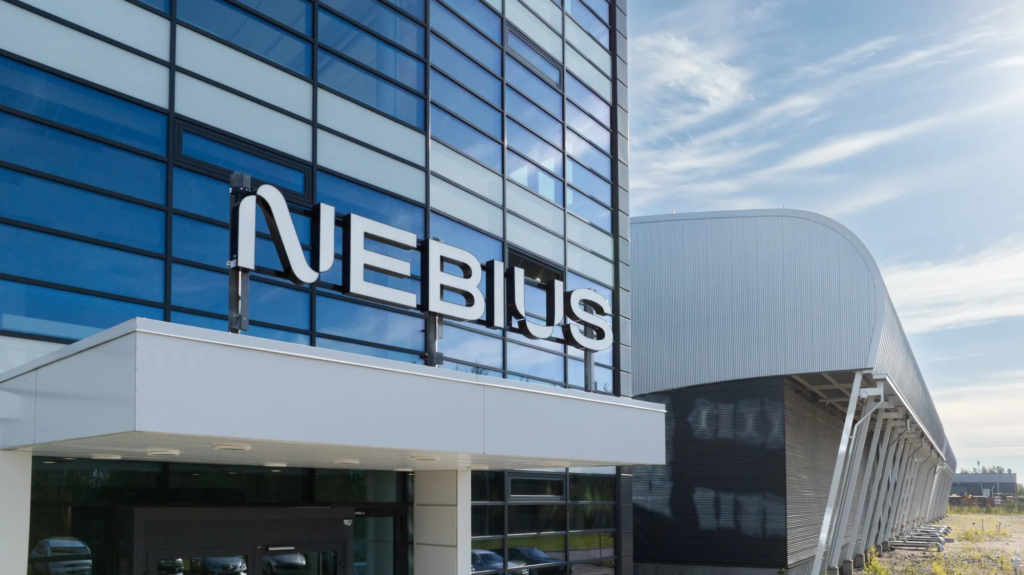
Nebius Group is a European AI infrastructure company formed from the international assets spun out of Yandex after its 2024 restructuring. Headquartered in Amsterdam, the company is positioning itself as a sovereign AI cloud provider focused on GPU-dense compute for training and inference workloads. Nebius operates hyperscale data centers in Europe and the U.S., targeting startups, enterprises, and research labs building foundation models. The company is early-stage in revenue but investing aggressively in NVIDIA-based infrastructure to capture growing AI compute demand. Its strategy is simple: become the “AI-first cloud” alternative to AWS, Azure, and Google Cloud in Europe.
Most Recent Earnings (Q4 2025)
- Revenue: $227.7 million for Q4 2025 — up ~547% year-over-year (from $35.2 million) but missed analyst expectations of ~$247.5 million.
- EPS: Reported loss per share of ($0.99), notably below consensus estimates around ($0.42) — a bigger miss than expected.
- Adjusted EBITDA: Nebius delivered positive adjusted EBITDA of ~$15 million in Q4 (versus a loss in the prior year), showing some operating leverage.
- Net Loss: Net loss from continuing operations widened to ~$249.6 million, reflecting heavy capex and depreciation.
- Revenue Growth: Revenue still soared ~547% YoY but falling short of Street targets triggered a stock slide.
Guidance & Management Commentary
- 2026 Revenue Guidance: Management reiterated full-year expectations for $3.0 B – $3.4 B in revenue for 2026 and targeted 40% adjusted EBITDA margins, a prudent yet bullish plan given scale-up capital needs.
- Annualized Run-Rate (ARR): Core AI cloud ARR ended 2025 at ~$1.2 B+, above guidance, pointing to strong contract demand.
- CapEx & Expansion: CapEx was massive (~$2.06 B in Q4 alone) to expand global data center capacity, with contracted power targets raised above 3 GW.
3. Founding and Background
Nebius emerged in 2024 when Yandex split its Russian and international businesses. The international assets—data centers, cloud services, and AI research operations—were consolidated into Nebius Group. The restructuring allowed the company to operate independently from Russia while maintaining access to global capital markets and Western customers.
4. Leadership and Structure
The company is led by former Yandex executives who previously built one of Europe’s largest internet ecosystems. The team brought experience in large-scale distributed systems, search infrastructure, and AI research. The corporate structure was intentionally redesigned to ensure Western governance standards, distancing operations from geopolitical risk.
5. Products and Services
Nebius offers AI-optimized Infrastructure-as-a-Service, including GPU clusters powered primarily by NVIDIA H100 and next-generation chips. Its cloud is purpose-built for large-scale model training, fine-tuning, and inference workloads. The value proposition centers on high-performance networking, liquid cooling, and efficient GPU utilization. Unlike general-purpose clouds, Nebius markets itself as AI-native from day one.
6. Headquarters and Footprint
Headquartered in Amsterdam, Nebius operates data centers in Finland and other European regions, leveraging access to renewable energy and colder climates to reduce cooling costs. This European footprint appeals to customers prioritizing data sovereignty and regulatory compliance within the EU.
7. Market Opportunity
The global AI infrastructure market is projected to exceed $400–500 billion by 2030, growing at a CAGR of 25–35% driven by generative AI adoption. Demand for GPU clusters continues to outstrip supply, especially in Europe where hyperscaler capacity lags U.S. deployments. Enterprises increasingly require sovereign cloud providers compliant with EU data laws.
8. Competitive Landscape
Nebius competes with hyperscalers such as Amazon Web Services, Microsoft Azure, and Google Cloud, as well as specialized GPU cloud providers like CoreWeave. Hyperscalers have scale and capital advantages, while CoreWeave and similar firms focus narrowly on GPU compute.
9. Differentiation
Nebius differentiates itself through geographic positioning and focus. It offers European AI compute capacity at scale, emphasizing sovereignty, regulatory alignment, and high-density AI optimization. While hyperscalers are diversified across services, Nebius is singularly focused on AI workloads, allowing tighter optimization of networking, cooling, and GPU scheduling.
10. Management Team
The leadership team includes former Yandex executives with deep experience in AI and infrastructure. The CEO previously oversaw international cloud expansion, while the CFO has capital markets and restructuring expertise. The CTO brings a background in distributed computing and machine learning infrastructure, reflecting a technically driven organization.
11. Financial Performance (5-Year View)
Because Nebius formally emerged in 2024, historical standalone financial data is limited. However, the underlying international cloud assets previously generated steady mid-double-digit growth under Yandex. Since separation, Nebius has shifted toward high-growth, capital-intensive AI infrastructure, resulting in accelerating top-line growth but widening operating losses.
12. Revenue and Earnings Trends
Revenue CAGR since separation is triple digits off a small base, driven by GPU cluster deployments. Gross margins are expected to improve as utilization rates increase. Net income remains negative as depreciation and infrastructure investments weigh on earnings. Balance sheet strength depends on capital raised during restructuring and potential future equity or debt offerings.
13. Bull Case
- Europe demands sovereign AI infrastructure independent of U.S. hyperscalers.
- GPU scarcity supports pricing power and high utilization.
- Early mover advantage in AI-first cloud architecture could drive high revenue CAGR into 2030.
14. Bear Case
- Capital intensity is extreme; dilution risk remains high.
- Hyperscalers can undercut pricing and expand EU capacity.
- Utilization risk if AI demand slows or customers insource infrastructure.
| Company | Revenue (TTM) | YoY Growth | Net Income | Market Cap |
|---|---|---|---|---|
| Nebius Group | Early-stage | Triple digit | Negative | Small/Mid Cap |
| CoreWeave | Multi-billion | High double digit | Negative | Large Cap |
| Amazon Web Services (segment of Amazon) | ~$90B+ | ~15–20% | Profitable | Trillion+ (parent) |
| Microsoft Azure (segment) | ~$70B+ est | ~25% | Profitable | Trillion+ (parent) |
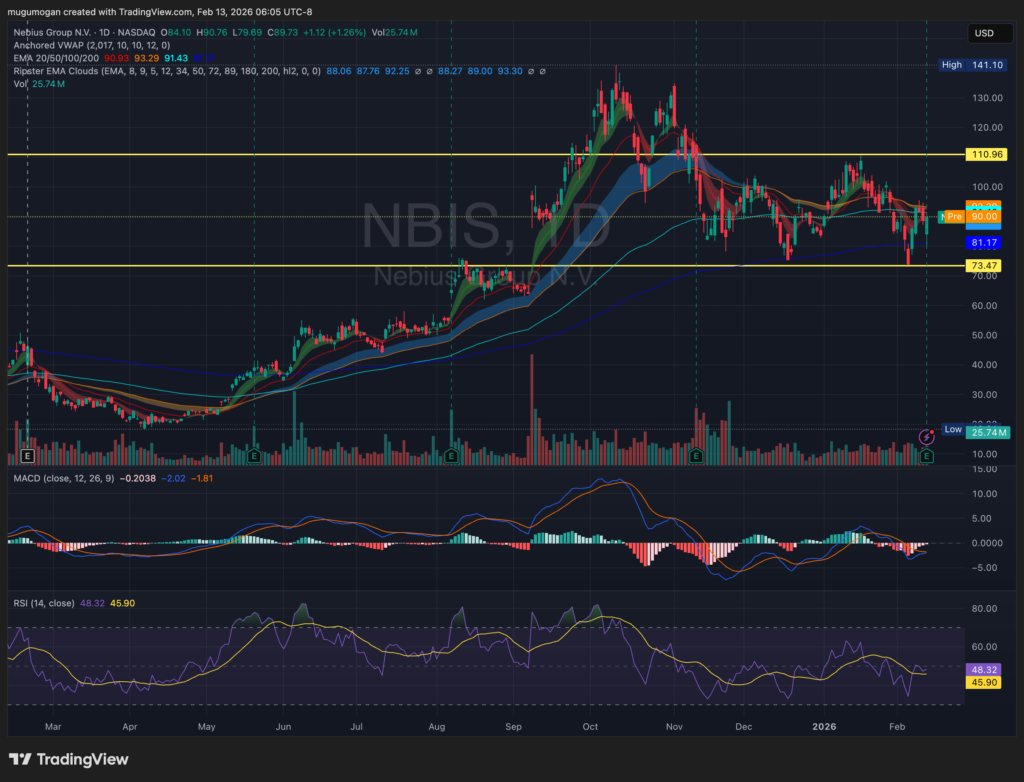
The stock is in a stage 4 decline on the monthly chart and weekly chart is consolidating in stage 1. The daily chart is range bound in stage 1 within $73 and $110 where it should be for a few more months. This might be a stock to trade for the short term in that range.