Cloudflare is a global cloud platform that provides security, performance, and reliability services to websites, applications, and APIs. Founded in 2009, the company operates one of the largest distributed networks in the world, spanning over 300 cities. In 2024, Cloudflare generated roughly $1.3 billion in revenue, growing more than 30% year over year as enterprises increasingly adopted Zero Trust security and edge computing solutions. The company’s mission is to help build a better Internet by making it faster and more secure without requiring customers to rip and replace infrastructure. Its primary competitors include Akamai, Fastly, and Zscaler, but Cloudflare positions itself as a unified platform rather than a point solution vendor.

Cloudflare’s most recent earnings were reported in early February 2026 for Q4 2025. The company delivered revenue of approximately $380 million, up roughly 28–30% year over year, ahead of analyst expectations. Adjusted EPS came in above consensus at roughly $0.18–$0.20, reflecting continued operating leverage. Management guided Q1 2026 revenue in the range of roughly $390–$395 million and full-year 2026 revenue toward the mid-$1.6 billion range, implying sustained high-20% growth. Importantly, large customer growth and $100K+ ARR expansion remained strong, reinforcing enterprise traction.
Cloudflare was founded by Matthew Prince, Michelle Zatlyn, and Lee Holloway after originally starting as a project called Project Honey Pot. The company is headquartered in San Francisco. Early funding came from firms like Venrock, NEA, and Union Square Ventures before it went public in 2019. From its origins as a content delivery network (CDN), Cloudflare expanded into DDoS protection, web application firewall (WAF), bot mitigation, and more recently Zero Trust, SASE, and developer-focused edge compute via Workers. Its global anycast network allows traffic to be routed through its infrastructure without customers managing hardware.
Over time, Cloudflare deliberately shifted from SMB roots toward enterprise customers. Today, it serves millions of properties worldwide, including Fortune 500 companies. Its “land and expand” model relies on starting with performance or DDoS protection and layering security, identity, and network services over time. The company’s innovation cadence has been rapid, often bundling new capabilities into its existing subscription tiers.
The market Cloudflare operates in spans multiple high-growth segments: CDN, application security, SASE (Secure Access Service Edge), Zero Trust, and edge computing. The broader cybersecurity market is projected to exceed $500 billion by 2030 with high single- to low double-digit CAGR, while SASE and Zero Trust specifically are expected to grow 20%+ annually through the decade. Edge computing, particularly serverless edge platforms, is forecast to compound at 20–25% CAGR as workloads move closer to end users.
Cloudflare benefits from structural tailwinds including increased cyber threats, enterprise cloud migration, hybrid work, and AI-driven application traffic growth. As AI inference traffic increases and latency-sensitive workloads expand, distributed edge networks become more valuable. Cloudflare’s ability to run compute and security at the same edge node gives it architectural leverage.
Key competitors include Akamai Technologies, Fastly, and Zscaler. Akamai is more mature and highly profitable but slower growing. Fastly focuses heavily on edge compute and media customers but has experienced revenue volatility. Zscaler dominates Zero Trust network access in large enterprises and trades at premium multiples due to strong margins.
Cloudflare’s differentiation lies in its single global network architecture. Unlike competitors that stitched together acquisitions, Cloudflare built its stack natively on one control plane and one network. This reduces latency, simplifies deployment, and allows bundling across product lines. Additionally, Cloudflare has aggressively targeted developers with Workers, R2 storage (S3-compatible without egress fees), and AI inference tools at the edge.
Management is led by CEO Matthew Prince, who remains a strong visionary voice for Internet architecture and security trends. Michelle Zatlyn serves as President and plays a critical role in go-to-market and culture. CFO Thomas Seifert, formerly of Symantec, brings enterprise financial discipline and has helped guide the company toward improving operating margins while sustaining growth.
Financially, Cloudflare has grown revenue from roughly $287 million in 2020 to approximately $1.3 billion in 2024, representing a four-year CAGR above 40%. Growth has moderated from hypergrowth levels but remains strong relative to peers. Gross margins have consistently stayed near 75–78%, reflecting software economics on top of network infrastructure.
Operating losses have narrowed significantly over the past five years as the company scaled. Adjusted operating margins have turned meaningfully positive, while GAAP profitability remains modest but improving. Free cash flow margins have steadily expanded into the mid-teens percentage range, signaling improving efficiency.
The balance sheet remains solid, with over $1.5 billion in cash and manageable convertible debt. Cloudflare has reinvested aggressively in network expansion and R&D but has done so while preserving liquidity. Revenue per customer continues rising as larger enterprises adopt multiple modules.
The bull case for Cloudflare centers on sustained 25%+ growth driven by Zero Trust, SASE, and AI edge workloads. Operating leverage could meaningfully expand margins over the next five years. If Cloudflare becomes the de facto Internet control plane, valuation multiples may remain premium.
The bear case focuses on intensifying competition from hyperscalers bundling similar services, potential margin pressure from infrastructure costs, and slowing growth as scale increases. Additionally, enterprise sales cycles can elongate during macro slowdowns.
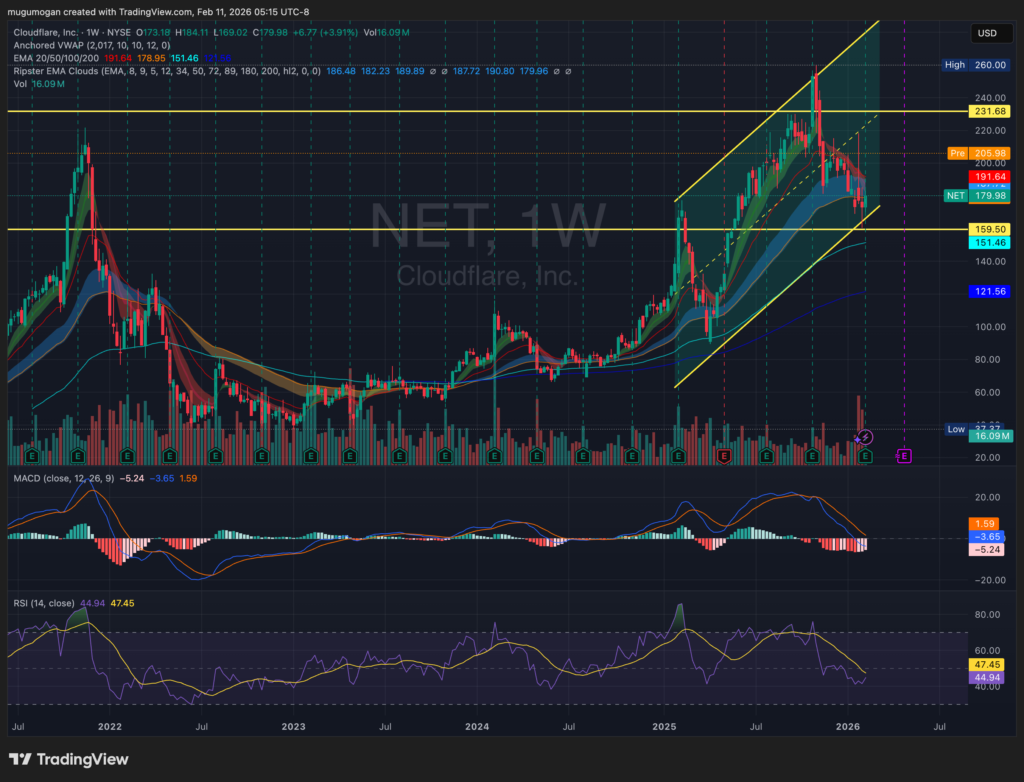
The stock is in a bullish stage 2 on the monthly and weekly charts, but the daily chart took a move lower to the $159 where it is reversing and should get to the $220 range soon where there is resistance. This is a terrific long term stock.