Company overview. The Walt Disney Company is a diversified global entertainment company spanning media networks, streaming, studios, and theme parks, built around the most valuable IP portfolio in the industry. Founded in 1923, Disney monetizes characters and franchises across film, TV, consumer products, and experiential destinations in a tightly integrated flywheel. Fiscal 2024 revenue was approximately $89.9 billion, with growth driven primarily by Parks, Experiences and Products and improving streaming economics. The company is headquartered in Burbank, California and operates in more than 40 countries. Disney’s top competitors include Netflix, Comcast, and Warner Bros. Discovery, though none match its IP depth plus parks footprint.

Recent earnings performance (most recent quarter)
Disney reported its most recent earnings in early February 2026 for fiscal Q1 2026, delivering adjusted EPS of roughly $1.25 versus analyst expectations near $1.10, a beat of about 14%. Revenue came in around $24.9 billion, modestly above consensus and up low-single digits year over year. Parks and Experiences again outperformed expectations with high-single-digit operating income growth, while Direct-to-Consumer posted another quarter of narrowing losses driven by pricing and advertising ARPU improvements. Management reiterated confidence in full-year EPS growth in the mid-teens and guided the next quarter toward continued DTC profitability improvement and steady parks demand, flagging normalization in linear TV advertising as the main near-term variable.
Founding, evolution, and core businesses
Disney was founded in 1923 by Walt Disney and Roy O. Disney as an animation studio and evolved into a vertically integrated entertainment empire. The company expanded from animation into feature films, television, and theme parks, creating a unique model where IP is continuously monetized across formats. Major acquisitions shaped the modern portfolio, including Pixar, Marvel, Lucasfilm, and 21st Century Fox assets. This acquisition strategy consolidated control over premium franchises while increasing content scale for global distribution.
Products, platforms, and IP engine
Disney’s operations are organized across three pillars: Entertainment, Sports, and Experiences. Entertainment includes studios such as Disney Animation, Pixar, Marvel, and Lucasfilm, producing theatrical and episodic content for global distribution. The Sports segment is anchored by ESPN, still one of the most valuable sports media brands despite secular cable declines. Experiences spans theme parks, resorts, cruises, and consumer products, delivering the highest margins and most durable cash flows in the portfolio.
Headquarters and operating footprint
Headquartered in Burbank, California, Disney maintains major production hubs in Los Angeles, Orlando, and London, with theme park operations across North America, Europe, and Asia. Walt Disney World in Florida remains the largest revenue contributor within Experiences, while Disneyland Paris and Shanghai Disney provide international growth leverage. The geographic diversification of parks has reduced dependence on any single consumer market. International revenue accounts for roughly one-third of total company sales.
Market landscape and industry position
Disney operates at the intersection of global media, streaming, and experiential entertainment, markets collectively exceeding $2 trillion in annual spend. The global theme park and attractions market alone is expected to grow at a 6–7% CAGR through 2030, driven by rising middle-class travel in Asia. Global streaming video remains competitive but continues expanding, with industry revenue projected to surpass $300 billion by 2030 at a high-single-digit CAGR. Disney’s hybrid model positions it better than pure-play streamers to absorb content cost inflation.
Competitive dynamics
In streaming, Disney competes most directly with Netflix and Amazon Prime Video, both of which emphasize scale and technology over IP ownership breadth. In traditional media, Comcast and Warner Bros. Discovery remain key peers, though both lack Disney’s parks-driven cash engine. In experiences, Universal Parks is the closest competitor, but Disney maintains higher per-capita guest spend and pricing power. The competitive advantage lies less in content volume and more in franchise longevity and cross-platform monetization.
Differentiation and moat
Disney’s unique differentiation is the ability to amortize IP investment across films, series, merchandise, games, and physical destinations over decades. A single franchise can generate box office revenue, subscription retention, park attendance, and merchandise sales simultaneously. This reduces reliance on any single distribution channel and lowers long-term IP risk. No competitor matches this closed-loop monetization model at global scale.
Management team overview
The company is led by Bob Iger, whose return stabilized strategy around profitability, IP discipline, and capital allocation. Hugh Johnston serves as Chief Financial Officer, focusing on balance-sheet strength and disciplined capex. Dana Walden, as Co-Chair of Disney Entertainment, oversees content strategy and studio execution across platforms. The leadership emphasis has shifted decisively from growth-at-any-cost to returns-focused execution.
Financial performance: revenue trends
Over the past five years, Disney’s revenue grew from pandemic-impacted lows near $65 billion in 2020 to nearly $90 billion in 2024, representing a CAGR of roughly 8%. Experiences revenue rebounded fastest post-COVID and now exceeds pre-pandemic levels by a wide margin. Studio revenue has been volatile due to box office normalization, but franchise releases continue to drive spikes. Linear TV revenue has declined gradually, partially offset by price increases and cost rationalization.
Financial performance: earnings and margins
Operating income collapsed during the pandemic but has steadily recovered, with fiscal 2024 operating income exceeding $15 billion. Earnings growth has been driven primarily by margin expansion in Parks and improving losses in Direct-to-Consumer. Streaming losses peaked in 2022 and have since narrowed materially, with management targeting sustained DTC profitability. Overall earnings CAGR over the last five years is distorted by COVID, but normalized earnings momentum is clearly positive.
Balance sheet and capital allocation
Disney maintains a strong balance sheet with net debt reduced to the low-$40-billion range after aggressive deleveraging post-Fox acquisition. Free cash flow has inflected sharply upward, enabling both debt reduction and selective shareholder returns. Capital expenditure remains elevated, primarily for park expansions and cruise ships, but returns on invested capital in Experiences remain well above the company average. Management has signaled resumed share repurchases once leverage targets are fully met.
Bull case for the stock
The bull case rests on sustained parks pricing power, a structurally profitable streaming business, and renewed franchise discipline in studios. If Experiences continues high-single-digit growth and DTC margins converge toward peers, earnings power could exceed prior cycle peaks. Multiple expansion would follow as cash flow visibility improves.
Bear case for the stock
The bear case centers on persistent linear TV decline accelerating faster than expected, content cost inflation returning, or consumer demand softening for premium park pricing. Streaming competition could cap margin expansion if churn rises or ad pricing weakens. Political and regulatory risks around ESPN sports rights also remain a long-term overhang.
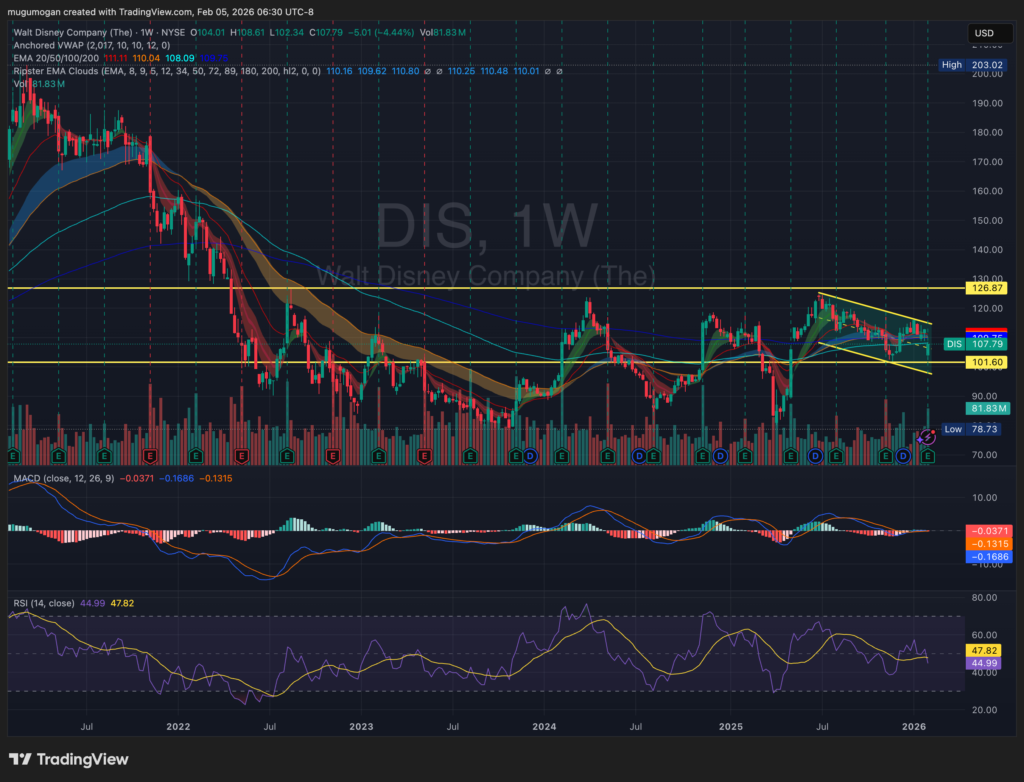
The stock is consolidating stage 3 on the monthly and weekly charts, but is on a stage 4 decline with support int he $94 – $101 range. We are not buyers yet