SanDisk is a leading developer and manufacturer of NAND flash memory solutions serving data center, enterprise, client, and consumer storage markets. The company traces its roots to 1988 and re-emerged as a standalone public company in 2025 following its separation from Western Digital’s flash business. SanDisk’s portfolio spans high-performance SSDs, embedded flash, removable storage, and custom NAND solutions optimized for AI workloads and hyperscale data centers. In fiscal 2025, the company generated approximately $10 billion in revenue, rebounding sharply from the cyclical downturn that hit memory markets in 2023. SanDisk is headquartered in Milpitas, California, and competes primarily with Samsung Electronics, SK hynix, and Micron Technology.
Most Recent Earnings Summary
SanDisk reported fiscal second-quarter 2026 earnings last week, delivering one of the strongest quarters in the memory sector this cycle. The company posted adjusted earnings per share of approximately $6.20, far ahead of consensus expectations that had been closer to the mid-$3 range, representing year-over-year growth of well over 300 percent. Quarterly revenue reached roughly $3.0 billion, up about 60 percent year over year and comfortably ahead of analyst estimates, driven by pricing recovery and stronger bit shipments. Management cited tight industry supply, disciplined capex, and accelerating AI-related demand as the core drivers of the upside. Gross margins expanded into the low-50 percent range, reflecting favorable pricing and mix. For the upcoming quarter, SanDisk guided revenue to approximately $4.4–$4.8 billion and EPS in the $12–$14 range, implying another sharp sequential step-up and well above prior Street models.
Founding, History, and Evolution
SanDisk was founded in 1988 by Eli Harari, Sanjay Mehrotra, and Jack Yuan, pioneers of flash memory technology who helped commercialize NAND flash for mass-market storage. The company became synonymous with removable flash storage in the 1990s and 2000s, building a globally recognized consumer brand while also expanding into enterprise and embedded markets. Over time, SanDisk invested heavily in joint-venture manufacturing and controller technology to vertically integrate its supply chain. In 2016, the company was acquired by Western Digital, combining HDD and flash capabilities under one roof. The 2025 spin-off returned SanDisk to independence, allowing management to focus exclusively on flash memory economics, capital discipline, and AI-driven storage demand.
Products and Solutions
SanDisk’s product lineup spans enterprise SSDs for hyperscale data centers, client SSDs for PCs and workstations, embedded flash for mobile and automotive applications, and consumer products such as portable SSDs and removable cards. In enterprise markets, the company focuses on high-capacity, high-endurance NAND optimized for AI training, inference, and cloud workloads. Client and consumer segments benefit from brand strength and scale, while embedded solutions provide longer-cycle, design-win-driven revenue streams. Across categories, SanDisk emphasizes controller firmware, endurance, and power efficiency as key differentiators.
Competitive Landscape and Headquarters
SanDisk operates in a highly concentrated global NAND market dominated by a small number of large players with massive capital requirements. Its primary competitors include Samsung Electronics, SK hynix (including Solidigm), and Micron Technology, all of whom compete on process technology, cost per bit, and scale. SanDisk’s headquarters are located in Milpitas, California, with manufacturing partnerships and operations across Asia. As a pure-play flash company post-spin, SanDisk’s strategy centers on supply discipline and return on invested capital rather than share-at-all-costs expansion.
Market Overview and Industry Dynamics
SanDisk operates in the global NAND flash memory market, which is highly cyclical but structurally growing due to data creation, cloud computing, and AI workloads. After a severe downturn in 2023 caused by oversupply and weak end demand, the industry entered a strong recovery phase in 2024 and accelerated further in 2025 and 2026. AI training clusters, high-performance storage, and enterprise SSD adoption are materially increasing bits per system. Industry analysts expect the NAND market to reach roughly $100–$120 billion in annual revenue by 2030, up from around $60 billion at the trough, implying a high-single-digit to low-double-digit CAGR.
Growth Outlook Through 2030
Looking ahead to 2030, NAND demand growth is expected to be driven less by consumer devices and more by enterprise and data-center use cases tied to AI and analytics. Bit demand is projected to grow in the mid-teens annually, while pricing will remain cyclical but structurally supported by higher-value products. Capital discipline among suppliers has improved compared to prior cycles, reducing the risk of prolonged oversupply. For SanDisk, this environment supports sustained revenue growth, margin expansion during upcycles, and stronger free cash flow generation.
Competitor Overview
Samsung Electronics remains the market leader in NAND, leveraging unmatched scale, manufacturing leadership, and internal consumption. SK hynix, particularly after integrating Solidigm, is strong in enterprise SSDs and data-center relationships. Micron Technology competes aggressively on technology transitions and cost efficiency, with a growing footprint in high-value enterprise flash. Compared to these peers, SanDisk positions itself as a focused, pure-play NAND provider with a balanced mix across enterprise, client, and consumer markets.
Unique Differentiation
SanDisk’s key differentiation lies in its singular focus on flash memory economics post-spin, allowing tighter capex discipline and faster strategic decision-making. The company benefits from a strong consumer brand, deep enterprise relationships, and vertically integrated controller and firmware capabilities. Management’s emphasis on supply discipline and return-driven growth contrasts with historical boom-and-bust behavior in the memory industry. This positioning has amplified earnings leverage in the current upcycle, as seen in the most recent quarter.
Management Team Overview
SanDisk is led by an experienced executive team with deep roots in the memory industry. The chief executive officer brings decades of experience across flash manufacturing, product strategy, and capital allocation. The chief financial officer has emphasized balance-sheet strength, free cash flow, and shareholder returns as core priorities post-spin. Together, the leadership team is focused on maintaining supply discipline while investing selectively in technology transitions that support long-term competitiveness.
Financial Performance Over the Last Five Years
Over the past five years, SanDisk’s financial performance has mirrored the broader NAND cycle, with revenues peaking during strong demand periods and contracting sharply during downturns. From 2021 to 2023, revenue declined materially as oversupply and pricing pressure weighed on results. Beginning in 2024, revenue rebounded strongly, accelerating into 2025 as pricing recovered and demand improved. The five-year revenue CAGR is modest due to cyclicality, but normalized mid-cycle revenues are now materially higher than prior peaks.
Earnings and Balance Sheet Trends
Earnings volatility has been extreme, with losses or minimal profits during the downturn giving way to outsized profitability in the current upcycle. The most recent quarter underscores this operating leverage, with EPS rising several hundred percent year over year. SanDisk’s balance sheet has improved post-spin, with manageable leverage, ample liquidity, and improving free cash flow. Capital expenditures remain disciplined relative to prior cycles, supporting stronger returns on capital.
Bull Case for the Stock
The bull case rests on sustained AI-driven demand for high-performance NAND, continued industry supply discipline, and SanDisk’s operating leverage as a pure-play flash company. Strong pricing and mix could drive earnings well above mid-cycle expectations. Improved capital returns post-spin further enhance equity value.
Bear Case for the Stock
The bear case centers on the inherent cyclicality of memory markets, where rapid capacity additions could again pressure pricing. A slowdown in AI infrastructure spending or macro-driven demand weakness would quickly compress margins. Competitive technology missteps could also erode SanDisk’s cost position versus larger rivals.
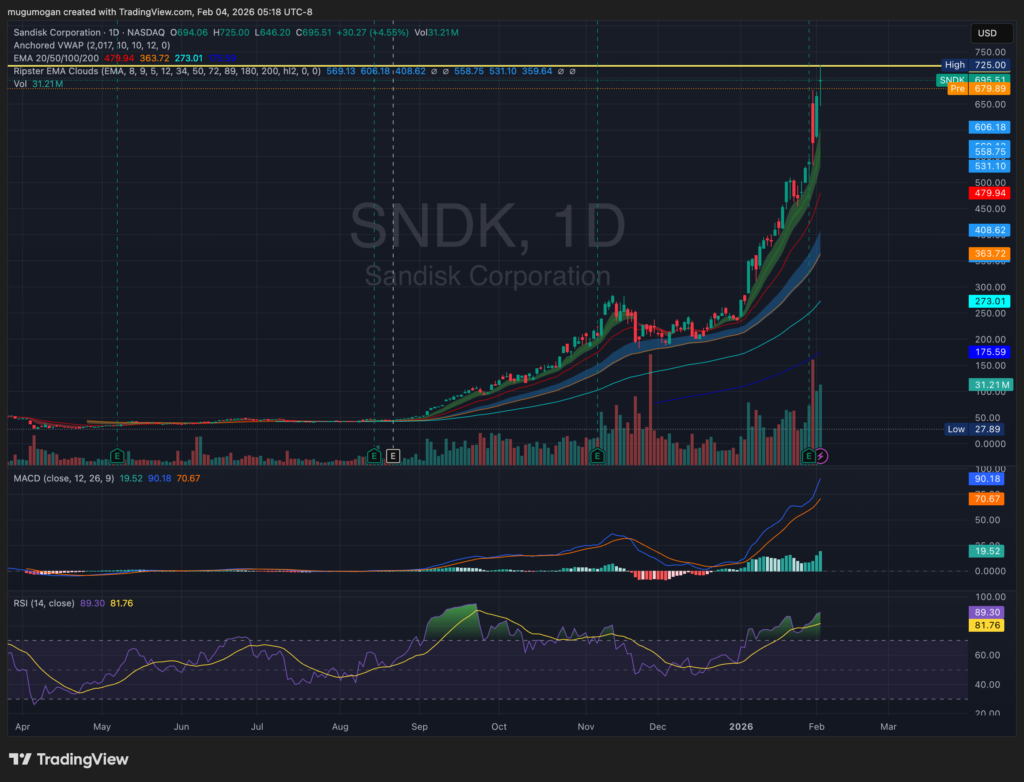
The stock is in a stage 2 markup, bullish on all 3 time frames with resistance in the near term at $723, but given the run up it should move lower to the $650s for a reversal.