United Parcel Service is one of the world’s largest logistics and parcel-delivery companies, operating an integrated global network spanning ground, air, and supply-chain services. Founded in 1907 and headquartered in Atlanta, UPS serves customers in more than 200 countries with a particular strength in U.S. domestic parcel delivery and time-definite international shipping. In 2025, UPS generated roughly $90 billion in annual revenue, making it one of the largest transportation companies globally. The company competes primarily with FedEx, DHL (Deutsche Post), and regional carriers while also facing insourcing pressure from large e-commerce players. UPS’s strategy has shifted toward “better, not bigger,” prioritizing higher-margin shipments over pure volume growth.
Most Recent Earnings — Q4 2025 Results (Reported January 27, 2026)
UPS reported fourth-quarter 2025 revenue of approximately $24.5 billion, exceeding Wall Street expectations despite a modest year-over-year decline driven by lower average daily volume. Adjusted EPS came in at about $2.38, materially ahead of consensus estimates near $2.20, reflecting disciplined cost control and favorable pricing. Operating profit was supported by improved revenue per piece and productivity initiatives, partially offsetting softer demand in discretionary e-commerce. Management guided to continued margin improvement in 2026, emphasizing network efficiency and yield management rather than chasing volume. The earnings beat, combined with constructive guidance, was received positively by the market.
Founding, History, and Evolution
UPS was founded in 1907 by James E. Casey in Seattle as a messenger company and gradually evolved into a national parcel-delivery network. The company expanded aggressively through the 20th century, building a proprietary ground network and later a global air fleet to support time-definite delivery. UPS went public in 1999, one of the largest IPOs of its era, and used its scale to expand internationally and into logistics services. Over time, the company diversified into freight forwarding, healthcare logistics, and supply-chain management. Today, UPS’s scale and integrated network remain its core competitive assets.
Products, Services, and Business Segments
UPS operates through three primary segments: U.S. Domestic Package, International Package, and Supply Chain Solutions. The U.S. Domestic segment is the largest, focused on ground and air delivery within the United States for both residential and commercial customers. International Package includes cross-border and intra-country delivery, where UPS benefits from global trade flows and premium time-definite services. Supply Chain Solutions offers freight forwarding, logistics, and specialized services such as healthcare logistics, providing diversification beyond pure parcel delivery. Together, these segments allow UPS to serve customers end-to-end across shipping and logistics needs.
Competitive Landscape and Key Rivals
UPS’s most direct global competitor is FedEx, which operates a similar integrated air and ground network but with a different cost and network structure. DHL, part of Deutsche Post, dominates international express shipments, particularly outside the U.S., and competes aggressively on cross-border logistics. Regional carriers and last-mile specialists exert pressure in specific geographies, while Amazon’s growing in-house logistics capability represents a structural headwind for residential volume. Despite this competition, UPS’s scale, reliability, and enterprise relationships provide a durable moat.
Market Dynamics and Industry Growth
The global parcel and logistics market is driven by e-commerce penetration, globalization of trade, and increasing demand for time-definite delivery. While growth has moderated post-pandemic, industry volumes are still expected to expand steadily through 2030, supported by cross-border trade and B2B logistics. Industry estimates suggest a mid-single-digit CAGR for global parcel delivery over the remainder of the decade. Profitability, however, will depend on pricing discipline and automation rather than raw volume growth.
Differentiation and Strategic Positioning
UPS’s differentiation lies in its integrated network, operational reliability, and pricing discipline. Unlike peers that have chased volume aggressively, UPS has explicitly prioritized higher-margin shipments and contract rationalization. The company’s investments in automation, route optimization, and network efficiency are designed to structurally improve margins. UPS also benefits from deep enterprise relationships and a strong presence in healthcare logistics, a higher-value vertical with long-term growth potential. This focus positions UPS as a yield-driven operator rather than a volume-at-any-cost carrier.
Management Team Overview
Carol Tomé serves as Chief Executive Officer and has emphasized return on invested capital, margin expansion, and shareholder returns since taking the role. Brian Newman, Chief Financial Officer, oversees capital allocation, cost discipline, and balance-sheet management. Together, the leadership team has steered UPS through post-pandemic normalization with a clear focus on profitability over scale. Management credibility has improved as execution has aligned with stated strategy.
Financial Performance — Revenue and Earnings Trends
Over the past five years, UPS has delivered solid revenue growth, benefiting from pandemic-era e-commerce tailwinds followed by normalization. Revenue peaked during the pandemic surge and has since stabilized at a lower but more profitable level. Earnings growth has outpaced revenue growth as management focused on pricing, mix, and cost efficiency. The company’s long-term revenue CAGR over the past five years remains positive, while earnings CAGR reflects meaningful margin expansion. This shift underscores the strategic pivot toward profitability.
Financial Performance — Margins and Cash Flow
Operating margins have improved as UPS reduced exposure to low-margin volume and optimized its network. Free cash flow generation remains strong, supporting dividends and share repurchases. Capital expenditures have been disciplined, focused on automation and fleet modernization rather than capacity expansion. The balance sheet remains investment-grade, with manageable leverage and ample liquidity. Overall financial health supports continued shareholder returns.
Financial Performance — Balance Sheet and Capital Allocation
UPS maintains a strong balance sheet with significant cash generation and prudent debt levels. The company continues to prioritize dividends, recently reaffirming its quarterly payout, reflecting confidence in cash flow durability. Share repurchases remain opportunistic, balancing returns with investment needs. Pension obligations are monitored closely but remain manageable. Capital allocation discipline is a key pillar of the current strategy.
Bull Case for the Stock
The bull case for UPS centers on sustained margin expansion driven by pricing discipline and automation. A recovery in global trade and B2B shipping could provide incremental volume upside without sacrificing profitability. Continued strong free cash flow supports an attractive dividend and shareholder returns.
Bear Case for the Stock
The bear case includes prolonged volume weakness in U.S. domestic parcels, particularly from e-commerce. Competitive pressure from Amazon and regional carriers could cap pricing power over time. Labor costs and contract negotiations remain a structural risk to margins.
Analyst Reactions and Market Response
Following the Q4 2025 earnings release, analysts highlighted the EPS beat and constructive 2026 guidance, with several firms reiterating or modestly increasing price targets. Commentary focused on the credibility of management’s “better, not bigger” strategy and improving margin profile. No major downgrades were reported immediately after the release, reflecting general confidence in execution. The stock traded higher in early reaction, signaling market approval of the results and outlook.
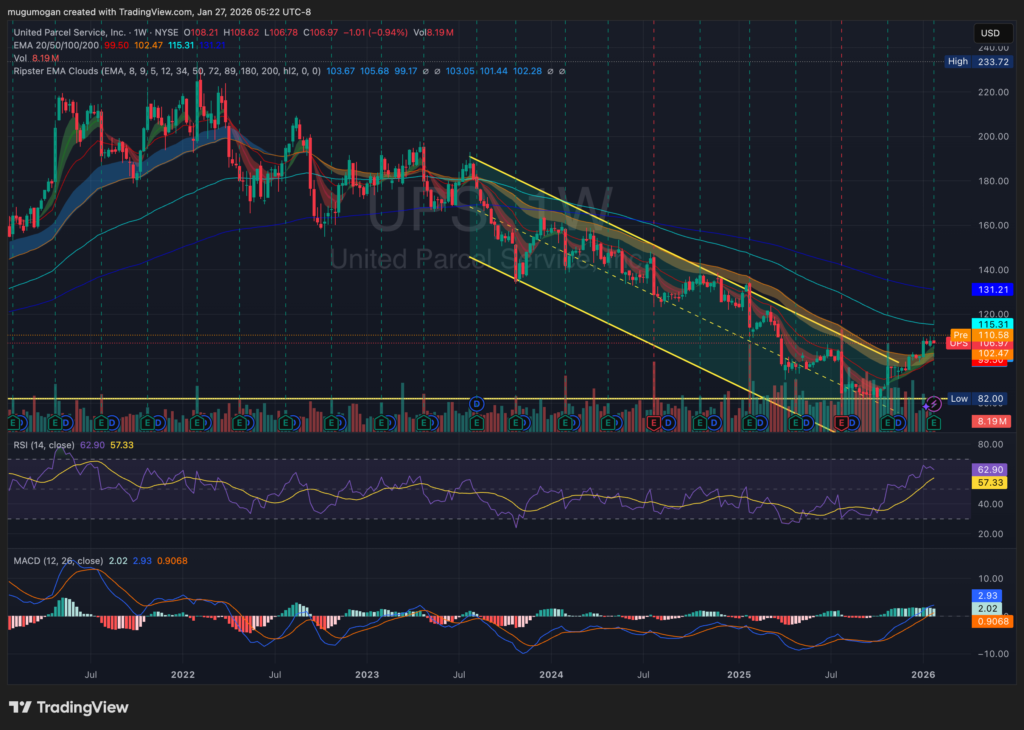
The stock is in a stage 4 bearish markdown on the monthly chart, but reversing stage 1 on the weekly and daily chart, and should get to the $123 range where it might consolidate and reverse again.