Company Overview
Charles Schwab is one of the largest U.S. brokerage and wealth-management firms, operating across retail brokerage, advisory services, asset management, and banking. Founded in 1971 and headquartered in Westlake, Texas, Schwab serves over 35 million active brokerage accounts with more than $8.5 trillion in client assets. The company earns revenue primarily from net interest income on client cash, asset-based fees, and trading and advisory services. Schwab’s scale gives it significant operating leverage, but also makes earnings highly sensitive to interest-rate movements. Its primary competitors include Fidelity, Vanguard, Morgan Stanley Wealth Management, and Bank of America Merrill.
Most Recent Earnings (This Week)
Charles Schwab reported earnings this week for Q4 FY2025, delivering results that beat expectations on profitability but showed slower revenue momentum. The company reported EPS of approximately $0.70, ahead of analyst expectations of around $0.66. Revenue came in near $4.6 billion, modestly above consensus but down slightly year-over-year due to pressure on net interest income. Net interest revenue declined year-over-year as rate cuts and higher funding costs compressed spreads, though management noted stabilization sequentially. Schwab guided to modest revenue growth in 2026, driven by asset inflows, fee growth, and expense discipline, while net interest income is expected to recover gradually as balance-sheet repricing progresses.
Founding, History, and Business Model
Charles Schwab was founded in 1971 by Charles R. Schwab with the goal of democratizing investing through low-cost brokerage services. The firm disrupted traditional commission-based brokerage models by emphasizing transparency, scale, and client trust. Over decades, Schwab expanded into registered investment advisor (RIA) custody, retirement services, asset management, and banking. A defining moment was the TD Ameritrade acquisition, which materially expanded Schwab’s retail footprint and asset base.
Schwab’s product portfolio includes retail brokerage accounts, managed portfolios, ETFs, mutual funds, retirement plans, and banking products such as sweep deposits and margin lending. The firm monetizes client cash through interest spreads, making interest rates a critical earnings lever. Unlike pure asset managers, Schwab combines brokerage, advisory, and banking economics under one roof.
Key competitors include Fidelity (private, diversified), Vanguard (mutual structure with lower margins), and large bank-affiliated wealth managers such as Morgan Stanley and Bank of America. Schwab’s headquarters relocation to Texas underscores its focus on cost discipline and long-term scalability.
Market Opportunity and Industry Outlook
Schwab operates in the U.S. wealth management and brokerage market, a sector benefiting from long-term growth in household wealth, retirement savings, and passive investing adoption. By 2030, the U.S. wealth-management market is expected to exceed $70 trillion in managed assets, growing at a 6–7% CAGR. Structural tailwinds include aging demographics, increasing participation in capital markets, and continued shift from commission-based to fee-based advisory models.
However, industry profitability is becoming more sensitive to interest-rate cycles and client cash behavior. Zero-commission trading commoditized execution, shifting competition toward trust, scale, and balance-sheet efficiency. Schwab’s size positions it well for consolidation benefits, but also amplifies rate-driven volatility.
Competitive Landscape
Schwab competes primarily with Fidelity and Vanguard in retail brokerage and asset custody, and with Morgan Stanley and Bank of America in full-service wealth management. Fidelity matches Schwab in technology and scale but lacks public-market transparency. Vanguard competes aggressively on fees but does not operate a comparable banking model. Bank-affiliated competitors benefit from lending cross-sell but often lack Schwab’s custody dominance in the RIA channel.
Schwab’s competitive edge lies in its combination of low-cost brokerage, massive client cash balances, and trusted brand. The trade-off is higher earnings sensitivity to rate compression compared with fee-only peers.
Unique Differentiation
Schwab’s key differentiation is its balance-sheet-driven brokerage model at massive scale. Client cash sweeps generate net interest income that materially boosts returns in rising-rate environments. The firm also dominates the RIA custody market, embedding Schwab deeply into advisor workflows. Few competitors combine brokerage, custody, asset management, and banking as seamlessly. This integration creates durable switching costs but introduces macro sensitivity.
Management Team Overview
CEO Walt Bettinger has led Schwab since 2008 and is widely credited with scaling the firm through multiple market cycles. CFO Peter Crawford has focused on balance-sheet resilience, liquidity, and expense discipline, particularly after rate volatility in 2023–2024. Founder Charles R. Schwab remains Chairman, providing continuity, brand credibility, and long-term strategic influence.
Financial Performance (Last Five Years)
Over the past five years, Schwab delivered strong revenue growth driven by asset inflows and rising interest rates, with revenues compounding at high single-digit rates through 2022. Earnings growth accelerated sharply during the rate-hike cycle as net interest income expanded. However, 2024–2025 marked a reversal, with earnings declining due to funding cost pressures and client cash sorting into higher-yield alternatives.
Despite near-term margin pressure, Schwab maintains a strong balance sheet with ample liquidity, conservative capital ratios, and improving funding mix. Expense growth has moderated, and management has emphasized operational efficiency as revenue growth normalizes. Long-term earnings power remains intact, but the path is rate-dependent.
Bull Case
• Net interest income rebounds meaningfully as balance-sheet repricing catches up to lower funding costs.
• Continued asset inflows from retail investors and RIAs drive fee growth regardless of rate environment.
• Expense discipline and scale restore operating leverage by 2026.
Bear Case
• Prolonged low-rate environment keeps net interest margins structurally compressed.
• Client cash continues migrating to money-market funds, reducing balance-sheet profitability.
• Competitive fee pressure limits upside even as markets recover.
Analyst Reaction
Post-earnings, analysts largely maintained neutral to positive stances. Several firms raised price targets modestly, citing stabilization in net interest income trends and strong client asset growth. No major downgrades were reported, but analysts emphasized that upside is contingent on rate normalization rather than multiple expansion.
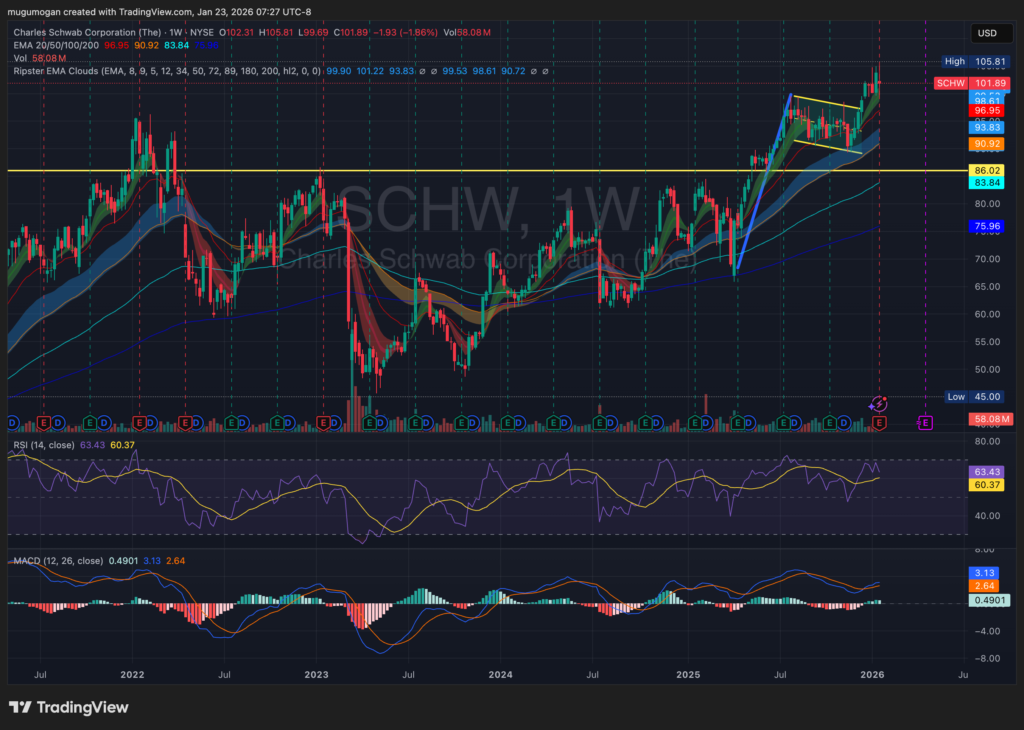
The stock is in a bullish stage 2 markup on the monthly chart, with a strong bull flag playing out as well. The weekly chart and daily are showing consolidation stage 3 and should move lower to reverse in the $96 – $100 range. But the stock will perform well into 2026.