U.S. Bancorp is a large American financial services holding company headquartered in Minneapolis, Minnesota, operating under the trade name U.S. Bank. It ranks as the fifth-largest commercial bank in the United States by asset size, offering retail and commercial banking, wealth management, payment services, and investment products across thousands of branches and ATMs nationwide. The company also owns subsidiaries such as Elavon and Talech, expanding its digital transaction and payments capabilities. In 2024, the firm reported over ~$678 billion in assets and more than 70,000 employees. Leadership under CEO Gunjan Kedia is prioritizing fee diversification, balance-sheet optimization, and strategic acquisitions like the planned BTIG deal. U.S. Bancorp’s diversified revenue model balances interest income with strong non-interest income streams like fees and services.
2) Most Recent Earnings — Q4 2025 (Reported Jan 20, 2026)
For the quarter ended December 31, 2025, U.S. Bancorp delivered solid results:
- EPS: $1.26 (adjusted), up ~18% YoY and above the consensus ~$1.19.
- Revenue: ~$7.36 billion, a ~5.1% YoY increase on record net revenue.
- Net Income: ~$2.045 billion, a ~23% YoY rise.
- Drivers: Growth in net interest income (+3-4% guidance), fee income (+7.6% in the quarter) and record consumer deposits.
Analysts reacted positively with forecast upgrades and price targets nudged higher, driven by the earnings beat. Guidance for 2026 projects 4-6% revenue growth, with net interest income and fee revenue expected to expand modestly — though some market commentary suggests guidance was “in line” rather than aggressive.
3) Company Origins, Founders & Evolution
Background & Formation:
U.S. Bancorp traces its roots to the First National Bank of Cincinnati established in 1863, making it among the oldest banking institution lineages in the U.S. over time through mergers and acquisitions. It was restructured into U.S. Bancorp and has grown into a diversified financial group.
Founders & Early History:
It did not begin with a well-known individual founder like some banks; instead, it evolved via consolidation of chartered national banks in the 19th and 20th centuries under regulatory frameworks.
Products & Services:
U.S. Bancorp provides broad financial services: consumer and business banking, payment solutions, credit products, investment and wealth management, mortgage lending, and institutional services. Its payments and fee income segments have become strategic growth pillars.
Headquarters & Footprint:
Headquartered in Minneapolis, Minnesota, with thousands of branches and ATMs across the U.S., U.S. Bancorp maintains a strong national network, particularly in the Midwest and West.
Key Competitive Landscape:
The bank’s products compete with large national and regional banks in both interest-bearing products (loans, deposits) and fee-oriented services (advisory, cards).
4) Market Overview & Growth Dynamics
Industry & Position:
U.S. Bancorp operates in the U.S. commercial banking sector, a mature but profitable segment of financial services. It is ranked as the fifth-largest U.S. bank by assets, trailing giants such as JPMorgan Chase, Bank of America, Citigroup, and Wells Fargo.
Market Scale & Trends:
The overall U.S. banking market is extensive — collectively generating hundreds of billions in revenue and profit each year — dominated by interest income and expanding fee services. Broader banking earnings trends are robust, with many large banks reporting record combined revenues and profits in 2025.
Growth Expectations:
Industry analysts typically forecast moderate expansion through 2030 with Continued digitization, payment services growth, and capital markets activities expected to drive fee income. Specific CAGR estimates vary by segment, but mid-single-digit revenue growth is common for diversified banks. (Note: exact 2030 CAGR figures aren’t in the recently published data available to me.)
5) Competitor Landscape
Primary Peers:
- JPMorgan Chase – largest U.S. bank with multi-segment dominance.
- Bank of America – extensive retail and wealth business.
- Wells Fargo – large retail and commercial franchise.
- Citigroup – global reach across consumer and institutional markets.
Regional Competition:
Mid-sized banks such as PNC and Fifth Third are also vying for market share, particularly in commercial loans and deposit growth.
6) Differentiation vs. Competitors
U.S. Bancorp differentiates by:
- Balanced revenue mix: fee income and interest income both contribute meaningfully.
- Strong deposit base: deep retail deposits improve net interest margin stability.
- Scale + agility: big enough to invest in tech and strategic acquisitions (e.g., BTIG) yet focused on cost discipline.
- Asset quality: comparatively low non-performing assets and disciplined credit controls.
7) Management Overview (Top Leaders)
Gunjan Kedia – CEO:
CEO since April 2025 and a seasoned executive with ~30 years in financial services, Kedia leads strategy, operations, and growth initiatives. She took over from longtime leader Andrew Cecere, emphasizing payments, productivity and acquisitions.
John Stern – CFO (Vice Chair & CFO):
Oversees financial strategy, capital allocation, and reporting. CFO plays a key role in guiding investor expectations and margin management (typical for banking CFO roles; specific bio details not publicly summarized in today’s data).
(If you want more detailed bios on Stern or other executives like heads of consumer/wealth divisions, I can compile them.)
8) Financial Performance (Last 5 Years)
Revenue Trends:
U.S. Bancorp’s revenues have grown modestly over the past few years (~4-5% annualized), with fee growth punctuating interest income strength.
Earnings Growth:
Annual net income has shown positive trends — growing from mid-single digits historically to double-digit increases in recent quarters, including a ~23% jump in Q4 2025.
Profitability:
Efficiency ratios have improved, and returns on tangible equity remain strong (~18% in Q4).
Balance Sheet:
Total assets near $670–680 billion, solid CET1 capital ratios (~10-11%), strong deposit base, and low non-performing assets underpin stability.
9) Bull Case
- Diversified revenue mix with rising fee businesses.
- Strong deposit and capital base supporting lending growth and margins.
- Strategic expansion through acquisitions like BTIG.
10) Bear Case
- Mid-tier scale risk: Smaller than mega banks; may lag in investment banking.
- Regulatory & rate uncertainty could pressure net interest income.
- Market valuation may already reflect the turnaround.
11) Recent Analyst Reactions
- RBC Capital lifted price target to $59 following Q4 results.
- Multiple sell-side forecasts have been revised upward post-earnings, reflecting EPS and revenue beats.
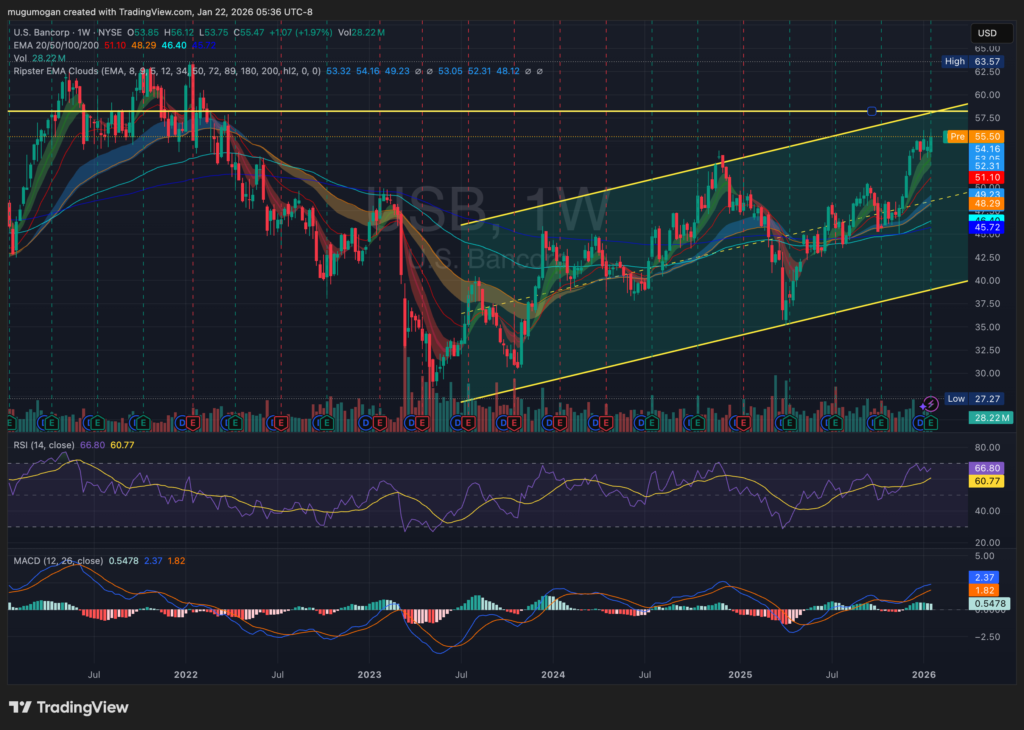
The stock is in a stage 2 markup bullish on the monthly and weekly charts. The daily chart is bullish and should get to the $60 range post earnings, but there is a lot of resistance at that level. Not a long term holding for us.