Company Overview — America’s Volume Homebuilder
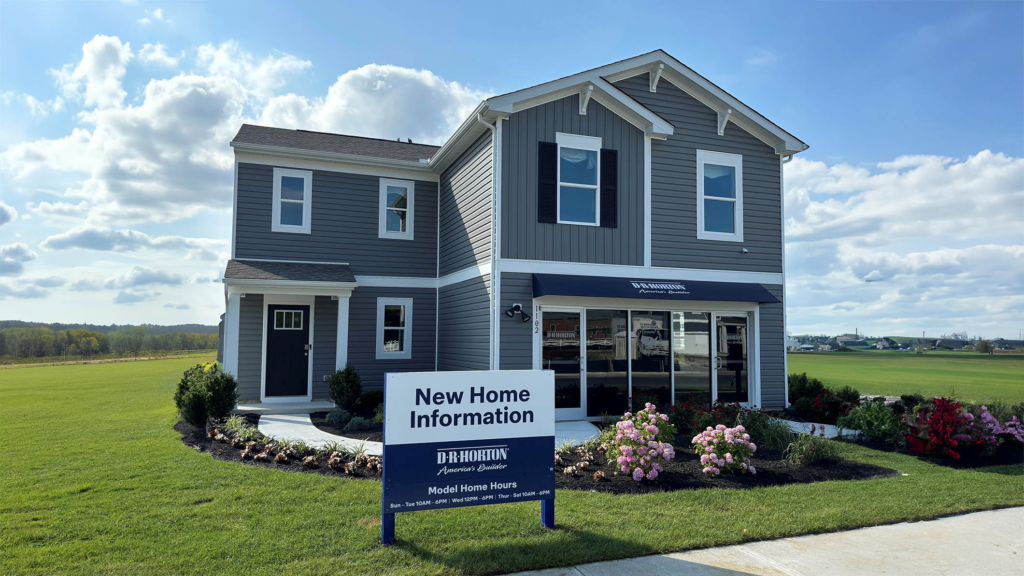
D.R. Horton is the largest homebuilder in the United States by volume, focused primarily on affordable single-family homes across entry-level, move-up, and active-adult segments. Founded in 1978, the company operates in more than 100 markets across 33 states and targets first-time and price-sensitive buyers, making it highly exposed to mortgage-rate cycles. In fiscal 2025, D.R. Horton generated approximately $36–37 billion in revenue, though growth has moderated amid affordability pressures. The company’s scale, land discipline, and standardized construction model allow it to remain profitable even in down housing cycles. Key competitors include $LEN Lennar, PulteGroup, and NVR.
Most Recent Earnings — Q1 FY2026 (Reported January 20, 2026)
D.R. Horton reported fiscal Q1 2026 results for the quarter ended December 31, 2025, delivering EPS of $2.03 on revenue of approximately $6.9 billion. EPS exceeded analyst expectations of roughly $1.93–$1.95, a 4–5% beat, while revenue also came in ahead of consensus by ~3%. Despite the beat, results declined year over year, with EPS down ~22% from $2.61 and revenue down ~9–10% versus the prior-year quarter. Net income totaled $594.8 million, down roughly 30% YoY. Management reaffirmed full-year FY2026 guidance of $33.5–$35.0 billion in revenue and 86,000–88,000 homes closed, signaling confidence in volume despite margin pressure from incentives.
Founding and Early History
D.R. Horton was founded in 1978 by Donald R. Horton in Fort Worth, Texas, with a strategy centered on building affordable homes at scale rather than chasing luxury margins. The company went public in 1992, using capital markets to aggressively expand land holdings during housing downturns. Its philosophy has consistently emphasized volume, standardized designs, and disciplined land acquisition rather than speculative pricing. This approach allowed D.R. Horton to survive the 2008 housing collapse better than many peers. Over decades, it has evolved into the dominant U.S. homebuilder by unit count.
Business Model and Product Segments
The company operates across several brands, including D.R. Horton, Express Homes (entry-level), Emerald Homes(luxury), and Freedom Homes (active adult). The Express Homes segment is particularly important, as it targets first-time buyers with lower square footage and price points. In addition to homebuilding, D.R. Horton operates a mortgage origination arm, title services, and lot development operations, providing vertical integration. Mortgage incentives are increasingly used to offset affordability constraints from elevated interest rates. This integrated model supports sales velocity but can compress margins in tighter markets.
Geographic Footprint and Operations
D.R. Horton has one of the broadest geographic footprints among U.S. builders, with heavy exposure to Texas, Florida, the Southeast, and the Southwest. These regions benefit from population inflows, lower taxes, and relatively favorable housing supply dynamics. Texas alone accounts for a significant share of total closings, making the company sensitive to Sunbelt economic conditions. Geographic diversification helps smooth local downturns, but national mortgage-rate shocks still affect overall demand. The company deliberately avoids overconcentration in coastal, regulation-heavy markets.
Market Overview — U.S. Residential Housing
D.R. Horton operates within the U.S. single-family residential housing market, which is structurally undersupplied by an estimated 3–4 million homes. Long-term demand drivers include household formation, immigration, and aging housing stock. However, near-term conditions are constrained by mortgage rates near 6.5–7%, which materially impact first-time buyers. By 2030, the U.S. homebuilding market is expected to grow at a low-to-mid single-digit CAGR, driven more by volume normalization than price appreciation. Builders with scale and affordability positioning are expected to gain share.
Industry Cyclicality and Interest Rate Sensitivity
Housing is one of the most rate-sensitive sectors in the economy, and D.R. Horton is no exception. Each 100-basis-point increase in mortgage rates materially reduces buyer qualification and absorption rates. To offset this, D.R. Horton has leaned heavily on rate buy-downs and incentives, which protect volume but pressure gross margins. The company’s strategy prioritizes maintaining construction momentum rather than maximizing short-term profitability. This makes earnings more volatile but market share more durable.
Competitive Landscape
D.R. Horton’s primary competitors are Lennar, PulteGroup, and NVR. Lennar competes closely on scale and geographic breadth but tends to emphasize asset-light land strategies. PulteGroup focuses more heavily on move-up and active-adult buyers, resulting in higher average selling prices. NVR operates a highly capital-efficient, option-based land model with superior margins but lower volume. D.R. Horton differentiates itself through sheer scale and entry-level dominance.
Differentiation vs. Competitors
D.R. Horton’s core differentiation is volume leadership at the affordable end of the market. While peers optimize for margin or capital efficiency, D.R. Horton optimizes for absorption and scale. Its standardized home designs, purchasing power, and construction processes allow it to operate profitably at price points where many builders struggle. This positioning becomes especially powerful during housing downturns, when smaller builders exit the market. In short: D.R. Horton wins by outlasting everyone else.
Management Team Overview
The company is led by David V. Auld, President and CEO, who has been with D.R. Horton for over three decades and embodies its operational discipline. Bill Wheat, Executive Vice President and CFO, oversees financial strategy, land discipline, and capital allocation. The leadership team is known for conservatism, avoiding over-leverage and speculative land bets. Management credibility with investors is high due to consistent execution across multiple housing cycles.
Financial Performance — Last Five Years
Over the past five years, D.R. Horton has delivered strong revenue growth driven by post-pandemic housing demand, peaking above $36 billion in annual revenue. Revenue CAGR over this period was in the high single digits, though growth has decelerated recently. Earnings growth was more volatile, with EPS peaking during the 2021–2022 housing boom and declining as rates rose. Despite margin compression, the company has remained solidly profitable throughout the cycle. The balance sheet remains conservative, with modest leverage relative to peers.
Balance Sheet and Capital Allocation
D.R. Horton maintains a strong balance sheet with significant liquidity and controlled debt levels. The company prioritizes land investment during downturns, positioning itself for outsized gains during recoveries. Share repurchases are used opportunistically but are secondary to operational flexibility. Unlike some peers, D.R. Horton avoids aggressive financial engineering. This discipline supports long-term survivability over short-term EPS optimization.
Bull Case for the Stock
- Structural U.S. housing undersupply favors large-scale builders with affordable offerings.
- D.R. Horton’s volume-first strategy enables market-share gains in down cycles.
- Rate normalization over the next 2–3 years could sharply re-accelerate earnings.
Bear Case for the Stock
- Prolonged high mortgage rates could suppress first-time buyer demand longer than expected.
- Incentive-driven sales pressure gross margins and profitability.
- Economic slowdown or job losses would disproportionately impact entry-level buyers.
Analyst Reaction to Latest Earnings
Following Q1 FY2026 earnings, analyst reactions were mixed. Several firms reiterated Hold or Neutral ratings, citing resilient orders but ongoing margin pressure. Price targets were largely maintained, reflecting confidence in long-term positioning but caution on near-term earnings growth. No major downgrades occurred, but enthusiasm remained muted given macro uncertainty.
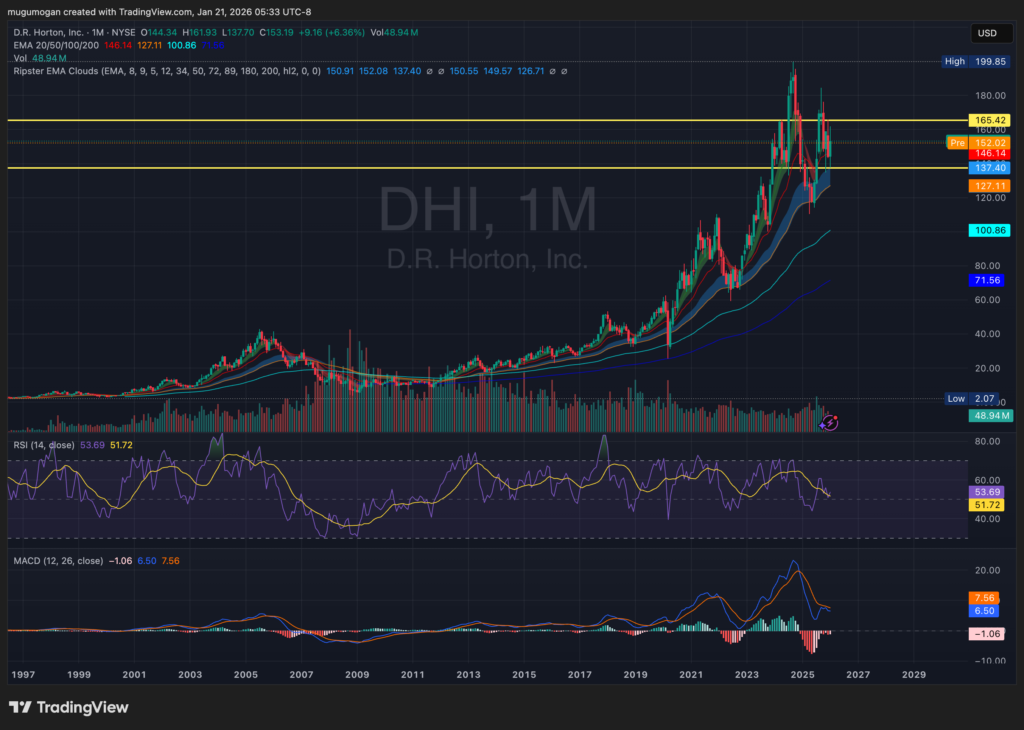
The stock is in a stage 4 bearish market markdown on all 3 time frames, and has a head and shoulders bearish pattern as well, with a likely support at $130 – $137 zone. Not a good stock to buy for 2027.