The Bank of New York Mellon Corporation (BNY Mellon) is one of the world’s oldest and largest financial institutions. It specializes in asset servicing, custody, investment management, and wealth services for institutional and individual clients across 35+ countries. BNY Mellon acts as a backbone of global capital markets, managing and safeguarding assets through the entire investment lifecycle. It serves central banks, sovereign funds, pension plans, corporations, and high-net-worth individuals. The company is headquartered in New York, New York and trades on the NYSE under the ticker BK.

BNY Mellon reported Q4 2025 results on January 13, 2026 that broadly beat expectations. Adjusted EPS was $2.08, topping the consensus of ~$1.99, while revenue grew ~7% to ~$5.18 B, slightly above Wall Street forecasts. Fee revenue and net interest income were key growth drivers, with NII up 13% year-over-year. Net income climbed roughly 26–27% year-over-year, and assets under custody and administration rose to **$59.3 T**. The bank projected a more modest ~5% revenue increase in 2026, with expenses expected up 3–4%, and raised its medium-term pretax margin target to ~38%.
Founding, History, and Business Model
Founded in 1784, BNY Mellon is the oldest bank in the United States and the first NYSE-listed company. It evolved through mergers — most notably the 2007 merger of The Bank of New York and Mellon Financial — to become a global financial services powerhouse.
Its business breaks down into two core segments:
- Investment Services — custody, asset servicing, broker/dealer services, corporate trust, and foreign exchange.
- Investment Management — wealth and asset management for institutional and retail clients.
BNY Mellon’s clients include over 90% of Fortune 100 companies, major pension plans, insurance firms, and central banks. Its revenue model relies on fee-based income from asset servicing and management, plus net interest income from lending and investment activities.
The firm has expanded globally, with operations in the Americas, EMEA, and APAC, reflecting a diversified revenue footprint.
Market Context & Growth Opportunities
BNY Mellon operates in global financial infrastructure and asset management, markets that benefit from increasing global wealth, institutional growth in passive and active investing, and demand for cross-border custody services. The asset servicing market is massive — measured in tens of trillions in assets under custody — and is expected to expand with continued institutional participation.
Macro tailwinds include:
- Rising global equity and fixed income markets, which boost fee revenue tied to asset valuations.
- A sustained need for secure, scalable financial infrastructure as institutions outsource back-office functions.
Longer-term data projects growth in global AUM and outsourcing trends through 2030, though exact CAGR figures vary by segment and are sensitive to interest rates and market volatility.
Competitors
BNY Mellon’s primary competitors include:
- State Street Corporation — another global custodian and asset servicer.
- Northern Trust — a custodian and wealth manager with strong private banking roots.
- JPMorgan Chase and Goldman Sachs — broader financials but significant asset management and services arms.
These competitors vary in scale and strategic focus, with BNY often leading in custody volumes but trailing larger universal banks in overall revenue.
Differentiation
BNY Mellon’s key advantage is its scale in custody and administration — managing custodial assets orders of magnitude larger than most peers. Its global infrastructure and regulatory compliance footprint make it a default partner for major institutional investors. Its combination of services from custody through investment management enhances client stickiness and cross-sell potential.
Management Overview
(Executives without photos)
- CEO — Leads strategy and operations across all business units.
- CFO — Oversees financial performance, capital allocation, and reporting.
- Head of Asset Servicing — Manages the largest revenue segment and client relationships.
(Exact current names change with filings; confirm from latest investor relations materials.)
Financial Performance (Last Five Years)
Over the past five years, BNY Mellon has delivered moderate but consistent growth in revenue and profitability. Revenue in 2024 was ~$18.55 B, rising to ~$20.1 B in 2025 (~8.4% growth). Net income also climbed significantly as fee and interest income expanded. Earnings performance has outpaced revenue growth, reflecting operating leverage and cost management.
Assets on the balance sheet grew to ~$455 B by late 2025, up year-over-year, driven by expanded custody operations and reinvestment of client funds.
Profit margins improved as pre-tax operating efficiency rose alongside fee diversification and higher net interest spreads in recent high-rate environments.
Bull Case
- Dominant global custody and asset servicing franchise that benefits from scale and long-duration client contracts.
- Growing fee revenue and net interest income with rising balance sheet efficiency.
- Elevated medium-term profitability targets and strong asset growth trends.
Bear Case
- Slowing revenue growth projections for 2026 could pressure sentiment if markets cool.
- Heavy reliance on macro conditions and asset valuations.
- Competitive pressure from diversified financial institutions and fintech infrastructure plays.
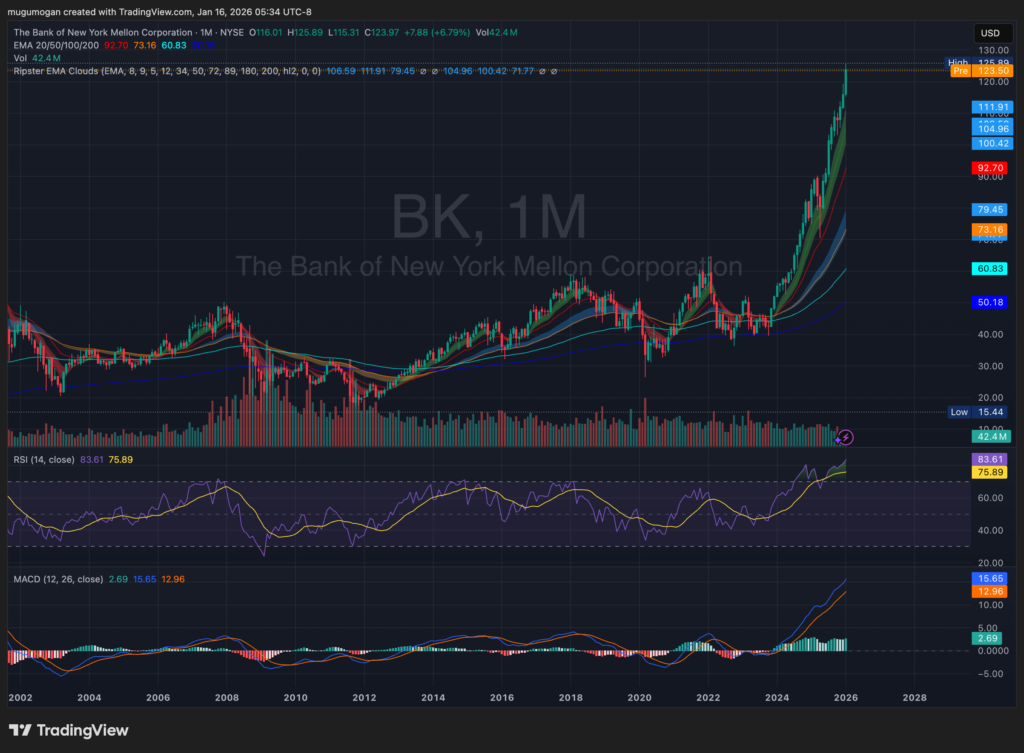
The stock is in a strong stage 2 markup (bullish) on all 3 time frames and should get to $150 soon. This is a strong and slow with steady return performer.