Accenture plc (NYSE: ACN) is a global professional services and IT consulting powerhouse that helps organizations with digital transformation, technology integration, strategy, and managed services across industries worldwide. Headquartered in Dublin, Ireland, the firm serves clients in over 120 countries with roughly 779,000 employees. It operates through core offerings like Strategy & Consulting, Technology, Operations, Accenture Song, and Industry X. Accenture consistently ranks on the Fortune Global 500 and is a key player in enterprise digital reinvention. The company’s revenue has steadily grown, underscoring its position as a go-to partner for large corporations tackling complex tech and business challenges

📊 Most Recent Earnings (Fiscal 2025)
For the fiscal year ended August 31, 2025, Accenture reported revenues of $69.7 billion, marking a 7 % increase year-over-year in both USD and local currency. Adjusted diluted EPS was $12.93, an 8 % rise compared with the prior year, while GAAP diluted EPS was $12.15. On a quarterly basis, Q4 revenues were $17.6 billion, up 7 % YoY, and adjusted EPS for the quarter was $3.03 (a 9 % increase); GAAP EPS declined due to restructuring costs. The company beat revenue expectations in the fourth quarter but reported softer margins, largely attributable to investments in talent and AI-centric services. For fiscal 2026, Accenture guided to 2 %–5 % revenue growth in local currency (approximately **3 %–6 % excluding certain impacts) and 5 %–12 % EPS growth, signaling modest growth against macro headwinds.
🧠 Company Background & Founding
Accenture was originally part of the accounting firm Arthur Andersen and formally separated as Andersen Consulting in 1989. The company rebranded as Accenture after its IPO in 2001, with the name meant to convey an “accent on the future.” Over the decades, it transformed from a traditional consulting outfit into a diversified professional services and technology integrator. Headquarters are in Dublin, Ireland, which provides tax efficiency and global reach. Its founder lineage traces back to Arthur Andersen’s consulting arm rather than a single entrepreneur, giving it deep roots in professional services history.
Accenture’s service portfolio evolved through strategic acquisitions and internal growth, adding capabilities in digital, technology, operations, and creative services (e.g., Accenture Song). Strategic subsidiaries include Avanade (joint venture with Microsoft) and others focused on specialized IT and consulting niches. The company competes with major consulting and IT services firms like Deloitte, IBM, Capgemini, Infosys, and Cognizant. Its global footprint and recurring engagements with large enterprise clients create a diversified revenue base.
🌍 Market Overview & Growth Potential
Accenture operates in the global professional services and IT consulting market, servicing digital transformation, cloud implementation, cybersecurity, AI enablement, and managed services demand. This sector benefits from enterprises modernizing operations, increasing IT budgets, and strategic investments in digital innovation. Growth drivers include AI adoption, cloud migration, cybersecurity spending, and business model reinvention initiatives.
Industry research projects mid-single-digit CAGR for the broader IT consulting market through 2030, as digitization and automation remain priorities for enterprises globally. Management consulting and tech services are expected to expand as organizations pursue resilience, sustainability, and competitive differentiation through tech. Accenture, with its scale and capabilities in AI and cloud services, is well positioned to capture this long-term demand.
📈 Competitor Landscape
Accenture’s main competitors are large consulting and IT services firms such as IBM Consulting, Deloitte, Capgemini, Infosys, and Cognizant. Deloitte often leads in consulting services by revenue, while IT-centric firms like Infosys and Cognizant compete on offshore delivery and digital transformation projects. IBM competes heavily in hybrid cloud and AI services. These players differ in geographic footprint, service mix, and enterprise focus, but all vie for major digital transformation contracts.
🚀 Competitive Differentiation
Accenture’s edge lies in its scale and breadth—an integrated portfolio spanning strategy, technology, operations, and creative services. Its deep ecosystem partnerships (e.g., with Microsoft, AWS, Google, and now AI leaders like OpenAI/Anthropic) fuel advanced offerings in cloud, AI, and automation. Accenture’s focus on reinvention services and industry-tailored solutions helps it secure multi-year engagements with large enterprises, giving stickier revenues than competitors with narrower service lines.
👥 Leadership Team (Select)
- Julie Sweet – Chair and CEO: Leads Accenture’s strategic direction with emphasis on digital growth, AI, and operational transformation.
- Angie Park – CFO: Oversees financial planning, capital allocation, and investor relations.
- Chief AI & Data Officer – Key exec driving AI integration across services and partnerships.Their combined leadership prioritizes talent upskilling, ecosystem partnerships, and growth in high-margin digital services.
📈 Financial Performance (Last 5 Years)
Over the past five years, Accenture has delivered steady revenue growth, expanding from roughly $61.6 billion in 2022 to $69.7 billion in 2025 (about 7 % CAGR). This growth reflects strong demand for digital transformation and managed services. Profitability has also improved, with adjusted operating margins expanding slightly and free cash flow scaling to $10.9 billion in FY 2025. Accenture’s EPS has grown, though GAAP EPS swings have been affected by restructuring charges; adjusted EPS increased about 8 % YoY in FY 2025.
Accenture maintains a robust balance sheet with significant cash reserves and ongoing stock repurchases and dividends. Its cash flow profile supports capital return programs and strategic investments in AI and talent. The company’s global scale and diversified revenue streams have helped it navigate macroeconomic cycles, though slower U.S. spending and headwinds like higher labor costs pose risks.
🐂 Bull Case
- Leading global scale in digital transformation and IT consulting.
- Strong AI and cloud ecosystem partnerships fueling high-growth services.
- Resilient cash flow enabling shareholder returns and strategic investments.
🐻 Bear Case
- Modest revenue growth guidance under macro pressure (~2-5 %).
- Restructuring and margin challenges could dampen profitability.
- Dependency on enterprise tech spend susceptible to economic slowdowns.
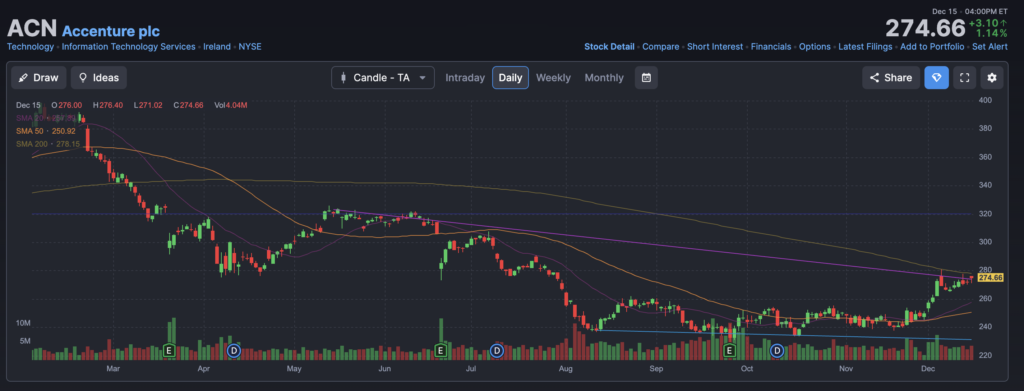
The stock is in a stage 4 markdown (bearish) on the monthly and weekly charts and trying to reverse into a stage 1 going to stage 2 on the daily chart. The cup and handle pattern is bullish, however, we would wait for a confirmation of the move higher to resistance at $296.