Company Overview – “Asset-Heavy Ops, Software-Heavy Margins”
Samsara (NYSE: IOT) is a connected-operations software company that helps fleets, industrial firms, and public-sector agencies monitor vehicles, equipment, sites, and workers using IoT sensors feeding into a cloud platform. Founded in 2015 by Sanjit Biswas and John Bicket (the Meraki founders) and headquartered in San Francisco, it has scaled to roughly 3,500 employees and more than $1.5 billion in trailing-twelve-month revenue. The business model is overwhelmingly subscription ARR sold to customers in transportation, logistics, construction, field services, utilities, manufacturing, and government. Revenue in fiscal 2025 (year ended Feb 2025) was about $1.25 billion, up 33% year over year, with TTM growth now just under 30% as the base gets larger. Its closest public comps are Trimble, Corpay (FleetCor), and Sensata, which all operate at the intersection of sensors, telematics, and industrial / fleet software, but with lower growth and more mature profitability profiles.
2. Latest Earnings – Q3 FY2026 Beat And First GAAP Profit
On 4 December 2025, Samsara reported Q3 FY2026 (quarter ended 1 November 2025) revenue of $416 million, up about 29% year over year and roughly 4% above consensus estimates around $399 million. Adjusted EPS came in at $0.15, versus $0.12 expected and about double the prior-year non-GAAP EPS of ~$0.07–0.08, and the company posted its first GAAP-profitable quarter with net income of roughly $7.8 million. Management highlighted ARR of about $1.75 billion, also growing 29% year on year, and record additions of 219 customers paying over $100,000 in ARR and 17 customers above $1 million in ARR. For Q4, Samsara guided revenue to $421–423 million (roughly 22% YoY growth) and non-GAAP EPS of $0.12–0.13, and for FY26 it now expects about $1.595–1.597 billion of revenue (≈28% growth) and $0.50–0.51 of non-GAAP EPS, modestly above Street expectations.
3. Founding And Early History
Samsara was founded in 2015 by MIT alumni Sanjit Biswas and John Bicket, who previously co-founded cloud networking company Meraki and sold it to Cisco for $1.2 billion in 2012. Their core thesis was that physical operations—trucks, trailers, warehouses, construction equipment, industrial assets—were dramatically under-instrumented relative to cloud data centers and SaaS, and that low-cost sensors plus a modern cloud stack could unlock large efficiency and safety gains. Early products focused on simple industrial sensors and gateways, but the company quickly pivoted to fleet telematics, video safety, and equipment monitoring, where ROI was clearest and purchasing was centralized. By 2018 the company had achieved unicorn status, with Andreessen Horowitz, General Catalyst, Tiger Global and others backing successive funding rounds that pushed private valuation above $6 billion pre-IPO.
4. IPO, Funding, And Scale-Up
Samsara went public on the NYSE in December 2021, raising roughly $805 million at an ~$11.5 billion valuation by selling about 35 million shares. The IPO gave it a substantial cash war chest to continue investing in R&D and sales capacity while chasing scale in what is still an underpenetrated market. Since listing, Samsara has more than doubled ARR from around $300 million in early 2021 to over $1.7 billion as of Q3 FY2026, while steadily improving free-cash-flow margins from negative territory to low-teens percentages. Today the company serves tens of thousands of customers across North America and Europe, including large enterprises and public-sector fleets, and runs an ecosystem of 350+ integrations in its app marketplace that plug into OEMs, ERPs, maintenance systems, and EV infrastructure.
5. Products, Platform, And Key Competitors
The core product is the Connected Operations Cloud, which ingests telemetry from vehicle gateways, AI dashcams, asset tags, environmental sensors, and mobile apps and then exposes it through modules for fleet management, video-based safety, equipment and site monitoring, driver workflows, and compliance. Revenue is almost entirely subscription-based, priced per asset (vehicle, trailer, machine, etc.), with upsell from adding modules (e.g., safety, equipment, compliance) and new asset classes via things like the Asset Tag launched in 2024. Key competitive sets vary by module: in heavy truck telematics and ELDs it competes with Geotab, Verizon Connect, Motive, and Teletrac Navman; in broader industrial and geospatial software, Trimble, Sensata, and OEM-embedded solutions are relevant; in payment / fuel card-adjacent workflows, Corpay/FleetCor is a reference point. The company differentiates by offering a single integrated cloud platform rather than point solutions stitched together.
6. Headquarters And Organizational Footprint
Samsara is headquartered in San Francisco, California, with major hubs across North America, Europe, and India that support engineering, sales, and customer success. The company reported around 3,500 employees in 2025, reflecting continued but moderated hiring versus the hyper-growth pre-IPO years. Its go-to-market model blends field enterprise sales for large fleets and industrial accounts with inside sales and channel partners for mid-market customers, supplemented by a growing ecosystem of OEM and marketplace partners. This footprint is optimized around markets with high density of commercial fleets and logistics, notably the U.S., U.K., Western Europe, and parts of Latin America.
7. Market Landscape And Growth To 2030
Samsara plays in what it calls “connected operations” or “physical-operations cloud,” essentially the convergence of fleet telematics, industrial IoT, and AI-driven analytics for equipment and sites. Various industry estimates put the global IoT/telematics and industrial digitalization TAM in the hundreds of billions by 2030; for example, the connected fleet and telematics market alone is often pegged at $60–80 billion by the end of the decade, with low-double-digit CAGRs, while broader industrial IoT is projected to grow in the mid-teens. Samsara itself has framed its serviceable market at tens of billions of dollars across transportation, construction, energy, utilities, manufacturing, retail, and public sector, given that most large organizations operate thousands of vehicles and assets with relatively low current sensor and software penetration.
8. Market Growth Drivers And Dynamics
Structural drivers into 2030 include fleet electrification, safety regulation, insurance incentives, ESG reporting requirements, and acute pressure on operating costs (fuel, maintenance, labor) for logistics and field-service operations. As OEMs embed more connectivity into vehicles and equipment, data volume increases but so does the need for a unified software layer to normalize, analyze, and act on that data across mixed fleets and multi-vendor environments. Most forecasts point to high-teens to low-20s CAGR for cloud-based fleet/asset software relative to mid-single-digit growth in the underlying transportation and industrial end-markets, implying continued share shift from clipboards and legacy on-prem systems to SaaS. Samsara’s current revenue growth of ~29–33% places it well above the market growth curve, but management is already guiding to a deceleration into the high-teens/low-20s over the next couple of years as the base grows.
9. Competitive Landscape
On the fleet side, Samsara goes head-to-head with Geotab (private), Motive (private), Verizon Connect, and Trimble’s telematics offerings, which have deep relationships with large truck fleets and OEMs. In industrial sensing and equipment monitoring, Sensata, Honeywell, and Siemens, among others, provide hardware-heavy solutions that are increasingly integrating with cloud dashboards but are not always as vertically integrated in software. Financial- and payments-centric players like Corpay/FleetCor and Wex sit adjacent to this stack, offering fuel cards and spend management that sometimes integrate telemetry but are not primarily operations clouds. The net effect is that Samsara must win both against “good enough” legacy systems with embedded install bases and against strong new entrants in specific niches like camera-based safety or asset tracking.
10. Differentiation – Why Customers Pick Samsara
Samsara’s main differentiation is that it is a software-first, vertically integrated cloud platform where hardware is a distribution vehicle rather than the core profit center. The company ships plug-and-play gateways, cameras, and tags that self-provision into the cloud, then layers on AI-driven features like driver-safety coaching, video-based incident detection, and predictive maintenance. Customers get a single pane of glass across vehicles, trailers, heavy equipment, depots, and front-line workers, plus an open API / marketplace for integrating into TMS, ERP, maintenance, and HR systems. Compared with many legacy telematics providers, Samsara’s UI, deployment experience, and pace of feature delivery are meaningfully more “SaaS-like,” which shows up in strong net retention (mid-teens uplift) and rapid ARR scaling.
11. Management Team
Sanjit Biswas serves as co-founder and CEO, bringing prior experience scaling Meraki from startup to a $1.2 billion acquisition by Cisco and a background in distributed systems from MIT. Co-founder John Bicket is Chief Technology Officer and has deep technical roots in wireless networking and large-scale distributed systems, having co-created much of Meraki’s underlying technology before leading Samsara’s product and engineering strategy. Around them, the broader leadership bench includes seasoned executives in sales, finance, and operations; for example, CFOs and CROs have been recruited from large enterprise software companies, and the board includes independent directors with backgrounds in industrials and cloud software, helping the company balance high-growth SaaS instincts with the realities of selling into conservative, asset-heavy industries.
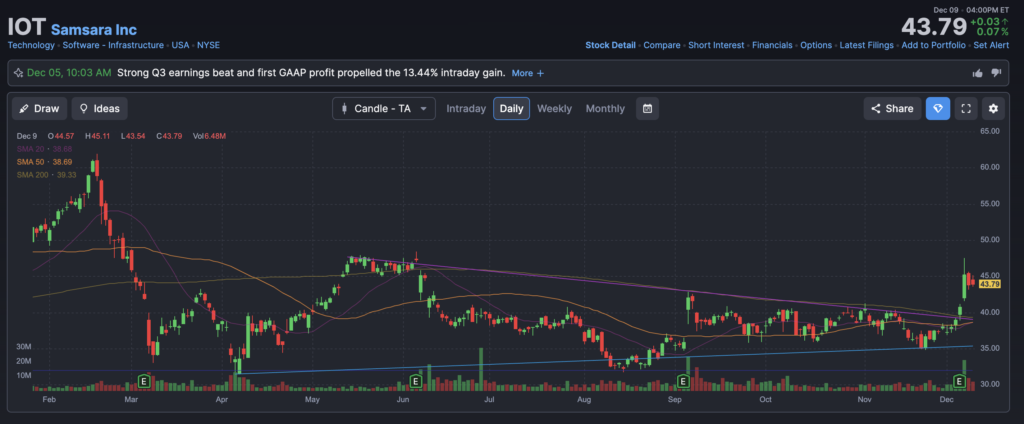
The stock is in a consolidation zone stage 1 on the weekly chart and has reversed to stage 2 bullish markup on the daily chart with strong resistance in the $48 zone. This should head to the $49 zone and then reverse back down.