Asana is a work management SaaS platform founded in 2008 that helps teams coordinate projects, workflows, and cross-functional initiatives through structured tasks, timelines, and automation. The company generated roughly $700 million in FY2024 revenue, growing at a mid-teens rate as enterprises adopt structured coordination tools to reduce operational friction. Asana is headquartered in San Francisco, and its platform spans task management, workflow orchestration, reporting, and AI-assisted productivity. The firm competes most directly with Monday.com, Smartsheet, Atlassian’s Jira Work Management, and to some extent ClickUp. Its value proposition centers on improved clarity, accountability, and orchestration across teams from marketing and product to operations and engineering.
2. Most Recent Earnings
Asana reported earnings on December 4, 2024, posting EPS of –$0.04, beating analyst expectations of roughly –$0.11, while revenue came in at $188.5 million, up 13% year over year and slightly ahead of consensus. Large-customer momentum continued, particularly among clients spending over $100K ARR, which grew over 20%. Guidance for the next quarter pointed to revenue of approximately $191–193 million, implying low-teens growth, with near-breakeven non-GAAP operating margins. Full-year guidance remained conservative given enterprise optimization trends. Analysts viewed the print as stable but not breakout, noting improved profitability paired with moderate top-line expansion.
3. Founding & Early Development
Asana was founded by Dustin Moskovitz, a Facebook co-founder, and Justin Rosenstein, the engineer credited with creating the Facebook “Like” button. The original mission was to reduce “work about work,” exposing the real-time state of projects without endless emails or status meetings. Early funding rounds attracted top-tier investors, and the product developed into a structured coordination hub built on clean design, intuitive UX, and cross-team visibility. Asana’s early differentiation stemmed from simplicity and accessibility compared to Jira’s complexity and legacy tools like Excel or email.
4. Product Evolution
Over time, Asana expanded beyond simple task lists into a multi-layered work orchestration platform supporting OKRs, dashboards, automation rules, workflow templates, and integrations with Slack, Zoom, Salesforce, Google, and Microsoft. Asana Intelligence — the company’s AI layer — now assists with summarization, workflow suggestions, risk prediction, and drafting status updates. This evolution pushes Asana into the enterprise collaboration and orchestration category rather than consumer-style to-do lists. The company has consistently focused on usability as a competitive edge, maintaining a minimal learning curve relative to other enterprise tools.
5. Headquarters, Global Reach & Organization
The company is headquartered in San Francisco with hubs across Dublin, Sydney, Vancouver, and Tokyo. Asana has enterprise penetration in more than 190 countries, driven by a freemium adoption model that expands organically inside organizations. The business has transitioned from SMB-heavy to more enterprise-focused, with increasingly larger deals and deeper IT integrations. Asana’s organizational structure reflects this shift, with investments in sales, partner ecosystems, and data governance features supporting large-scale customers.
6. Market Landscape
Asana operates within the work management and enterprise collaboration market, a category projected to exceed $110–130 billion by 2030, expanding at a CAGR of 12–14%. Growth is driven by digital transformation, distributed workforces, automation-driven efficiency, and the rise of AI-based productivity tools. Many enterprises now realize that email and spreadsheets cannot scale to cross-functional coordination, pushing adoption of structured workflow platforms. As systems of record like CRMs and ERPs become more rigid, the work orchestration layer — Asana’s sweet spot — is becoming mission-critical.
7. Market Growth Dynamics
By 2030, the TAM expands further due to AI orchestration layers replacing manual coordination, with AI copilots and agents expected to automate 30–50% of routine project administration. Asana’s investments in AI aim to secure long-term relevance and boost enterprise stickiness. The platform also benefits from compliance requirements (SOC2, ISO, GDPR) and governance features that make shadow work tools less acceptable at scale.
8. Competitive Environment
Asana’s key competitors include Monday.com, Smartsheet, and Atlassian. Monday has grown faster with a broader product suite spanning CRM and dev tools, appealing to companies seeking an all-in-one operating system. Smartsheet dominates project-centric workflows for operations-heavy industries like construction and field services. Atlassian leverages Jira for engineering-led work management and has deep penetration with technical teams. While these competitors often push “platform-level expansion,” Asana maintains a narrower yet deeper focus on cross-functional visibility and task orchestration.
9. Differentiation
Asana’s core differentiation lies in its information architecture — it is built around clarity, hierarchy, and workflow visualization, making it easier for non-technical departments to adopt. The UI and design language remain best-in-class, with a learning curve far gentler than Jira or Smartsheet. AI integration is natively embedded into workflows rather than bolted-on features, positioning Asana as a coordination engine rather than a simple task tracker. The company also wins with quality-of-life UX features that reduce friction for teams scaling from 5 users to 5,000.
10. Management Team Overview
Dustin Moskovitz continues as CEO and remains deeply involved in product and long-term strategy, with a reputation for meticulous, mission-driven leadership. Tim Wan, CFO (formerly at Applovin), leads financial discipline and margin expansion. Anne Raimondi, COO, drives go-to-market execution across sales, customer success, and operations, helping shift Asana toward enterprise adoption. The leadership team is regarded as stable and product-focused, with Moskovitz’s significant ownership aligning incentives toward long-term stewardship rather than aggressive short-term optimization.
11. Five-Year Financial Performance
Over the past five years, Asana has grown revenue from roughly $227 million in FY2020 to about $700 million in FY2024, a CAGR of roughly 32%. While revenue growth has moderated to low-to-mid teens, the firm has steadily improved unit economics and reduced operating losses. Gross margins remain strong at around 88–90%, consistent with best-of-breed SaaS productivity players. Over time, Asana moved from heavy cash burn toward near-breakeven operating performance.
12. Profitability & Cash Flow Trends
Net losses have declined significantly as the company curbed sales and marketing spending while increasing enterprise deal sizes. Operating leverage improved as R&D efficiency increased with more modular platform development. Free cash flow has approached break-even in recent quarters — a stark improvement from heavy outflows in earlier years. The path to sustained profitability depends on maintaining enterprise expansion while keeping cost discipline.
13. Balance Sheet & Liquidity
Asana maintains a strong balance sheet with several hundred million dollars in cash and equivalents and no urgent debt maturity pressures. The company has maintained healthy short-term liquidity and can reinvest in AI, platform reliability, and enterprise sales execution without external capital. While dilution has historically been a concern, improving cash flow reduces long-term dependency on equity issuance.
14. Bull Case
The bull case centers on stable double-digit growth powered by enterprise expansion, strong gross margins, and a maturing AI orchestration category in which Asana is well positioned. As AI agents automate workflows, Asana could transform into a command center for work, expanding ARPU significantly. If the company accelerates platform breadth and continues margin discipline, it could evolve into a $10B+ category leader with durable profitability.
15. Bear Case
The bear case highlights slowing growth and intense competition, particularly from Monday.com’s velocity and Atlassian’s entrenched developer base. AI differentiation could be eroded quickly as rivals ship similar features. Enterprises may consolidate tools toward larger platforms like Microsoft, reducing Asana usage. If growth dips below 10% and profitability stalls, valuation compresses sharply.
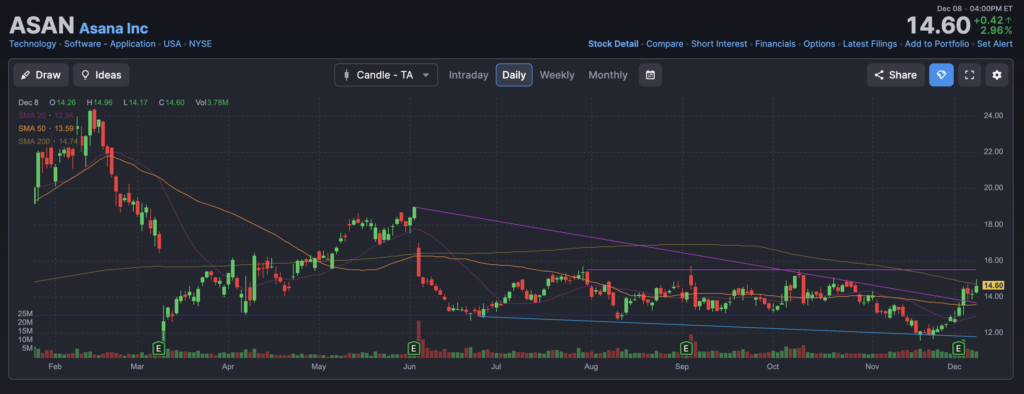
The stock is still in a long term consolidation stage 1 with resistance at the $15.3 – $15.15 range. We are not interested in the stock at this time.