1. Company overview
Walmart Inc. is a global retailing giant, a “people-led, tech-powered omnichannel retailer” dedicated to helping customers “save money and live better.” It operates thousands of stores (over 10,750 globally) and a large online business across ~19 countries. With fiscal year 2025 revenue of approximately US$681 billion, it is one of the largest companies by revenue worldwide. Its business spans discount stores, supercenters, warehouse clubs (via Sam’s Club), e-commerce and marketplace operations. It emphasises everyday low prices, scale in sourcing and logistics, and leveraging technology to serve both offline stores and online channels.
In short: global retail behemoth, deeply entrenched in physical stores and increasingly focused on digital/tech.
2. Most recent earnings
Subtitle: Q3 Fiscal Year 2026 (for period ended November 2025)
In its Q3 FY26 release (November 20, 2025) Walmart reported total revenues up 5.8% year-over-year (constant-currency) and operating income growth of 6.0%. Net income jumped by more than 30% (one source noted a ~33% rise) to around US$6.1 billion. U.S. same-store sales grew ~4.5%; global e-commerce surged (one article saying ~27% growth). Walmart also raised its full-year sales growth guidance to ~4.8-5.1% and adjusted earnings per share outlook to US$2.58-2.63. The performance indicates resilient consumer spending in Walmart’s channels, particularly value/grocery, and strength in its online and fulfilment capabilities.
On the flip side: margins remain under pressure given competitive pricing and rising cost inputs, so while growth is solid, margin expansion may be slower.
3. Company history, founding, key products, funding, etc
Walmart traces its roots to 1962 when founder Sam Walton opened a discount store in Rogers, Arkansas. It incorporated as Wal-Mart, Inc. in 1969 and went public on the NYSE in 1970. Over the decades it expanded across the U.S., entered international markets, launched Sam’s Club (1983) and built distribution/logistics scale. The company is headquartered in Bentonville, Arkansas.
In terms of funding: as a public company it is large and matured; there are no recent “venture-funding” style infusions — it’s now an established giant.
Its product & service footprint: general merchandise (apparel, home goods, electronics), groceries (a major share), pharmacy, e-commerce marketplace, membership club via Sam’s Club, and increasingly digital/fulfilment/logistics services and advertising/retail-media. The business leverages physical store footprint + e-commerce to deliver goods. Key competitors include Target Corporation, Costco Wholesale Corporation, and to some extent Amazon.com, Inc. (especially online). The company’s funding focus is internal: investments in technology, logistics automation, store remodels, expansion of fulfilment, etc.
In sum: rooted in Walton’s discount store model, scaled globally, evolved into omnichannel retail leader.
4. Market the company operates in & growth expectations
Walmart is primarily in the global retail industry — brick-and-mortar plus online retail. According to one market report, the global retail market was valued at approx US$27.26 trillion in 2025 and is projected to reach about US$36.91 trillion by 2030 — which implies a ~6.25% CAGR. Another source places the global retail market reaching ~US$48.22 trillion by 2030, implying a higher ~10.98% CAGR, though that projection may include broader retail segments or higher growth geographies. Focusing on food & grocery retail (a big part of Walmart’s business), one report expects the market globally (valued at ~US$11,932.5 billion in 2023) to reach ~US$14,781.1 billion by 2030 (CAGR ~3.2%).
For Walmart, growth drivers include:
- Shift to e-commerce/omnichannel (store + online) allowing growth beyond pure store footprint.
- Retail media/advertising growth (higher margin).
- Growth in emerging markets/international expansion and membership clubs (Sam’s Club).
- Efficiency gains (logistics, automation) enabling margin improvement or reinvestment.At the same time, the industry is mature, especially in developed markets, so much of growth is incremental rather than explosive. The macro trend is moderate growth (mid-single digits) with shifts toward higher-margin digital services, logistics, and membership-based models.Conclusion: Walmart sits in a large market (tens of trillions) with modest overall growth (~5-7% globally) but room for outperformance via tech/efficiency/online leverage.
5. Competitors overview
Key competitors:
- Target Corporation: A general merchandise retailer in the U.S. with strong apparel/home presence; smaller scale than Walmart.
- Costco Wholesale Corporation: Warehouse club model, membership driven, higher average spend but fewer locations.
- Amazon.com, Inc.: While more digitally native, Amazon competes for consumer spending, especially online, and increasingly for groceries and marketplace.Each competitor has strengths: Costco — strong membership loyalty and high basket size; Target — differentiated brands and store experience; Amazon — scale online and logistics. Walmart’s ability to compete depends on leveraging its physical footprint, low-price positioning, and expanding digital presence.In many segments (groceries, discount general merchandise) Walmart is the low-cost leader, so competition tends to follow rather than lead.One challenge: Amazon’s online-only scale means Walmart must keep investing heavily to keep pace in online/grocery/delivery. Also, in some international markets Walmart competes with local chains with stronger regional presence.
6. What makes Walmart unique / its differentiation
- Massive store + logistics footprint: Walmart is routinely within a short distance of a large portion of the US population; this store network doubles as fulfilment infrastructure for e-commerce and omnichannel operations.
- Everyday low price (EDLP) strategy: Walmart’s sourcing scale, bargaining power, and operational efficiency allow it to price aggressively and defend value-seeker consumer segments.
- Omnichannel integration + retail media growth: Walmart is pushing its digital marketplace, membership/club format (Sam’s Club), and advertising business, which create higher-margin business lines beyond pure retailing.
- Tech and automation investments: Walmart increasingly emphasises automation (warehouses, freight, fulfilment), AI for assortment/forecasting, and leveraging its physical-digital model to extract cost efficiencies and faster fulfilment.In short: the combination of physical scale, value proposition, multi-channel presence, and evolving digital business gives Walmart an edge over many pure-brick or pure-online competitors.
7. Management team (max 3)
- Doug McMillon — President & Chief Executive Officer (current, though announced to retire Jan 31 2026) He has been CEO since 2014 and oversees global operations.
- Greg Penner — Chairman of the Board Member of the Walton family lineage, involved in governance and strategic oversight.
- John Furner — President & CEO, Walmart U.S., and announced successor to McMillon (effective February 1, 2026) Having risen through the ranks, his elevation signals continuity and focus on U.S. operations.These leadership individuals steer Walmart’s strategy of store/digital integration, global growth, and technology investment.
8. Financial performance overview (last 5 years)
In fiscal 2025 Walmart reported revenues of approximately US$681 billion, up ~5.1% from the previous year. In fiscal 2024 revenue was around US$648 billion, up ~6.0% from fiscal 2023 (≈US$611 billion). That suggests a revenue growth CAGR for the last 2-3 years of roughly 5-6%. Earnings growth has been more variable given margin pressures; for example, net income rose moderately in recent years but margins face headwinds from cost inflation, tariffs and reinvestments. The balance sheet remains robust — Walmart has significant assets, strong cash flow generation from its operating business, and uses stores and logistics assets effectively. Its scale gives it leverage in cost structure. Over the last five years the revenue CAGR approximates mid-single digits. Earnings CAGR likely slightly higher when digital/advertising growth kicks in, but margin improvement may be modest due to competitive pressures and heavy investment. On the balance sheet side, Walmart carries significant property, plant & equipment (stores/warehouses/distribution centres). It uses scale to manage working capital and inventory turnover. It generally maintains investment grade credit ratings and generates healthy free cash flow, enabling dividends, share repurchase and reinvestment. In summary: stable growth, strong cash flow, moderate margin improvement, and significant capital/emphasis on long-term scale and efficiency rather than short-term explosive growth.
9. Bull case
- Walmart’s scale, store + fulfilment network and omnichannel capabilities position it to capture both physical and online retail growth, and to defend value-seeker consumers in uncertain macro conditions.
- Growth of higher-margin segments (retail media, marketplace, digital fulfilment/logistics services) can drive margin expansion over time, improving earnings growth even if core retail growth stays modest.
- In a cost-inflation / value-shopping environment, Walmart is well-positioned: budget-conscious consumers may gravitate to Walmart’s everyday-low-price model, giving it resilience versus premium or niche retailers.
10. Bear case
- The retail market is mature; moderate growth (mid-single digits) means Walmart needs to continuously invest (capital, technology, logistics) to sustain growth — weight of capital may constrain returns.
- Margin pressures: cost inflation (labor, freight, tariffs), promotional pricing to hold value positioning, and competition from online pure-players (e.g., Amazon) could squeeze margins and earnings growth.
- Consumer macro risk: Walmart serves many price-sensitive customers; if consumer spending weakens materially (job losses, inflation shock), even value retailers can be impacted — growth may slow or inventory risk may increase.
11. Analyst reactions after earnings
Following the Q3 FY26 results, Walmart raised its full-year guidance and beat revenue expectations: core message was positive. Some analysts upgraded the stock on the back of the guidance raise and strong e-commerce numbers. One note: the planned move of the listing from NYSE to Nasdaq (Dec 9, 2025) was interpreted as signalling Walmart’s emphasis on technology and innovation, which may have supported positive reactions. I did not locate a comprehensive list of multiple upgrade/downgrade actions publicly in this dataset, but the guidance raise and beat triggered favorable commentary.
In summary: the earnings reaction leaned positive — raised guidance, e-commerce growth, strength in consumer value segment.
12. Valuation table with top 3 competitors
| Company | Revenue (most recent) | Revenue growth rate | Net income | Market capitalisation* |
|---|---|---|---|---|
| Walmart Inc. (WMT) | ~US$ 681 billion (fiscal 2025) | ~5%-6% on recent years (approx) | Not specified exactly here; net income rose ~30% in latest quarter | ~US$ 800+ billion (ranked #2 largest retail by market cap) |
| Costco Wholesale Corporation | (Publicly listed) Smaller than Walmart; approximate revenue ~US$ 200-250 billion (not exact here) | (Not specified in our source) | (Not specified here) | ~US$ 435 billion according to list |
| Target Corporation | (Not fully detailed here) | (Not specified) | (Not specified) | ~US$ 47.8 billion per list |
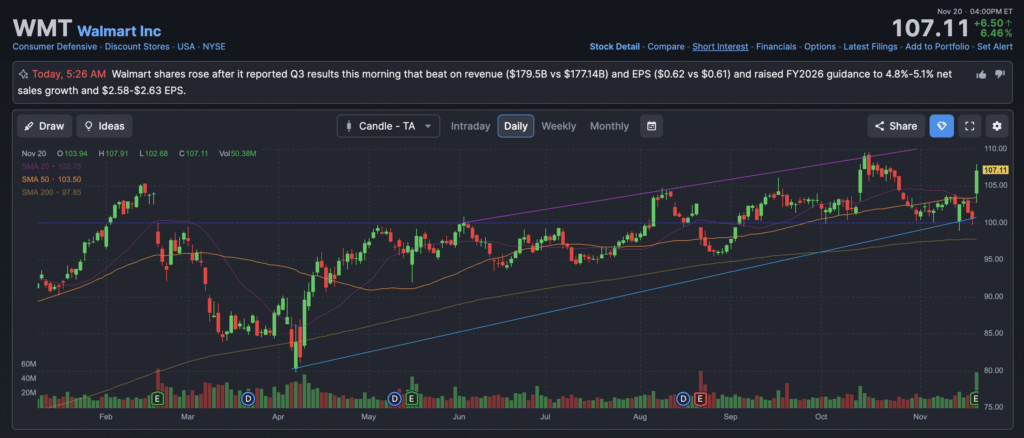
The stock is in a stage 2 markup (bullish) on all 3 timeframes and has a strong move to the $125 range.