Company Overview
Target Corporation is a large U.S. discount retailer operating general-merchandise stores that sell everything from apparel and home goods to electronics and groceries. The company differentiates itself by targeting a more trend-aware, slightly higher-income shopper compared to ultra-value competitors, with an emphasis on “expect more, pay less”. Headquartered in Minneapolis, Minnesota, Target operates nearly 2,000 stores across the United States. It also has a digital/e-commerce arm and private-label brands that aim to drive loyalty and margins. The company is publicly traded and part of the S&P 500. It’s facing a challenging macro retail environment (consumer caution, inventory issues, competition), but with a brand and infrastructure that give it scale.
Most Recent Earnings
For the third quarter (Q3) of fiscal 2025, Target reported GAAP EPS of $1.51, down from $1.85 in the prior year. On an adjusted basis (excluding severance and asset-related charges) EPS was $1.78. The company did not provide full detailed growth vs analyst expectations for that exact quarter in the public release cited, but the EPS decline indicates clear pressure. Target has also said it’s offering over 20,000 new items (twice the prior year) and placing emphasis on value this holiday season. Regarding guidance, the company had previously adjusted full-year expectations downward (in earlier quarters) to a low-single-digit sales decline and adjusted EPS in the range of about $7 – $9 for fiscal 2025. These signals show management expects flat to declining top-line and modest/no growth in earnings in the near term.
Company History & Background
Target’s origins trace back to the Dayton Company in Minnesota; the first Target store opened in May 1962. It evolved through Dayton-Hudson Corporation, changing its name to Target Corporation in 2000. The founding store concept by Douglas Dayton and John Geisse aimed at creating a discount department store with style and design at value price points. Headquarters are in Minneapolis (Target Plaza, Minnesota). Over many decades the business expanded nationwide, built its private-label brands, invested heavily in supply chain and digital platforms. Funding for a public company like Target has primarily been internal/operational rather than venture-style external rounds; it finances by debt/equity markets as a large public retailer.
Key products and offerings: general merchandise (hardlines, softlines), groceries (under its “PFresh” format expansion), digital/e-commerce, private label brands (e.g., Good & Gather, up & up) and credit/debit card operations via REDcard. Key competitors include large mass retailers and e-commerce giants such as Walmart Inc., Amazon.com, Inc., and Costco Wholesale Corporation.
Market & Industry Environment
Target operates primarily in the U.S. general-merchandise retail market — a highly competitive and low-margin business characterized by large scale, logistics, pricing pressure and changing consumer behaviour. The move toward e-commerce, omni-channel fulfillment (store pickup, same-day delivery), and consumer shifts in spending (less discretionary, more essentials) are influencing its market. Looking to 2030, the global retail market growth (including non-food) is often projected in the low-single-digit to mid-single-digit CAGR range depending on region. Within the U.S., general merchandise discount segments may see modest growth or even slight contraction unless differentiated. The challenge for Target: leverage its brand, digital/omni-capability and unique value proposition to capture growth. The market tailwinds include continued growth in e-commerce fulfilment & convenience, private label margin expansion, and value-oriented shoppers under cost-pressure. On the flip side, macro headwinds (inflation, wage pressure, supply-chain cost) could compress margins.
Competitor Landscape
In the competitive arena:
- Walmart is the dominant player in discount retail (massive scale, aggressive pricing, strong grocery penetration) and poses a formidable challenge.
- Amazon competes on e-commerce, convenience, third-party marketplace services and increasingly on general merchandise. Target must keep pace on digital/fulfilment.
- Costco, with its membership-model wholesale club, competes on value and bulk purchasing, though with a somewhat different format. Thus, Target sits between deep-value mass retailers and curated discount/department formats — giving it differentiation but also exposing it to pressure from both ends.
Unique Differentiation
Target’s edge lies in its positioning: more trend-forward and design-conscious merchandise than typical discount chains, appealing to a younger, more design-savvy customer base. Its private-label brands (which it controls fully) offer higher margin potential. Its omni-channel fulfilment capabilities (store-online integration, same-day services) provide convenience. Moreover, its store footprint is optimized for both value and experience rather than pure deep-discount or luxury. The combination of style + value + convenience gives Target a unique niche. But to maintain this edge it must execute in a challenging environment.
Management Team
- Brian Cornell – (Chairman & CEO) He has led Target for a number of years and oversaw much of its transformation into a more digital-enabled retailer.
- Michael Fiddelke – (Incoming CEO effective Feb 1, 2026) A 20-year company veteran, he currently heads operations or enterprise acceleration efforts and will take over the top role.
- (Other senior executive) – While not named here in my sources, there are senior leaders in merchandising, digital, operations whose performance will matter strongly for the turnaround.The key point: leadership is undergoing transition, which adds execution risk but also potential for renewed focus.
Financial Performance (Last 5 Years)
In fiscal year 2024, Target reported net sales of $106.566 billion, slightly down from $107.412 billion in 2023 and $109.120 billion in 2022. Net earnings in 2024 were $4.091 billion compared to $4.138 billion in 2023. Diluted EPS in 2024 was about $8.86 compared to $8.94 in the prior year. Over the last five years, this implies near-zero or slight negative revenue growth (thus a very low or flat CAGR), and earnings similarly stagnant. The margins appear under pressure given flat sales and operational cost headwinds. On the balance sheet front: as of 2024 Target reported assets of about $57.77 billion. Equity was around $14.67 billion. The company generates substantial cash flow (given its size) but the flat revenue growth and earnings plateau suggest the business model is under stress in this environment. This stagnation raises questions about return on invested capital and growth prospects unless the company executes its turnaround initiatives effectively.
Bull Case
- Strong brand + private label + differentiated positioning offer upside if execution improves and margins expand.
- Improved digital/omni-channel operations could unlock growth in fulfilment, same-day services and higher-margin offerings.
- Cost‐saving and simplification initiatives (new CEO, enterprise acceleration) may restore profitability and free up cash for reinvestment or shareholder returns.
Bear Case
- Flat to declining top-line growth in a highly competitive, low-margin retail segment may persist and erode margins further.
- Macro headwinds (consumer spending weakness, inflation, supply chain cost increases, labor pressure) could hamper earnings and cash flow.
- Execution risk: management transition, strategic turnaround may take longer than expected, increasing investor impatience and valuation erosion.
Analyst Reactions
Following recent earnings and guidance actions, analysts have been cautious. For instance, when Target lowered full-year guidance and reported weaker comps, the stock dropped ~7%. The CEO succession announcement also caused a notable stock decline (~7% on one day) despite some positive metrics. Overall, while there have been no broad upgrades reported in the sources I accessed, the sentiment remains skeptical until sustained improvement manifests.
Valuation & Peer Comparison
Here is a rough comparison among Target and three competitors: Walmart, Amazon, Costco (figures approximate, U.S. $ billions unless noted):
| Company | Revenue | Revenue Growth | Net Income | Market Cap |
|---|---|---|---|---|
| Target (TGT) | ~$106.6 billion (2024) | Flat/-0.8% (2024 vs prior) | ~$4.09 billion (2024) | ~$41.6 billion (Nov 2025) |
| Walmart Inc. (WMT) | ~$681 billion (2025) | ~+5% (2025) | ~$19.44 billion (2025) | ~$808 billion (Nov 2025) |
| Costco Wholesale Corporation (COST) | ~$275.2 billion (2025) | ~+8% (2025) | ~$8.099 billion (2025) | ~$410 billion (2025) |
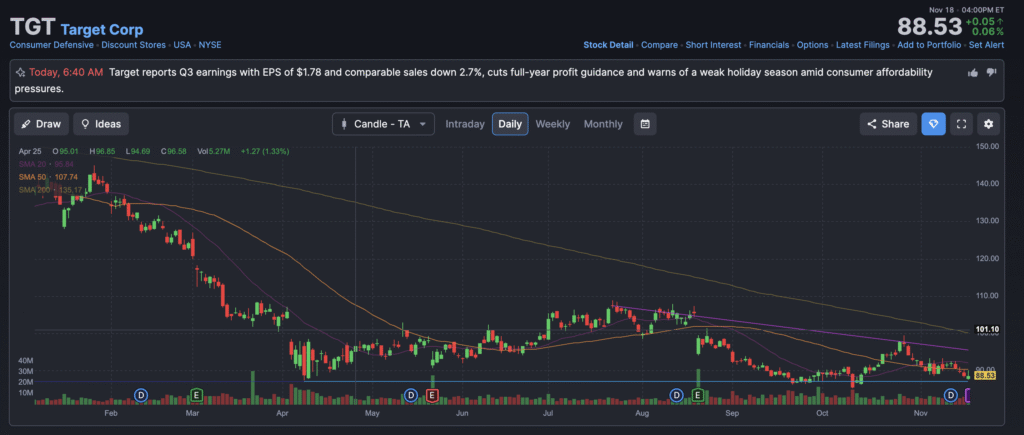
The stock is in consolidation stage 1 on all 3 timeframes and is not worth an investment yet.