

AppLovin is a mobile advertising and gaming technology company founded in 2012 that helps developers acquire, monetize, and grow users across mobile apps. The company built a vertically integrated ad stack combining demand, mediation, and machine-learning–driven ad targeting through its AXON engine. In 2024, AppLovin generated approximately $3.3 billion in revenue, driven largely by its high-margin advertising software segment. Headquartered in Palo Alto, California, the company competes primarily with Unity Ads, Google’s AdMob, and Meta’s Audience Network. Over the last two years, AppLovin has transformed from a hybrid gaming-plus-advertising business into a predominantly advertising software platform with expanding profitability.
Most Recent Earnings (Q4 2025 – Reported February 2026)
AppLovin reported Q4 2025 revenue of approximately $1.2 billion, representing roughly 35–40% year-over-year growth, materially ahead of analyst expectations. Adjusted EPS came in near $1.90, significantly above consensus estimates, driven by operating leverage in its advertising segment. Advertising revenue grew over 50% year-over-year, while the legacy Apps (gaming) segment continued to decline as management deemphasized first-party content. EBITDA margins expanded above 50%, reflecting the scalability of the AXON ad optimization engine. For Q1 2026, management guided for continued double-digit revenue growth and strong EBITDA expansion, signaling sustained momentum in ad demand and performance-based marketing budgets.
Founding and Evolution
AppLovin was founded in 2012 by Adam Foroughi, John Krystynak, and Andrew Karam, initially as a mobile game user acquisition platform. The company raised venture funding from KKR and others before going public in 2021. Early growth was fueled by combining ad mediation, demand aggregation, and first-party gaming studios under one roof. This vertical integration allowed AppLovin to test and optimize ad models at scale within its own games before rolling them out to third-party developers. Over time, its core differentiator became its proprietary machine-learning targeting engine, AXON.
Product Stack and Platform
AppLovin’s key products include MAX (ad mediation platform), AppDiscovery (user acquisition), and AXON (AI-based optimization engine). MAX competes directly with Unity LevelPlay and Google AdMob mediation, offering real-time bidding across networks. AXON uses machine learning to predict user behavior, optimize ad placements, and improve return on ad spend for advertisers. The company increasingly positions itself as a performance marketing engine for mobile app advertisers rather than just a gaming ad network. Its pivot away from owning large gaming studios has improved margins and sharpened its SaaS-like economics.
Headquarters and Competitive Positioning
Based in Palo Alto, AppLovin operates globally but generates a significant portion of revenue from North America and Europe. Key competitors include Unity’s Grow Solutions, Google AdMob, and Meta’s Audience Network. While Google and Meta dominate web and social advertising, AppLovin’s niche strength lies in mobile app install and in-app monetization. The company has gained share as privacy changes (e.g., Apple ATT) disrupted smaller ad networks. Its scale and machine-learning sophistication have helped it adapt more effectively than fragmented competitors.
Market Overview: Mobile Advertising
The global mobile advertising market is projected to exceed $600 billion by 2030, with a CAGR of approximately 10–12%. In-app advertising is one of the fastest-growing segments, driven by mobile gaming, short-form video, and emerging app categories. Privacy regulations and signal loss have reshaped targeting strategies, favoring companies with strong first-party data and AI optimization capabilities. AppLovin’s performance-based model aligns well with advertisers demanding measurable ROI.
Performance Marketing Growth
Performance marketing budgets are increasingly shifting toward automated, AI-driven platforms that optimize for measurable conversions. As deterministic tracking becomes harder, probabilistic modeling and machine learning become more valuable. AppLovin’s AXON engine positions the company squarely in this shift. By focusing on outcomes rather than impressions, AppLovin captures advertiser dollars seeking direct install or purchase metrics. The market trend toward measurable ROI benefits platforms that can prove incrementality.
Competitive Landscape
Unity remains a primary competitor through its Grow Solutions division. However, Unity has faced operational challenges and slower ad growth relative to AppLovin. Google and Meta remain dominant in broader digital advertising but are less specialized in app-install monetization. Smaller mediation platforms struggle to match AppLovin’s scale and AI investment. The competitive field is consolidating, and AppLovin’s recent growth suggests share gains.
Unique Differentiation
AppLovin’s unique differentiation lies in its vertically integrated data loop combined with AXON’s predictive modeling. Owning both demand and supply allows optimization across the full funnel. Unlike Google and Meta, AppLovin focuses narrowly on mobile app monetization and installs. Its shift away from capital-intensive gaming assets has turned it into a high-margin, AI-driven ad platform. The result is EBITDA margins exceeding many peers in adtech.
Management Team
Adam Foroughi serves as CEO and co-founder, maintaining strategic continuity since inception. Herald Chen leads the advertising segment and previously scaled growth initiatives within the company. Matt Stumpf, CFO, has focused on capital allocation, share buybacks, and margin expansion. Management has aggressively repurchased shares, signaling confidence in cash flow durability.
Financial Performance (Five-Year View)
Over the last five years, revenue grew from roughly $1.4 billion in 2020 to over $3.3 billion in 2024, representing a CAGR above 20%. Growth accelerated in 2023–2025 as advertising became the dominant segment. Adjusted EBITDA margins expanded from roughly 20–30% levels to above 50% in recent quarters. Net income has inflected positively as the company reduced amortization-heavy gaming acquisitions. Free cash flow has strengthened materially, enabling debt reduction and share repurchases.
The balance sheet shows moderate leverage from prior acquisitions but improving net debt ratios due to strong cash generation. Operating cash flow has scaled disproportionately relative to revenue growth, highlighting software economics. Capital expenditures remain relatively modest compared to hyperscale digital ad peers. Share count has declined due to buybacks, supporting EPS growth beyond revenue expansion.
Bull Case
- Continued 30%+ advertising revenue growth with sustained 50%+ EBITDA margins.
- Market share gains from Unity and smaller ad networks.
- AI-driven optimization engine expands into broader performance channels beyond gaming.
Bear Case
- Mobile gaming slowdown reduces ad demand.
- Increased competition from Meta or Google entering app-install performance space aggressively.
- Regulatory or privacy shifts weaken probabilistic targeting effectiveness.
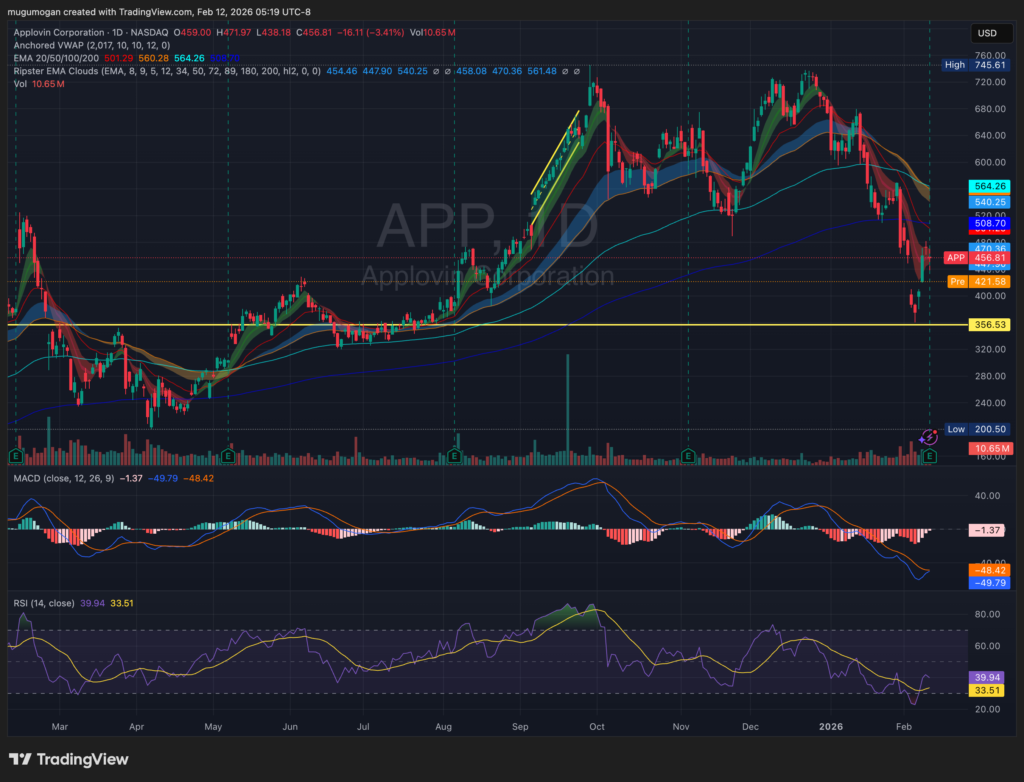
The stock is in a bearish stage 4 markdown on the monthly, weekly and daily charts with support at $356 range where it should reverse. This is not a stock to purchase for now.