








Company Overview
Oscar Health is a technology-first health insurance company focused on the U.S. individual and small-group markets, positioning itself as a consumer-friendly alternative to legacy insurers. Founded in 2012, the company built its brand around a mobile-first experience, virtual care access, and transparent plan design aimed at younger, digitally native consumers. Oscar operates primarily through Affordable Care Act (ACA) marketplace plans, with selective exposure to Medicare Advantage via partnerships. In 2024, Oscar generated approximately $9.2 billion in revenue, driven almost entirely by ACA membership growth and improved pricing discipline. Headquartered in New York City, its closest public peers include Clover Health, Alignment Healthcare, and Bright Health’s legacy operations.
Most Recent Earnings Performance
Oscar Health most recently reported earnings in early February 2026 for full-year 2025 results, delivering adjusted profitability well ahead of its historical trajectory. The company reported adjusted EPS of roughly $0.78 for the year, compared to analyst expectations closer to $0.60, driven by strong medical cost control and favorable risk adjustment outcomes. Revenue came in at approximately $9.9 billion, representing year-over-year growth of about 8%, modestly ahead of consensus forecasts. Management guided for 2026 revenue growth in the mid-single-digit range, reflecting a deliberate strategy to prioritize margin stability over aggressive member expansion. Guidance emphasized continued adjusted EBITDA profitability, signaling Oscar’s transition from turnaround story to disciplined operator.
Founding and Early History
Oscar Health was founded in 2012 by Mario Schlosser, Josh Kushner, and Kevin Nazemi with the explicit goal of re-imagining health insurance as a technology product rather than a claims-processing bureaucracy. The founders believed that poor user experience, opaque pricing, and limited digital access were structural flaws in U.S. healthcare coverage. Early funding rounds attracted high-profile investors, including venture capital firms and strategic healthcare players, enabling rapid market entry across multiple ACA exchanges. The company quickly became known for its intuitive app, free telemedicine, and proactive care reminders. However, early growth came at the cost of underwriting discipline, leading to significant losses during its first decade.
Products and Platform
Oscar’s core product portfolio centers on ACA individual and family plans, supplemented by small-group offerings for employers. The company differentiates itself through its proprietary technology stack, including a consumer app that integrates virtual primary care, claims tracking, deductible monitoring, and provider search. Oscar leverages data analytics to guide members toward cost-effective care options, aiming to reduce unnecessary utilization. While Oscar previously experimented with Medicare Advantage and provider partnerships, management has since narrowed focus to markets where pricing accuracy and risk adjustment outcomes are more predictable. This simplification has been critical to recent margin improvement.
Competitive Landscape and Headquarters
Headquartered in New York City, Oscar competes against both incumbents and newer tech-enabled insurers. Large legacy insurers such as UnitedHealth Group and CVS Health dominate employer and Medicare markets, while smaller challengers focus on specific segments. Oscar’s most direct competition comes from other ACA-focused insurers attempting to blend technology with insurance underwriting. The company has deliberately exited unprofitable geographies, concentrating on states where it has actuarial confidence and operational scale. This geographic discipline marks a notable shift from its earlier expansion-at-all-costs approach.
Market Opportunity
Oscar operates primarily within the U.S. individual health insurance market, which serves roughly 18–20 million ACA marketplace enrollees. This market is expected to grow modestly through 2030, with enrollment expansion driven by demographic shifts, employment volatility, and continued government subsidies. Industry analysts estimate a low-to-mid single-digit CAGR for the ACA market through 2030, with profitability increasingly determined by risk adjustment sophistication rather than raw membership growth. Oscar’s opportunity lies less in market expansion and more in capturing economically attractive sub-segments. The total addressable revenue pool for ACA plans is projected to exceed $150 billion annually by the end of the decade.
Industry Growth Dynamics
The broader U.S. health insurance market is mature, but sub-segments like individual exchange plans remain structurally complex and volatile. Regulatory changes, subsidy levels, and risk corridor mechanics heavily influence insurer economics. By 2030, digital engagement and virtual care integration are expected to be baseline requirements rather than differentiators. Oscar’s technology advantage narrows over time, increasing the importance of underwriting discipline and scale efficiency. In this environment, consistent profitability becomes the key competitive moat.
Competitor Overview
Clover Health focuses heavily on Medicare Advantage with a data-driven clinical model, exposing it to different regulatory and utilization dynamics than Oscar. Alignment Healthcare similarly concentrates on Medicare Advantage but targets senior populations with coordinated care networks. Bright Health previously pursued ACA and Medicare growth but largely exited the market after sustained losses, serving as a cautionary tale. Compared to these peers, Oscar is more narrowly focused on ACA plans and has demonstrated improving cost control. This focus reduces diversification but improves execution clarity.
Competitive Positioning
Oscar’s differentiation lies in its consumer experience and operational discipline rather than novel clinical models. Unlike Medicare-focused peers, Oscar avoids heavy provider ownership or capitated risk structures. This lighter-asset approach allows faster geographic exits when economics deteriorate. However, it also limits upside from care delivery integration. Oscar’s strategy is best described as “tech-enabled payer, not tech-led care provider,” which lowers execution risk but caps long-term margin potential.
Unique Differentiation
Oscar’s unique edge is its disciplined retreat from unprofitable growth combined with a still-strong digital front end. While many insurtech peers chased scale, Oscar pulled back, re-priced risk, and rebuilt credibility with investors. Its app-centric engagement remains among the best in the ACA market, contributing to member retention and cost awareness. Importantly, management now treats technology as an efficiency tool rather than a growth narrative. This shift has materially improved investor confidence.
Management Team Overview
Mario Schlosser, co-founder and CEO, brings a technology and data background, shaping Oscar’s product-centric culture. The CFO, Richard Vaughn, has been instrumental in enforcing underwriting discipline and cost controls during the company’s turnaround phase. Together, the leadership team has prioritized actuarial rigor over headline growth. Their credibility has increased as Oscar moved from chronic losses to adjusted profitability. Management compensation is increasingly aligned with margin performance rather than enrollment growth.
Financial Performance Over Five Years
Over the past five years, Oscar’s revenue has grown from roughly $4.5 billion to nearly $10 billion, representing a CAGR of approximately 17%. This growth, however, masked significant volatility in medical loss ratios and operating margins. From 2020 through 2022, the company posted substantial net losses, driven by aggressive pricing and adverse risk adjustment outcomes. Beginning in 2023, Oscar materially improved its medical loss ratio, bringing it closer to the low-80% range. This operational reset laid the groundwork for profitability.
Earnings and Balance Sheet Trends
Earnings have improved dramatically since 2022, with adjusted EBITDA turning positive and net losses narrowing sharply. By 2025, Oscar achieved adjusted profitability, a milestone few ACA-focused insurtechs have reached. The balance sheet remains conservatively positioned, with sufficient statutory capital to support current membership levels. Cash burn has declined materially, reducing reliance on external financing. While margins remain thinner than diversified insurers, the trajectory is clearly positive.
Capital Discipline and Sustainability
Oscar’s capital strategy emphasizes sustainability over expansion. The company has avoided large acquisitions and exited capital-intensive ventures. This conservatism limits upside optionality but reduces existential risk. Investors increasingly view Oscar as a steady, if unexciting, compounder rather than a speculative disruptor. In health insurance, boring is often bullish.
Bull Case
Oscar continues to generate consistent adjusted profitability as ACA pricing stabilizes and risk adjustment execution improves.
Management maintains strict geographic and underwriting discipline, avoiding the expansion traps that killed peers.
Valuation remains modest relative to revenue scale, offering upside if margins normalize further.
Bear Case
ACA policy changes or subsidy reductions materially compress margins.
Technology differentiation erodes as incumbents improve digital experiences.
Limited diversification leaves Oscar exposed to exchange-specific volatility.
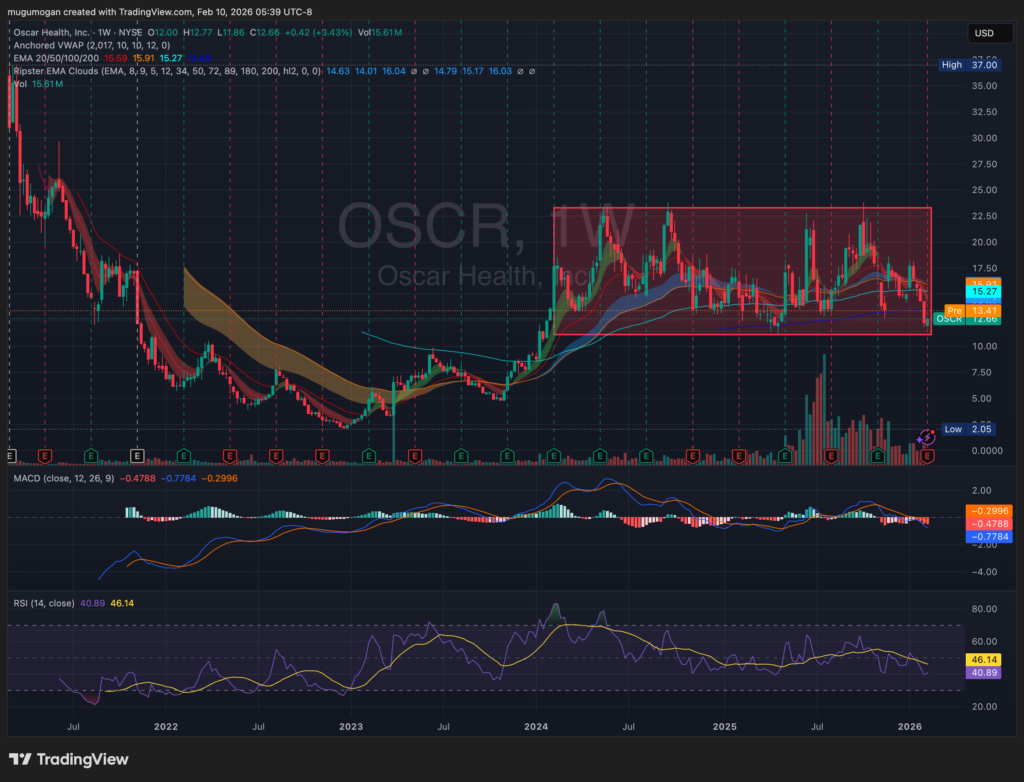
The stock is consolidating in stage 1 on the monthly and weekly charts, with support at $99 – $104 range but the earnings has caused a reversal to stage 2 on the daily chart and it should get to the resistance at $150 range.