





F5 Networks is an application delivery and security company best known for ensuring that mission-critical applications stay fast, available, and secure across hybrid and multi-cloud environments. Founded in 1996 and headquartered in Seattle, F5 sits at the intersection of networking infrastructure and application-layer security, a niche that tends to matter most when systems break or get attacked. The company serves large enterprises, service providers, and governments, with a customer base that skews heavily toward complex, regulated environments. Over the past decade, F5 has shifted from hardware-centric appliances toward software subscriptions and cloud-delivered services. Competitors most often mentioned alongside F5 include Palo Alto Networks, Fortinet, and Akamai.

Most Recent Earnings (Q1 FY2026 – reported last week)
F5 reported Q1 FY2026 earnings on January 27, 2026, delivering a clean beat across the board. Non-GAAP EPS came in at approximately $4.45 versus analyst expectations near $3.6, representing a material upside surprise driven by operating leverage and stronger-than-expected systems demand. Revenue was roughly $822 million, exceeding consensus expectations by about $60–70 million and growing mid-single digits year over year. The earnings quality mattered: this was not a one-line accounting beat, but a combination of systems strength, steady software revenue, and disciplined cost control. Management raised both near-term and full-year guidance, signaling confidence that demand visibility has improved materially.
Founding and Early History
F5 Networks was founded in 1996 by Jeff Husvar and colleagues during the early expansion of enterprise internet traffic. The company initially focused on load balancing, solving the problem of distributing application traffic reliably across servers as web usage exploded. Its early success came from deep technical expertise rather than aggressive sales, which helped F5 establish credibility with network engineers. Over time, BIG-IP became the de facto standard for application delivery controllers in large enterprises. This engineering-first DNA still shapes F5’s product philosophy today.
Product Evolution and Portfolio
F5’s core product line remains BIG-IP, which handles traffic management, load balancing, and application security at scale. Over the last several years, the company has expanded aggressively into software-based and SaaS offerings, including distributed cloud services that protect applications across public cloud, private data centers, and edge environments. Security has moved from a feature to a primary value proposition, particularly around application-layer DDoS protection and web application firewalls. This evolution has allowed F5 to defend relevance even as pure hardware spending cycles fluctuate. Importantly, the product set is sticky; once deployed, ripping out F5 is operationally painful.
Competitive Landscape Context
F5 competes in a crowded but segmented market. Palo Alto Networks and Fortinet dominate next-generation firewalls and broad security platforms, while Akamai focuses on edge delivery and content acceleration. F5’s differentiation is its application-centric control plane rather than perimeter security alone. In practical terms, F5 tends to sit deeper in the application stack than many competitors, which makes it less visible but harder to replace. This “plumbing” position is unglamorous but economically durable.
Market Overview and Growth Outlook
F5 operates primarily in the application delivery controller and application security market, which is increasingly converging with cloud networking and zero-trust architectures. Industry estimates suggest this combined market could exceed $50–60 billion by 2030 as enterprises modernize legacy applications rather than fully rewriting them. Growth expectations are mid-single-digit to high-single-digit CAGR through 2030, slower than headline cybersecurity but steadier and less cyclical. F5 benefits from this dynamic because many enterprises run hybrid environments indefinitely, not temporarily. That reality favors vendors that manage complexity rather than promise full cloud purity.
Customers and Demand Drivers
Demand for F5’s solutions is driven less by greenfield adoption and more by lifecycle upgrades, security events, and architectural transitions. Large enterprises tend to expand spend after incidents or compliance pressure rather than during optimistic planning cycles. This creates lumpy systems revenue but stable long-term cash flows. Subscription and software growth smooths these cycles, though hardware remains strategically important. The Q1 FY2026 results suggest that deferred infrastructure refreshes are beginning to unlock.
Unique Differentiation
F5’s key differentiation is control at the application layer, not just the network perimeter. While many security vendors protect “north-south” traffic, F5 manages how applications actually behave under load, attack, and failure conditions. This gives F5 a structural role in production environments that competitors often complement rather than replace. The result is pricing power without headline growth. In plain terms: F5 sells insurance for things that cannot go down.
Management Team Overview
The company is led by François Locoh-Donou, CEO since 2017, who has overseen the shift from hardware dependence to a more balanced software and services mix. Under his leadership, F5 has emphasized margin discipline and capital returns alongside product expansion. The CFO and core executive team have remained stable, reinforcing investor confidence in execution consistency. There is little founder-driven volatility; this is an operator-run company. That matters for predictability.
Financial Performance (Last Five Years)
Over the past five years, F5 has delivered modest but resilient revenue growth, generally in the low- to mid-single digits annually. Earnings growth has outpaced revenue due to disciplined cost management, mix shift toward software, and share repurchases. Operating margins remain strong relative to infrastructure peers, reflecting pricing discipline and a high-value customer base. The balance sheet is clean, with solid cash generation and no leverage stress. This is not a growth rocket, but it is a compounding machine.
Capital Allocation and Balance Sheet
F5 consistently returns capital through buybacks, which has materially supported EPS growth even during flat revenue periods. Free cash flow conversion remains high, and management has avoided aggressive acquisitions that could dilute returns. The balance sheet strength gives F5 optionality without forcing strategic risk-taking. Investors effectively get paid to wait. In a market that punishes uncertainty, that matters.
Bull Case
The bull case for F5 rests on the idea that hybrid architectures are permanent, not transitional, which structurally supports F5’s relevance. Operating leverage remains underappreciated as systems revenue rebounds alongside steady software growth. Valuation remains modest relative to security peers despite similar cash generation quality.
Bear Case
The bear case is that application delivery becomes increasingly abstracted by hyperscalers, compressing F5’s strategic control point. Revenue growth could remain structurally capped in the low single digits, limiting multiple expansion. A sharp enterprise spending downturn would still hit systems revenue disproportionately.
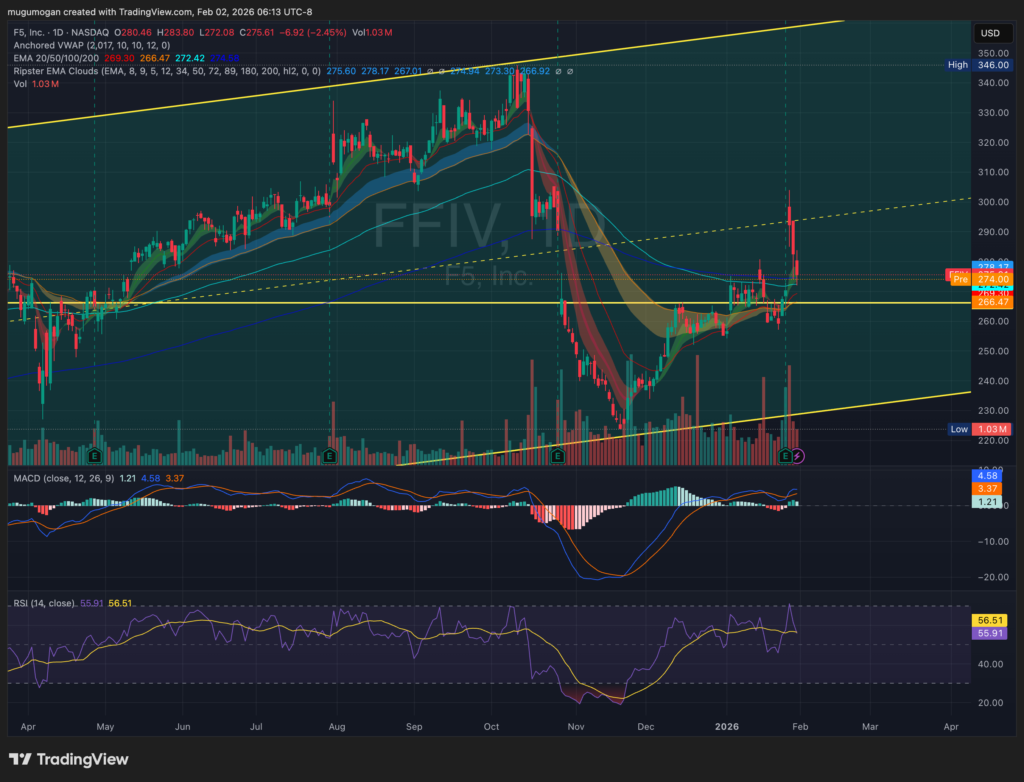
The stock is in a stage 2 bullish markup on the monthly and weekly chats and is on a stage 4 markdown (bearish) on the daily chart, with support in the $240 – $268 range. It should reverse at that point.