





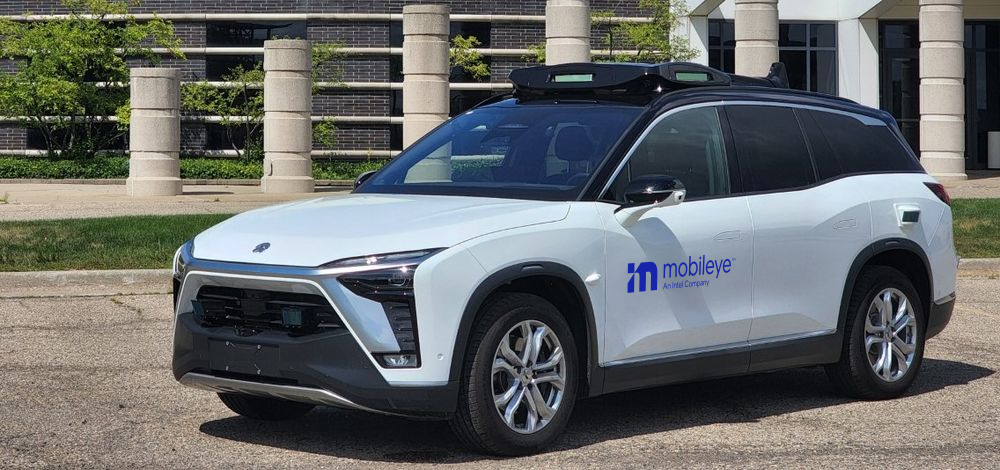
Overview — Mobileye Global (MBLY) develops advanced driver-assistance and autonomous driving technology that combines camera-based perception, mapping, and purpose-built automotive compute (the EyeQ chip family) to help automakers deliver safer driving features at scale. It is best known for “hands-off” highway/road driving in assisted systems (SuperVision) and its longer-horizon autonomy stack (Chauffeur/Drive), plus its data and safety frameworks that support OEM deployment. Mobileye is Israel-headquartered (Jerusalem) and remains majority-owned by Intel following Intel’s 2017 acquisition and Mobileye’s 2022 relisting as a public company. In full-year 2025, Mobileye reported revenue of about $1.894B, with results heavily influenced by the industry’s ongoing normalization of ADAS chip inventory after the 2023–2024 digestion cycle. At today’s scale, MBLY is a specialist in automotive autonomy compute/software, competing more on deployment credibility and OEM integration depth than on raw silicon budget.
Most Recent Earnings (Last Week) — Mobileye reported Q4 2025 results on January 22, 2026, delivering revenue of $446M (down ~9% year-over-year from $490M) and adjusted EPS of $0.06 (down from $0.13), with revenue modestly ahead of consensus while EPS was roughly in-line. Management attributed the year-over-year decline primarily to lower EyeQ system-on-chip volume as customers exited the year with tighter-than-normal inventory levels and a more balanced supply/demand posture. The quarter was “fine” on print, but the stock’s reaction was driven far more by the shape of the 2026 outlook than by Q4 itself. Investors effectively treated the quarter as a recap and the guidance as the real product release.
Guidance — For FY2026, Mobileye guided revenue to $1.90B–$1.98B, implying roughly flat-to-low-single-digit growth versus FY2025, and guided operating profit materially below what the Street had been modeling (company guide versus prior higher expectations). Management framed the outlook as conservative given limited near-term visibility at OEMs and Tier-1s, with macro factors (including tariff-related uncertainty) pressuring automaker planning and therefore ADAS ordering patterns. The practical takeaway is that 2026 is being positioned as a transition year: Mobileye expects to keep funding R&D and platform buildout while waiting for stronger volume and mix tailwinds to reassert themselves.
Founding & Early History — Mobileye was founded in 1999 by Prof. Amnon Shashua (with early co-founders including Ziv Aviram) based on computer-vision research commercialized from academia into a camera-first driver-assistance approach. The company’s core insight was that scalable safety could be delivered with commodity camera sensors plus specialized perception software and a purpose-built processor, rather than relying purely on expensive sensor stacks. That “software-on-efficient-hardware” worldview is still the company’s DNA and informs its current positioning as a compute + software platform for mainstream vehicles, not just premium prototypes.
Ownership & Corporate Milestones — Intel acquired Mobileye in 2017 for $15.3B, a deal that effectively turned Mobileye into Intel’s automotive autonomy spearhead and gave it access to long-cycle manufacturing and platform resources. Mobileye later returned to public markets in 2022 while Intel retained a large majority stake, and Intel has reiterated at various points that it is not planning to divest its majority position. This matters to investors because MBLY trades partly like a high-volatility autonomy pure play, but it operates with some strategic and balance-sheet implications of being Intel-controlled.
Products & Revenue Drivers — Mobileye’s commercial engine is still dominated by EyeQ-based ADAS programs (camera compute + software) shipped through Tier-1s to global automakers, with higher-value “system” offerings expanding the revenue-per-vehicle opportunity. On top of the core ADAS stack, the company markets higher autonomy solutions such as SuperVision (hands-off capability while eyes-on) and Chauffeur (a step toward consumer AV functionality) as well as mapping and safety layers that support OEM adoption and regulatory confidence. In other words, the product ladder is designed to move customers from chip-centric ADAS into higher-ASP system revenue over time as feature content grows.
Go-To-Market & Ecosystem — Mobileye sells into a brutally slow enterprise market—automotive—where design wins can take years, volumes arrive in waves, and supply-chain and platform decisions can whiplash demand quarter-to-quarter. The upside of that pain is stickiness: once an OEM platform decision is made and a system is validated, suppliers can enjoy multi-year production runs and follow-on upgrades. The risk is that the industry can temporarily “pause” ordering due to inventory digestion or vehicle production shifts, which is exactly what has been happening cyclically over the past two years.
Market Context — Mobileye operates in the ADAS-to-autonomy continuum, where regulatory safety requirements, falling compute costs, and consumer expectations are steadily pushing more automation into more vehicles. Independent market research commonly models the global ADAS market roughly doubling by 2030, translating into low-teens CAGR dynamics through the decade. A practical investor lens is that this is not a “will it exist” market; it is a “who captures the value per vehicle” market, and value capture depends on OEM architecture decisions (centralized compute, software-defined vehicles, sensor strategy) as much as it depends on features.
2030 Outlook & What It Implies for MBLY — If the ADAS market grows to roughly the mid-$60B range by 2030 at ~12% CAGR, Mobileye’s upside case depends on expanding content per vehicle (more compute + more paid software features), not merely shipping more units. Separately, the automotive compute stack is being re-architected toward centralized domain/zone controllers, which can either compress MBLY’s chip-centric advantage or amplify it if Mobileye wins those centralized platforms with its integrated “system” approach. The company’s long-run bet is that it can be the safe, scalable middle path between (a) OEMs building everything in-house and (b) hyperscale GPU platforms that are powerful but expensive, power-hungry, and integration-heavy for mass-market cars.
Competitors — Mobileye’s competition comes in three flavors: (1) silicon-first autonomy stacks (notably NVIDIA Drive and Qualcomm Snapdragon Ride) that sell high-performance compute platforms; (2) traditional Tier-1 auto suppliers (Bosch, Continental, Valeo and others) that bundle sensors, ECUs, and integration; and (3) OEMs building their own autonomy stacks (Tesla being the obvious reference point) that can compress supplier share by vertical integration. In public-market terms, the closest “peer set” for valuation comparisons tends to include Aptiv (Tier-1 systems/integration) and the platform silicon players (Qualcomm, NVIDIA), even though none is a perfect apples-to-apples match.
Differentiation — Mobileye’s most defensible edge is that it has spent decades translating perception and driving-policy research into production-grade automotive deployments, with a platform that many OEMs already know how to integrate, validate, and ship at volume. Its camera-first heritage (paired with mapping and safety frameworks) is explicitly designed around cost, scalability, and power efficiency—key constraints for mainstream vehicle adoption. Compared with GPU-heavy approaches, Mobileye’s pitch is not “we have the most compute,” but “we have enough compute, plus the software maturity and safety architecture, to ship broadly and profitably.” That tends to resonate with automakers that want advanced features without turning the vehicle into a rolling data center.
Management — Prof. Amnon Shashua serves as President and CEO and is the company’s technical and strategic anchor, with a long track record in computer vision and autonomy. Moran Shemesh Rojansky is the CFO, leading finance and capital allocation in a business that must balance heavy R&D investment with the cyclicality of automotive demand. Prof. Shai Shalev-Shwartz is CTO, reinforcing that Mobileye remains an engineering-led company where roadmap credibility is inseparable from leadership credibility.
Five-Year Financial Performance — Over the last five years, Mobileye grew from roughly $967M revenue in 2020 to about $1.894B in 2025, with a notable acceleration into 2022–2023, a sharp dip in 2024 tied to customer inventory digestion, and a rebound in 2025 (up ~15%) as ordering improved. Earnings have been noisier than revenue: Mobileye has posted periods of net losses even as it generates substantial operating cash flow, largely reflecting high R&D intensity and, in some years, large non-operating or non-cash items that distort GAAP profitability. In 2025 specifically, the company highlighted strong operating cash generation and ended the year with roughly $1.8B in cash and cash equivalents, which gives it real endurance to fund the autonomy roadmap through a softer 2026 volume environment. The strategic investor question is whether MBLY can convert its platform investments into sustained higher-margin “system” mix as volumes normalize, rather than remaining trapped in a low-visibility chip-volume cycle.
Bull Case — First, Mobileye successfully expands content per vehicle via SuperVision/Chauffeur adoption, lifting revenue per program even if global vehicle volumes stay choppy. Second, the 2026 “conservative” guide proves sandbagged and inventory normalization plus new design-win ramps re-accelerate growth into 2027. Third, MBLY’s safety and production credibility wins centralized compute platforms as OEMs migrate to software-defined vehicle architectures, improving both scale and margin profile.
Bear Case — First, silicon platform competitors and OEM in-sourcing compress Mobileye’s attach rates or pricing, limiting its ability to expand content per vehicle. Second, automotive demand uncertainty (including tariff-driven planning whiplash) prolongs a low-growth, low-visibility 2026–2027, keeping the stock de-rated. Third, the market continues to penalize MBLY for high R&D and inconsistent GAAP profitability, forcing investors to wait longer for clear operating leverage.
Analyst Reactions — Post-earnings, the common analyst refrain was “mixed quarter, soft/cautious 2026,” with multiple notes focusing on the operating profit guide coming in below prior Street expectations even though Q4 revenue beat consensus. Specific published reactions included price-target cuts while maintaining existing ratings (for example, Raymond James lowering its target to $16 while keeping an Outperform stance), and other firms emphasizing that 2026 looks like a transition year rather than a clean re-acceleration. Separately, earlier in January there were also rating/target adjustments (including upgrades to more neutral stances) that framed MBLY as a reset story into 2026 rather than a near-term momentum name, and the stock’s muted reaction reflects that investors now demand execution proof, not vision.
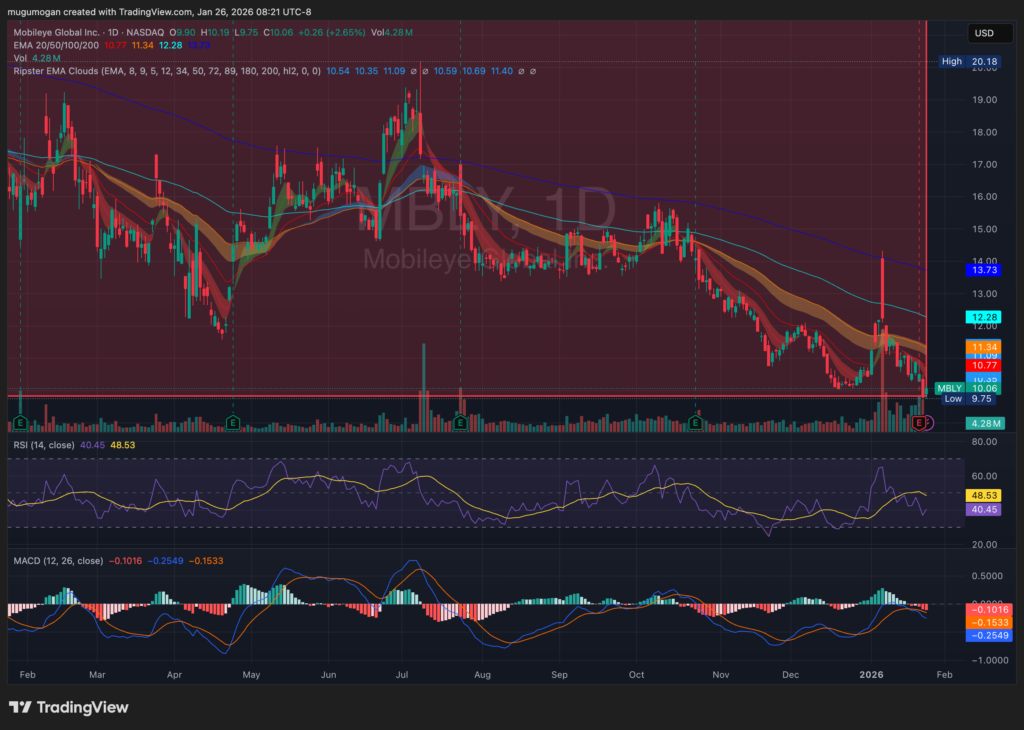
The stock is in a stage 1 consolidation phase in all 3 time frames and is actually heading lower to stage 4 on the daily chart (bearish). Not worth an investment yet.