







Overview — What Wells Fargo is (5 sentences). Wells Fargo & Company is a U.S. diversified bank with leading positions in consumer banking, mortgage, small-business banking, and commercial lending, plus a growing investment-banking and wealth footprint. The firm traces its founding to 1852 and is headquartered in San Francisco. For full-year 2025, Wells Fargo reported total revenue of $83.699B and net income of $21.338B, reflecting a bank that is still materially driven by net interest income but increasingly supported by fee-based lines. Its scale places it alongside “money-center” peers like JPMorgan Chase, Bank of America, and Citigroup, while competing regionally and in specific product silos with players like U.S. Bancorp and PNC. The stock is widely owned for its capital return profile (dividends + buybacks) and for the “operational cleanup → earnings power” narrative under CEO Charlie Scharf.
Most recent earnings — Q4 2025 (reported January 14, 2026). For Q4 2025, Wells Fargo posted EPS of $1.62 on revenue of $21.292B, versus EPS of $1.43 and revenue of $20.378B in Q4 2024, meaning both earnings and revenue rose year over year. On the quarter, headline EPS was up about 13% YoY (1.62 vs 1.43), while revenue was up about 4–5% YoY (21.292 vs 20.378). However, the print was framed as “mixed” by markets because revenue came in a touch light versus consensus expectations cited by financial media, even as profitability held up. The biggest investor sensitivity remained net interest income trajectory and the bank’s confidence in sustaining returns while absorbing cost and credit normalization.
Guidance — What the company said about next quarter and 2026. Management guided investors to focus on full-year 2026 rather than any single quarter, flagging that quarterly NII can move around with rate cuts, deposit pricing, and loan mix. The company reiterated a 2026 net interest income expectation of about $50B and set a 2026 noninterest expense outlook of about $55.7B (both expressed as full-year guideposts). Translation: Wells Fargo is effectively telling you earnings power is a spread-and-scale story—keep NII stable-ish, keep expenses controlled, and capital returns do the rest. Investors will watch whether the expense number drifts up (the classic bank “just one more transformation program” trap) and whether NII lands below guide if rate cuts hit faster or deposit costs stay sticky.
Company history — Founding and evolution. Wells Fargo was founded in 1852 by Henry Wells and William G. Fargo and became synonymous with early American commerce via express and banking services that scaled westward. Over decades it evolved into a modern universal bank with national consumer distribution, a large mortgage franchise, and deep commercial relationships—particularly in the West and across middle-market businesses. The post-2008 era was defined by balance-sheet strengthening and consolidation, while the late-2010s and early-2020s were dominated by regulatory and operational remediation that constrained growth and forced sharper discipline. In the Scharf era, the storyline has been simplification, risk-control upgrades, technology modernization, and rebuilding fee engines (investment banking, markets, wealth) to diversify away from pure spread income.
Company profile — Products and where money is made. Wells Fargo’s product set clusters into consumer banking (checking/savings, cards, auto, mortgage), commercial banking (C&I, CRE, treasury management), and capital-light fee lines (investment banking advisory, brokerage/wealth, payments-related fees). The strategic bet is that a cleaner operating platform plus improved cross-sell (done compliantly) lifts revenue per customer while keeping risk costs stable. A key driver for valuation is the bank’s ability to keep returning capital: in 2025 it repurchased a very large slug of stock (share count down) while also increasing dividends, which mechanically boosts EPS even if revenue growth is modest. The “boring but lethal” path to compounding here is steady ROTCE, disciplined expenses, and a benign-ish credit cycle.
Competitors — Who Wells Fargo runs into in the real world (1/2). In U.S. banking, Wells Fargo competes most directly with Bank of America in mass-market consumer banking and mortgages, JPMorgan in scale, payments, and investment banking, and Citigroup across cards, corporate banking, and markets (especially with multinational clients). The day-to-day battlefield is not just price; it’s distribution, deposit stickiness, underwriting standards, digital UX, and the ability to bundle treasury + lending + payments for businesses. Wells Fargo’s competitive tension is that JPM and BAC have broader “all-weather” fee engines, while Wells Fargo has historically been more spread-sensitive and more exposed to regulatory/operational overhang headlines.
Competitors — The “next ring” (2/2). In addition to the big three, Wells Fargo faces strong regional and super-regional competitors (U.S. Bancorp, PNC, Truist, Capital One in specific lanes) that can be more nimble or over-indexed to certain profitable niches. Fintechs compete in slices—payments, lending origination, cash management, and brokerage—but many still rely on banks for rails and balance sheet. The real competitive question for the next cycle is whether incumbents can keep customer relationships while “unbundling” continues (specialists taking the best margins) and as deposit competition intensifies whenever rates fall.
Differentiation — What Wells Fargo can do that peers can’t (or won’t). Wells Fargo’s edge is its massive U.S. consumer + small-business footprint combined with an enormous deposit base that, when managed well, can be a durable funding advantage. Unlike some peers, it has a very visible “self-help” runway: operational fixes, tech modernization, and efficiency gains can expand returns even without heroic macro tailwinds. The market also tends to price in skepticism because of past issues—meaning execution can re-rate the stock faster than at peers that are already “priced for perfection.” Put bluntly: Wells Fargo’s differentiation is less about a magical product and more about recovering earnings power from a platform that already has scale.
Management — The three people that matter most. Charlie Scharf (CEO) is the core of the turnaround thesis; investors underwrite whether he can keep risk/control remediation tight while improving profitability and fee mix. Mike Santomassimo (CFO) is crucial because bank stories live and die on NII guidance credibility, expense discipline, and capital return messaging. A third key leader to watch is the head of consumer and small business banking (the franchise that drives deposits and relationship primacy), because the consumer base is Wells Fargo’s strategic “engine room” for low-cost funding and cross-product adoption.
Financial performance — The last five years (1/4): revenue and trajectory. Wells Fargo’s recent financial arc is best described as “stability with a slow grind up,” rather than hypergrowth: revenue has hovered around the low-$80B range in recent years, with full-year 2025 revenue at $83.699B versus $82.296B in 2024, implying low-single-digit growth. That profile is typical for mature banks: growth is capped by the balance-sheet cycle, rate environment, and regulatory capital constraints, and is often “manufactured” through mix shifts and fee attach rather than volume alone. The key is whether revenue quality improves (more fees, less rate sensitivity) and whether the bank avoids buying growth via loosening underwriting.
Financial performance — The last five years (2/4): earnings power and operating leverage. Profitability has improved meaningfully as credit normalized and cost actions took hold, culminating in $21.338B net income in 2025. EPS growth can run ahead of net income growth when buybacks are heavy, and Wells Fargo has leaned into that lever. Investors should watch efficiency ratio and expense guidance like a hawk because banks rarely “accidentally” become more efficient—someone usually has to cancel projects and say no (a lot). If expense discipline holds near the 2026 outlook, incremental revenue tends to fall to the bottom line at attractive margins.
Financial performance — The last five years (3/4): balance sheet and capital return. The bank has emphasized fortress-like capital and consistent capital return; in 2025 it returned substantial capital through repurchases and dividends, reinforcing the equity-story flywheel: fewer shares + steady earnings = higher EPS. For bank valuation, capital strength matters because it determines how aggressively management can buy back stock without risking regulatory friction or forced balance-sheet shrinkage. The other balance-sheet watch items are deposit beta (how fast deposit costs rise/fall vs market rates), loan growth quality, and credit loss normalization as consumer and commercial cycles shift.
Financial performance — The last five years (4/4): what’s “actually” moving the stock. In practice, Wells Fargo trades on three variables: net interest income direction, expense credibility, and credit quality (especially if macro weakens). When investors get comfortable that NII won’t structurally fade and that expenses are contained, the stock tends to re-rate toward peers. When confidence wobbles (guidance trimmed, expense creep, or credit deterioration), multiples compress quickly because banks are inherently levered to confidence. This is why a “small” revenue miss can matter: it’s not the quarter—it’s the implied slope of the next eight quarters.
Bull case — Why WFC could work (up to 3 bullets).
- Execution-driven upside: steady progress on efficiency and controls supports expanding ROTCE and a valuation re-rate versus history.
- Capital return flywheel: sustained buybacks + dividend growth can drive per-share earnings growth even in modest top-line environments.
- Macro optionality: if credit stays benign and rate cuts stabilize funding costs faster than asset yields compress, NII can surprise to the upside.
Bear case — Why WFC could disappoint (up to 3 bullets).
- NII pressure: faster rate cuts, higher deposit competition, or weak loan demand could push net interest income below guide.
- Expense creep: transformation programs that don’t end (and severance that “keeps happening”) can cap operating leverage.
- Credit normalization: if consumer delinquencies or commercial losses rise, provisions can eat the EPS story fast.
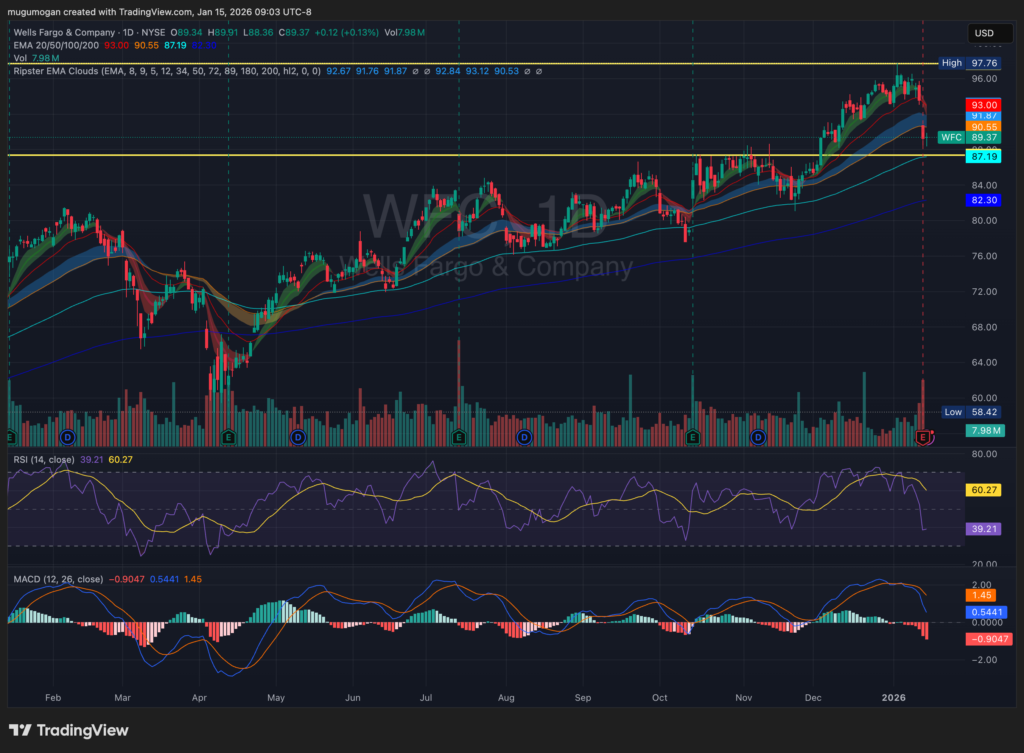
The stock is in phase 2 bullish markup on the monthly and weekly charts, but moving to stage 3 consolidation (neutral) with support in the $85 – $87 range, where it could reverse. We are not buying yet.