







Company Overview
HSBC Holdings plc is one of the world’s largest banking and financial services institutions, founded in 1865 to finance trade between Europe and Asia. The bank operates across more than 60 countries, with a strategic focus on Asia, particularly Hong Kong and mainland China. In 2024, HSBC generated roughly $66–68 billion in revenue, benefiting from higher interest rates and a restructured global footprint. Its core businesses include Wealth and Personal Banking, Commercial Banking, and Global Banking & Markets. Headquartered in London, HSBC competes most directly with JPMorgan Chase, Citigroup, and Standard Chartered on a global basis.

Most Recent Earnings Performance
High rates did the heavy lifting, not loan growth
HSBC last reported earnings in Q3 2024, delivering earnings per share of approximately $0.83, modestly ahead of analyst expectations. Revenue came in near $16.2 billion, reflecting low-single-digit year-over-year growth, primarily driven by net interest income rather than volume expansion. Credit quality remained stable, with impairment charges still well below long-term averages despite macro uncertainty. Management reiterated disciplined cost control and capital returns as priorities, signaling a cautious but confident outlook.
Founding and Historical Context
Born to finance empire, now managing its retreat
HSBC was founded in Hong Kong in 1865 by Scottish banker Thomas Sutherland to support trade between China and Europe. The bank expanded aggressively during the British Empire era, becoming one of the most geographically diversified banks in the world. Over decades, HSBC built dominant franchises in Asia, the UK, and select emerging markets. That historical breadth later became a liability as regulation, compliance costs, and capital requirements increased. Since 2020, HSBC has been actively shrinking non-core geographies to refocus on Asia.
Products and Business Lines
Three pillars, one balance sheet
HSBC operates through three primary segments: Wealth and Personal Banking, Commercial Banking, and Global Banking & Markets. Wealth management is increasingly central, targeting high-net-worth and mass affluent clients in Asia. Commercial Banking serves mid-market and multinational corporates engaged in cross-border trade. Global Banking & Markets provides investment banking, FX, and capital markets services, where HSBC retains strength in foreign exchange and trade finance.
Competitive Landscape
Competing with scale, not speed
HSBC’s closest global competitors include JPMorgan Chase, Citigroup, and Standard Chartered. JPMorgan dominates in technology, profitability, and U.S. consumer banking. Citi overlaps heavily in global corporate banking but lacks HSBC’s Asian retail depth. Standard Chartered mirrors HSBC’s emerging-market focus but operates at a smaller scale with higher volatility.
Market Opportunity
Asia’s wealth growth is the real prize
HSBC is positioned to benefit from long-term growth in Asian wealth, cross-border trade, and capital flows. By 2030, Asia-Pacific is expected to account for over 50% of global wealth growth, with high-net-worth populations expanding at a 6–7% CAGR. Trade finance and FX volumes are expected to grow at 4–5% annually as supply chains diversify. HSBC’s challenge is execution, not opportunity.
Unique Differentiation
Nobody else looks like this bank
HSBC’s primary differentiation is its unmatched global transaction network, particularly in trade finance and foreign exchange. It is one of the few banks that can serve a multinational client seamlessly across Asia, Europe, and the Middle East under one balance sheet. The bank also benefits from entrenched positions in Hong Kong retail banking and Asian wealth management. However, this same complexity slows decision-making and innovation.
Management Team Overview
Cost cutters, not empire builders
HSBC is led by Georges Elhedery, who assumed the CEO role with a mandate to simplify operations and improve returns. The leadership team emphasizes capital efficiency, exits from low-return markets, and shareholder distributions. Management credibility has improved following aggressive asset sales and restructuring. The tone is pragmatic rather than visionary.
Financial Performance (Five-Year View)
Cyclical recovery masks structural limits
Over the last five years, HSBC’s revenue growth has been uneven, reflecting rate cycles and restructuring. Revenue has grown at a low-single-digit CAGR, while earnings growth has been more volatile due to impairment swings and one-time charges. Return on tangible equity improved into the mid-teens in 2023–2024, largely driven by higher interest rates. The balance sheet remains strong, with a CET1 ratio above 14%, supporting dividends and buybacks.
Capital Allocation and Shareholder Returns
Dividends over dreams
HSBC has leaned heavily into capital returns, reinstating robust dividends and executing multi-billion-dollar share buybacks. The payout ratio has normalized toward 50%, appealing to income-focused investors. Management has clearly deprioritized aggressive expansion in favor of predictable returns. This makes HSBC more bond-like than growth-oriented.
Bull Case for the Stock
HSBC benefits from sustained higher interest rates, which support net interest income without requiring aggressive loan growth. Asian wealth management continues to compound at attractive rates, improving fee mix and margins. Ongoing simplification and exits from low-return markets raise long-term return on equity.
Bear Case for the Stock
A sharp decline in global interest rates would materially compress earnings. Geopolitical risk in Hong Kong and China remains an ever-present overhang. HSBC’s operational complexity limits its ability to innovate as quickly as U.S. peers.
Analyst Reactions to Earnings
Cautious optimism, tempered enthusiasm
Following the most recent earnings, analysts largely maintained Hold to Buy ratings, citing strong capital returns but limited growth visibility. Several price targets were modestly raised to reflect higher near-term earnings power. No major downgrades occurred, but commentary emphasized sensitivity to rate cuts. Analysts broadly agree HSBC is a yield play, not a growth story.
Valuation vs Key Competitors
Cheap for a reason
HSBC trades at a lower price-to-book multiple than JPMorgan and slightly above Standard Chartered, reflecting its moderate profitability and geopolitical exposure. Revenue growth lags U.S. peers but exceeds some European banks. Market capitalization remains above $150 billion, reinforcing its status as a global systemically important bank. The valuation implies steady cash generation rather than multiple expansion.
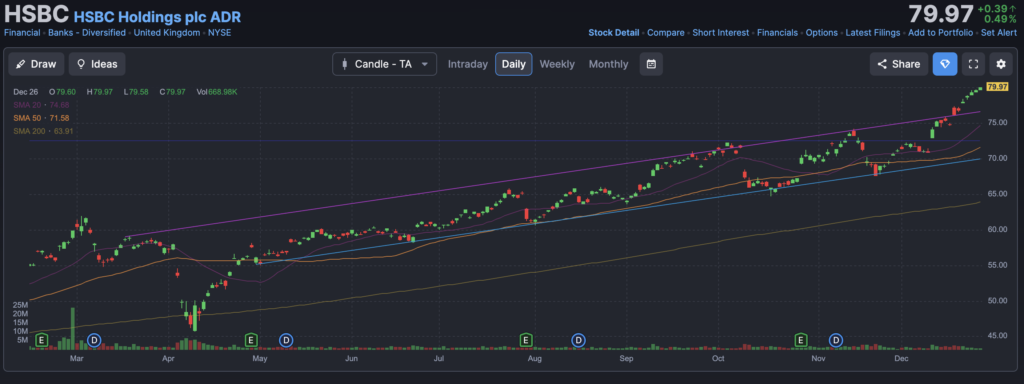
The stock is in a strong bullish stage 2 markup on all 3 time frames with the monthly chart showing a cup pattern which indicates a move to the $100 is most likely by earnings.