







🧠 CarMax (KMX) — Company Snapshot
CarMax, Inc. is the largest used vehicle retailer in the United States, known for its no-haggle pricing, large inventory, and customer-centric sales experience. Headquartered in Richmond, Virginia, it operates hundreds of retail locations across dozens of states and a finance arm (CarMax Auto Finance) to support auto loans. The business combines physical superstores with an omni-channel digital platform to let customers browse, buy, and finance both in-store and online. CarMax was founded in 1993 as a subsidiary of Circuit City and spun off in 2002, focusing entirely on used cars and related services. Today it stands as a major legacy brand in auto retail with a market cap around $5.7–$6.0B and a stock ticker KMX on the NYSE.
📊 Latest Results – Fiscal Q3 2026 (Reported Dec 18, 2025)
For the quarter ended Nov 30, 2025, CarMax posted:
- Revenue: ~$5.79 billion, down ~6.9% year-over-year, but above analyst forecasts.
- EPS: ~$0.43, beating consensus expectations (consensus ~0.32-0.37).
- Profit and margins shrank due to weaker used-car demand and pricing pressure.
Management did not provide formal guidance for Q4, instead signalling plans to cut margins and increase marketing to drive sales. The company is led by interim CEO David McCreight following the departure of longtime CEO Bill Nash amid operational headwinds.
🧠 Founding, Evolution & Structure
CarMax began in 1993 as an innovative division of Circuit City designed to modernize the used car buying experience. It emphasized large selection, transparent pricing, and customer guarantees. Timeline
- 1993: First store opens in Richmond, VA.
- 1997: IPO as a tracking stock under Circuit City.
- 2002: Spin-off as independent public company (NYSE: KMX).
- 2020s: Expanded omni-channel strategy with integrated online and retail purchase options.
CarMax’s core products and services include used vehicle retail sales, wholesale auctions, vehicle financing through CarMax Auto Finance, extended service plans, and integrated appraisal services.
📍 Market & Industry Context
CarMax competes in the U.S. used car market, which is large and resilient due to affordability pressures and inventory dynamics. Estimates vary, but global used car market projections suggest growth from roughly $2.31 trillion in 2025 to nearly $3 trillion by 2030 (~5.2 % CAGR).
North America alone is a massive segment — nearly half of total volume — with projections showing sustained mid-to-high single-digit CAGR through the decade.
This growth is supported by demographics favoring used vehicles over new ones as affordability remains challenged by high prices and credit conditions.
🚗 Competitive Landscape
CarMax’s primary competitors include:
- Carvana – online-first used car retailer with a digital-native experience and rapidly growing unit sales.
- AutoNation – diversified automotive retail group (new & used) with strong physical footprint and market reach.
- Enterprise Car Sales – rental fleet resale specialist with a no-haggle, warranty-based purchase model.
🔍 Competitive Differentiators
CarMax’s edge rests on scale, trust, and omni-channel capability. Its no-haggle pricing and thorough inspection processes have built consumer confidence, while the combination of physical retail and online shopping reduces friction and expands reach. The integrated finance arm captures value beyond just vehicle sales.
Competitors like Carvana focus heavily on online convenience, but CarMax’s hybrid model and nationwide franchise of physical stores help bridge digital and in-person buyers.
📈 Financial Trajectory (Summary)
Over the past few years, CarMax has faced revenue headwinds and earnings volatility:
- Annual revenue has seen modest growth or decline, influenced by market conditions, pricing cycles, and inventory sourcing.
- Net income and EPS have fluctuated with used car pricing and cost pressures.
- The stock has repriced lower in 2025 as sales volumes softened and competitive pressures increased.
📈 Bull Case
- Large, established retail footprint gives strategic advantage over pure online players.
- Omni-channel model poised to capture shifting consumer preferences.
- Potential recovery in used car affordability and demand could boost volume and margins.
📉 Bear Case
- Market share erosion to agile online competitors like Carvana.
- Used car market pressure (prices, inventory) compressing margins and volumes.
- Leadership changes and strategic execution risks during transition.
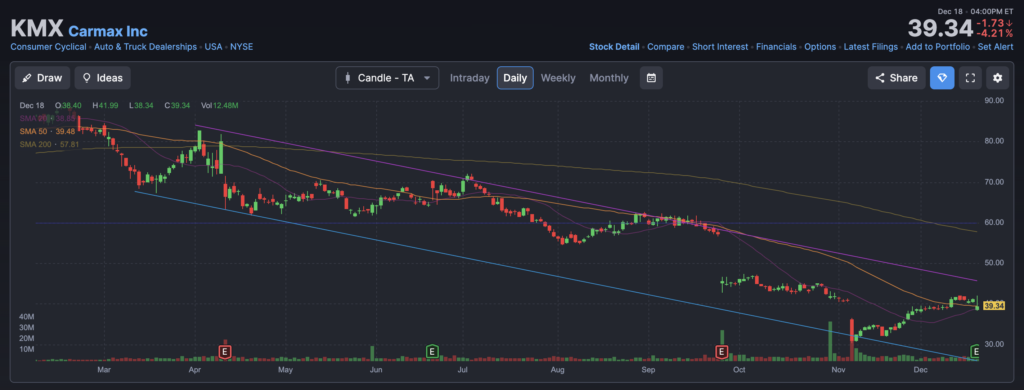
The stock is in a stage 4 markdown (bearish) on the monthly and weekly timeframe. The daily chart is showing signs of moving from a stage 1 to stage 2, with narrow range of $35 – $47. We are not buying the stock yet.