



Snapshot
GitLab is a publicly traded software company offering an end-to-end DevSecOps platform that supports version control, continuous integration/continuous deployment (CI/CD), security, compliance, and software project planning.
It serves a broad range of customers — from small projects to large enterprises — using a freemium model: open-source core features, paid tiers for advanced enterprise functionality.
GitLab aims to make software delivery faster, more secure, and more efficient — consolidating many DevOps, security, and operations tools into one integrated platform.
As of 2025, the company is headquartered in San Francisco, but it is known for operating as a mostly remote organization, with employees distributed globally.
On the stock market (ticker GTLB), GitLab is often viewed as a growth-oriented tech company, betting on the increasing demand for DevOps and security tooling as enterprises accelerate software delivery cycles and adopt cloud infrastructure.
Recent Earnings (Latest Quarter — Q3 Fiscal Year 2026, reported Dec 2, 2025)
- GitLab reported revenue of US$244.4 million, up ~25 % year-over-year, beating analyst consensus (~US$239.3 million).
- Non-GAAP (adjusted) EPS came in at US$0.25/share, above analysts’ expectation of ~US$0.20.
- On a GAAP basis, the company still reported a net loss (US$ –8.3 million, or –US$0.05/share), compared with a profit of US$29.1 million (US$0.18/share) a year ago.
- Management raised fiscal-year 2026 guidance: now anticipating adjusted EPS of US$0.88–0.89/share and revenue around US$946–947 million.
- The stock reaction was negative, with shares falling ~9 % pre-market, as investors focused on GAAP loss, softness in public-sector demand, and potential headwinds from competition, including AI-driven rivals.
Origins, Founders, Business & Positioning
GitLab started in 2011 as an open-source project to offer teams a Git-based collaborative environment for code, with issue tracking, merge requests, code review, wikis and more.
The project was led by the Ukrainian developer (first name) and Dutch developer Sytse Sijbrandij (among others).
Over time GitLab expanded into a full DevSecOps platform — integrating version control, CI/CD, security scanning, compliance tooling, project management, monitoring and more — targeting organizations needing to build, deploy, and secure software at scale.
Funding history: early seed funding was followed by a Series A (~US$4 M), Series B (~US$20 M), Series C (~US$20 M), a Series D (~US$100 M), and Series E (~US$268 M) at a valuation of ~US$2.7 billion.
GitLab went public in October 2021 on Nasdaq under ticker GTLB, with an IPO valuation around US$10 billion.
Today, it competes in the DevOps/DevSecOps space globally, offering both cloud-based (SaaS) and self-hosted versions (for customers needing on-premises or private-cloud compliance).
Key competitors include companies/platforms such as GitHub (owned by Microsoft), and other DevOps / code-hosting / CI/CD / developer-platform providers.
Headquarters: officially based in San Francisco, USA — but GitLab is known as a fully remote (distributed) company.
Market & Industry — Size, Growth Forecasts, Opportunities
GitLab addresses the global DevSecOps / software-development tools market. According to company-related estimates, the total addressable market (TAM) could be around US$40 billion.
Some broader market forecasts suggest the DevSecOps platform market could grow to nearly US$70 billion by 2036, or ~$24–25 billion by 2029 under conservative scenarios — implying a healthy long-term growth tailwind.
Given the increasing complexity of software development, rising demand for security/compliance (especially among large enterprises), and accelerated digital transformation globally — demand for integrated DevSecOps platforms is likely to grow strongly. GitLab is positioned to benefit from: cloud migration; regulatory/compliance pressures; shift to remote & distributed development; and security & compliance needs.
However — as that market grows — competition intensifies not just from traditional rivals but also from newer, AI-native developer tools and platforms.
Competitors — Who GitLab Is Up Against
- GitHub — widely adopted, owned by Microsoft, with deep integration into VS Code, Azure, and widespread community and enterprise use.
- Other DevOps / CI-CD / code-hosting / security-tool providers and smaller specialist firms (as per data ~200+ competitors active) in tooling, security, code hosting and collaboration.
- Emerging AI-powered development and security-oriented platforms that could threaten GitLab’s seat-based/subscription model, especially if they undercut on price or offer novel, AI-native workflows.
What Differentiates GitLab
- GitLab offers a full end-to-end integrated platform combining source control, CI/CD, security/compliance, project planning, and deployment — reducing the need to stitch together multiple disparate tools. This simplifies workflows and increases developer productivity.
- Flexibility: GitLab supports self-hosted installations and cloud-based SaaS, which appeals to enterprises needing data residency, isolation, compliance, or operating in regulated industries.
- Broad adoption and enterprise penetration — including large enterprises and many Fortune-100 companies — give it a strong base of recurring revenue and customer relationships.
- As a fully remote organization, GitLab claims operational flexibility and global talent pool, which may help with cost structure and global reach.
Key Management (selected)
- Sytse Sijbrandij — Co-founder and long-time leader; instrumental in founding the open-source project that became GitLab.
- Bill Staples — CEO (as of 2025), overseeing GitLab’s strategic direction, platform evolution, and growth initiatives.
- Brian G. Robins — CFO (until his departure in 2025), had overseen GitLab’s financial reporting and growth strategy.
Financial Performance (Last ~5 Years)
Revenue growth has been impressive: annual revenue rose from about US$424 M (2023) to ~US$580 M (2024), then ~US$759 M (2025) — roughly a 30–37% year-over-year increase.
That implies a compound annual growth rate (CAGR) in revenue over those years on the order of ~30%.
On profitability: results have been mixed. While revenue has grown strongly, GitLab has often reported GAAP net losses, though non-GAAP (adjusted) profitability has occasionally been positive. For example, in Q2 FY2026 non-GAAP net income was ~US$40.9 million, compared to US$24.5 million a year earlier.
However, trailing EPS has been negative (TTM EPS ~ –US$0.28 per share) as of recent data.
Non-GAAP operational metrics (like free cash flow, operating cash flow) have improved — indicating positive cash generation even if GAAP net remains negative, which might suggest path toward sustained profitability if growth and cost management align.
Balance-sheet wise: while I don’t have a full breakdown here, the cash flow and non-GAAP income suggest GitLab is generating cash and likely has operating resilience — though debt levels, cash reserves, and long-term liabilities are not detailed in the public summary I reviewed.
Bull Case (Why GitLab could outperform)
- Strong market demand: As firms accelerate digital transformation, move to cloud, and invest more in secure, compliant software pipelines — GitLab’s integrated DevSecOps platform fits well.
- Enterprise adoption & recurring revenue: With many large enterprises and Fortune-100 firms already using GitLab, recurring revenue and expansion (upselling existing customers) can drive sustainable long-term growth.
- Platform consolidation & efficiency: Many organizations prefer all-in-one platforms over disparate toolchains; GitLab’s breadth (security + CI/CD + dev + ops + compliance) can be a competitive moat if they continue innovating, particularly around AI-powered DevSecOps features.
Bear Case (Risks / What Could Go Wrong)
- Intense competition: Rivals — especially large incumbents like GitHub/Microsoft or emerging AI-first dev tool startups — could undercut GitLab’s pricing or offer comparable services with stronger ecosystems.
- Profitability uncertainty: Despite revenue growth, GAAP losses persist; if growth slows or competition forces pricing pressure, maintaining profitability (or achieving net-income growth) could be challenging.
- Reliance on enterprise & high-tier customers: If macroeconomic slowdown or tech spending cuts hit large customers, or demand softens (especially in the public sector, as recently highlighted), GitLab’s growth and renewal rates may suffer.
Analyst Reactions & Recent Sentiment
- After the latest earnings beat (Q3 FY2026), some analysts downgraded or cut price targets: e.g. Mizuho cut its target to US$47 (from US$52), citing modest growth and competitive threats.
- KeyBanc Capital Markets lowered its target from US$53 to US$49, even while rating the stock Overweight — noting conservative guidance due to SMB and public sector softness, and evolving go-to-market.
- The mixed reaction reflects concerns that even strong revenue and adjusted-EPS beats aren’t enough to offset uncertainties around GAAP profitability, macro headwinds, and competitive threats.
Valuation Perspective (vs. Intrinsic Value)
One third-party analysis suggests that under a base-case scenario, GitLab’s “intrinsic value” is around US$32.09/share, which — compared to current trading levels (~US$37–38) — implies the stock is ~14 % overvalued.
That said, intrinsic value is sensitive to assumptions; upside remains if growth continues, margins improve, and GitLab captures more of its total addressable market (TAM).
My Take / What to Watch
GitLab remains a compelling play on the growth of DevSecOps, cloud adoption, and enterprise software delivery modernization. Its integrated platform and enterprise foothold offer advantages — but profitability remains a concern, and competition is heating up (especially with AI-powered dev tools on the rise).
In the near term, watch closely for: how well GitLab turns non-GAAP profitability into consistent GAAP net income; how customers respond to pricing and retention; whether competition can erode its seat-based revenue model; and how macroeconomic headwinds impact enterprise and public-sector tech spend.
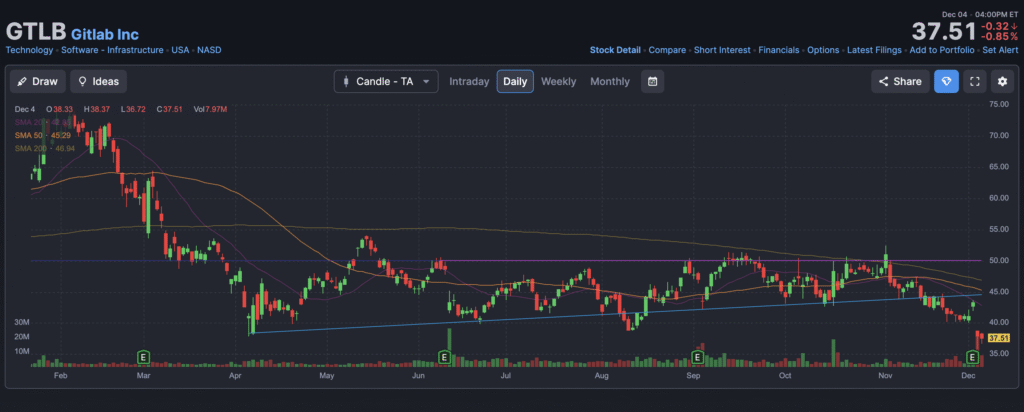
The stock is still consolidating stage 1 on all 3 time frames and still not found its reversal. We will wait for a confirmed reversal at this point.