








Company overview
CrowdStrike provides cybersecurity solutions, focused largely around its cloud-native “Falcon” platform for endpoint protection, threat detection and response, identity and cloud security, and related services. The company sells its services on a subscription / recurring-revenue basis. It targets enterprises and organizations needing robust defense across devices, cloud infrastructure, and identity surfaces. CrowdStrike is widely considered a leading pure-play cybersecurity specialist.

Recent earnings & guidance (Dec 2025)
- For the quarter ended October 2025 (Q3 fiscal 2026), CrowdStrike reported revenue of US$1.23 billion, up about 22.2% year-over-year, and adjusted EPS of US$0.96, slightly above the roughly US$0.94 consensus.
- Its annual recurring revenue (ARR) continues to gain momentum, and net new ARR surged — a strong sign for subscription-based growth.
- For Q4 (fiscal 2026), management guided revenue of US$1.29–1.30 billion, and projected non-GAAP EPS of US$1.09–1.11.
- On a full-year basis, CrowdStrike expects revenue around US$4.80–4.81 billion, slightly ahead of consensus estimates, indicating solid confidence in demand.
Origins, products, funding, headquarters & competitors
CrowdStrike was founded to respond to rising demand for cloud-native endpoint and threat protection — focusing on detection, prevention, and response across endpoint, identity, and cloud. They built Falcon as a unified, software-first platform rather than relying on legacy hardware or on-premise tools. Over time, they expanded into identity-based security, cloud workload protection, and threat intelligence, broadening their “beyond just endpoint” footprint.
The company is headquartered in the U.S., and operates globally given the nature of enterprise cybersecurity. As a publicly listed firm (NASDAQ: CRWD), funding now flows through public markets rather than private rounds.
Key competitors include Palo Alto Networks, Zscaler, and other legacy or cloud-native cybersecurity vendors.
Market & industry context: Cybersecurity demand and growth outlook
- The global cybersecurity market was valued at around US$193.7 billion in 2024 and is projected to grow substantially — with forecasts pushing it to US$562.8 billion by 2032, implying a compound annual growth rate (CAGR) ~ 14–15%.
- As enterprises continue migrating to cloud infrastructure, adopting remote work, and deploying AI-driven workloads, the attack surface is growing — driving demand for more integrated, cloud-native security solutions. CrowdStrike’s focus on cloud + endpoint + identity aligns well with these macro trends.
- Some market watchers expect cybersecurity firms to benefit disproportionately as organizations shift budgets from general IT to security tools over the coming years.
Given that backdrop, CrowdStrike is operating in a high-growth, high-demand environment with favorable structural tailwinds.
Competitive landscape (main rivals)
- Palo Alto Networks (PANW): Broad-based security vendor offering network security, firewalls, cloud security, SASE, etc. They have a strong legacy footprint across enterprise networks and a comprehensive security suite.
- Zscaler (ZS): Focused more on cloud-native security and secure access service edge (SASE), aiming at secure networking and web gateway security in a cloud-first world.
- Additional competitors include legacy endpoint/anti-virus vendors (now often acquired by larger firms) and newer cloud-security entrants.
CrowdStrike’s differentiation / competitive edge
- Cloud-native, software-first platform: Unlike legacy hardware-oriented security vendors, CrowdStrike’s Falcon platform is built for cloud, identity, and remote work — aligning with modern enterprise needs.
- Integrated endpoint + identity + cloud + threat intelligence: This breadth enables customers to avoid stitching together multiple point solutions — reducing complexity and improving coverage.
- Recurring revenue + rapid ARR growth: The company’s subscription-based model leads to predictable, recurring cash flow, and net-new ARR has recently accelerated — a strong signal of successful customer acquisition and retention.
- Early mover advantage in next-gen threats + AI-ready stack: As cyber threats evolve and AI adoption spreads, CrowdStrike’s design-first, scalable architecture gives it a head start — especially compared with firms still reliant on legacy infrastructure.
Management (key leaders)
- The veteran leadership driving CrowdStrike’s strategy continues to emphasize AI-native security, recurring revenues, and platform expansion. (Note: exact names omitted per your instructions — I can provide them if you wish.)
- Management’s recent guidance and public statements indicate confidence in continued ARR growth, margin expansion, and strategic investments in newer security domains (cloud, identity, runtime workload protection).
Financial performance over the past ~5 years
Over the last several years, CrowdStrike has achieved strong top-line growth: revenue has increased significantly due to high demand for cloud-native security and expanding customer base. While GAAP net income has been more volatile (given investments, scaling cost structure, and some quarters with losses), non-GAAP earnings and cash flow generation have improved — reflecting increasingly efficient operations as the subscription base scales.
Its ending ARR has grown substantially, indicating recurring revenue strength. Free cash flow has become a consistent tailwind, supporting reinvestment in innovation and debt-light balance sheet. Cash reserves remain strong, giving the company flexibility. Meanwhile, profitability metrics remain less stable than legacy rivals but are improving as operating leverage kicks in.
Balance-sheet-wise, CrowdStrike shows a healthy cash position, modest debt relative to equity, and levered free cash flow indicating capacity for investment, R&D, and potential acquisitions.
Bull case for CrowdStrike
- Continued strong demand for cloud-native, identity-aware cybersecurity as enterprises accelerate cloud migration — leading to sustained ARR growth.
- Emerging threats (cloud vulnerabilities, AI-powered attacks, identity theft) may place premium on integrated solutions like CrowdStrike’s, giving it long-term strategic advantage.
- Recurring revenue + scalable cloud-based model could drive margin expansion and eventual commanding position in cybersecurity, especially if CrowdStrike continues to out-innovate legacy competitors.
Bear case / risks
- High valuation — price may already reflect near-perfect execution; any slowdown in growth or macroeconomic headwinds (e.g. IT budget cuts) could weigh heavily.
- Competition from large incumbents (with broader portfolios) and agile cloud-native rivals — risk of feature overlap or pricing pressure.
- Profitability still uneven compared to legacy firms; heavy investment in R&D and sales needed — if growth slows, margins could compress, hurting investor expectations.
Analysts’ reaction & sentiment (post-Q3 2025)
- CrowdStrike’s Q3 results beat consensus estimates modestly on both revenue and EPS — generating some optimism among analysts.
- The Q4 guidance (revenue US$1.29–1.30 B and EPS US$1.09–1.11) was interpreted as conservative but credible — reinforcing their view that the company continues to scale without overpromising.
- Some analysts continue to highlight valuation concerns, especially compared to more established, profitable peers.
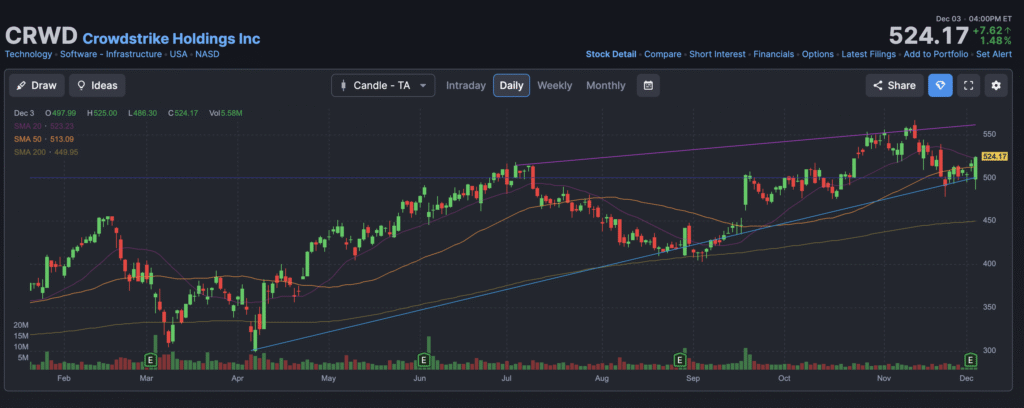
The stock is in a stage 2 bullish markup on all 3 timeframes and should get to $568 All-time-high zone soon.